BY: Mareb Al-ward
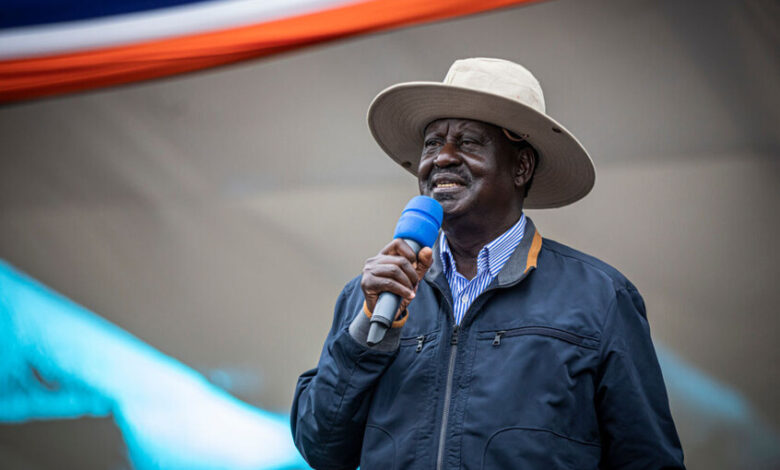
Raila Odinga, who passed away at the age of eighty, represents one of the foremost pillars of contemporary Kenyan politics, a figure whose name has been associated with democratic struggle and social justice for more than five decades. He was not merely an opposition leader or a presidential candidate who repeatedly lost elections; he embodied human and political values, earning him the affectionate title “Baba” — meaning “Father” in Swahili — reflecting his symbolic role as a protector of the poor and marginalized. His life was more than a struggle for power; it was a long journey of defending democracy and equality, striving to turn political defeat into an opportunity for reform.
Odinga was born into a prominent political family belonging to the Luo tribe, Kenya’s fourth largest and most influential ethnic group. His father, Jaramogi Oginga Odinga, served as the first Vice President after independence, a central political figure who left a clear mark on the country’s history. Despite this legacy, Raila chose to follow a path of continuous opposition, embodying the voice of justice and equality while adhering firmly to the principles of freedom and democracy.
Odinga was influenced by his father from an early age, growing up in an environment that valued African socialist thought and social justice, which significantly shaped his political vision. His opportunity to study in East Germany during the socialist era allowed him to gain deeper insight into progressive social thought, further reinforcing his natural inclination toward justice and equality. This experience solidified his belief that the state should play a central role in providing essential services to citizens, including education, healthcare, and infrastructure, ensuring a dignified life for the poor and marginalized alike.
Political struggle was a constant in Odinga’s life from childhood. His father resigned from the government in 1966 following a sharp disagreement with President Jomo Kenyatta, father of the fourth president Uhuru Kenyatta. This conflict stemmed from differing international orientations: his father favored stronger ties with the Soviet Union and China, while Kenyatta opted for alliances with the United States and Western countries. The conflict ended with Jaramogi being imprisoned for 18 months until 1971, instilling in Raila a spirit of political struggle from a young age.
This background was not far removed from his personal experience, as he too endured political imprisonment as part of his struggle. He was jailed twice between 1982 and 1991 during President Daniel arap Moi’s rule due to his opposition to the one-party system. The first imprisonment followed his involvement in a failed coup attempt in 1982, which helped cement his national reputation and earned him recognition as a courageous opponent committed to democracy and social justice.
From the beginning of his political career, Odinga was closely associated with calls for constitutional reform and power-sharing, believing that Kenya could not prosper except under a fair system that ensured equitable distribution of opportunities and influence. His goal was not solely to attain power; he saw democracy as a means to protect the dignity of citizens, especially the poor and marginalized in remote regions.
In this context, Odinga founded the Orange Democratic Movement (ODM) in 2005, representing a center-left current aimed at combining democratic pluralism with economic and social equality. While not explicitly Marxist, he focused on social justice and reducing class disparities, distancing himself from the economic liberalism favored by his opponents.
Odinga ran for the presidency five times, with each race being a comprehensive experience in patience, perseverance, and political reform. His electoral journey began in 1997, using the symbol “Tinga” or water pot, which helped him build a wide popular base despite not winning. In the 2007 elections, one of the most controversial races, he lost by a narrow margin, leading to widespread public protests, yet he filed legal challenges that helped improve the transparency of electoral institutions. He ran again in 2013, in a fiercely contested election, focusing on strengthening democracy and reforming the electoral process rather than personal gains. In 2017, he ran once more and narrowly lost, continuing to support judicial and electoral reforms. In 2022, he again lost to President William Ruto by a slim margin but maintained his position as opposition leader, before a subsequent political understanding led to his participation in the government in 2024, demonstrating his ability to balance opposition with practical governance, though this partnership drew criticism against him.
These experiences were more than mere electoral contests; they were opportunities to reform Kenya’s democratic process and transform every defeat into a practical lesson. His role in post-election legal challenges demonstrated that democracy requires continuous protection and that electoral institutions must evolve to enhance transparency. According to an analysis published by BBC titled “How Odinga’s Court Challenges Helped Improve Elections in Kenya,” these challenges compelled institutions to improve their systems and transparency, while also reinforcing the judiciary’s role as a genuine oversight body. The legal challenges were not merely political confrontations but a practical model for turning loss into an opportunity for reform.
From the perspective of his supporters, Odinga was characterized by a conciliatory approach after each heated election, driven by his belief that societal stability and national unity were more important than any personal gain. He always sought to calm tensions and prevent escalation following the announcement of results, which often made him a target of criticism from opponents who viewed his conciliatory stance as a mere political tactic to gain advantages after defeat. Nevertheless, Odinga remained steadfast in his belief that national interest outweighed any personal or partisan gains, affirming his commitment to social cohesion and state stability.
His personality was marked by a remarkable ability to mobilize the masses and forge political alliances, making him a voice for the poor and a primary advocate for a fairer distribution of wealth. He was close to the people, spoke their language, and believed that politics should be built on justice rather than tribal loyalties or familial influence. He was a man of dialogue before he was a man of conflict, maintaining friendships across political divides, leaving an imprint on the hearts of his opponents before his supporters, and demonstrating that tolerance and political courage can coexist.
Odinga passed away with his legacy firmly linked to democratic struggle and social justice in Kenya, leaving a clear lesson that defeat is not measured by votes lost but by the reforms and awareness it generates in the conscience of the nation. He exemplified that politics is not merely a contest for power but an ethical responsibility toward the people, and that democracy is realized through continuous reform and a commitment to social justice.
In addition to his political activity, Odinga was a successful businessman, owning companies such as East Africa Spectre, which produces gas cylinders, and Kisumu Molasses Plant for ethanol production. Yet wealth was never the focus of his endeavors; he remained dedicated to social and political causes affecting the broader population.
Raila Odinga was a leader who combined political experience with human acumen, firmly believing that social justice and democracy are the path to building a strong and stable nation. His passing represents a significant loss for Kenya, but he left a living legacy in political and social institutions, inspiring future generations to continue the struggle for a just and equitable state.