Yemen Monitor / Special Writing:
The Yemeni interim capital Aden witnessed significant security tensions on Thursday evening, just hours after the first meeting of the new government headed by Shaya Al-Zindani.
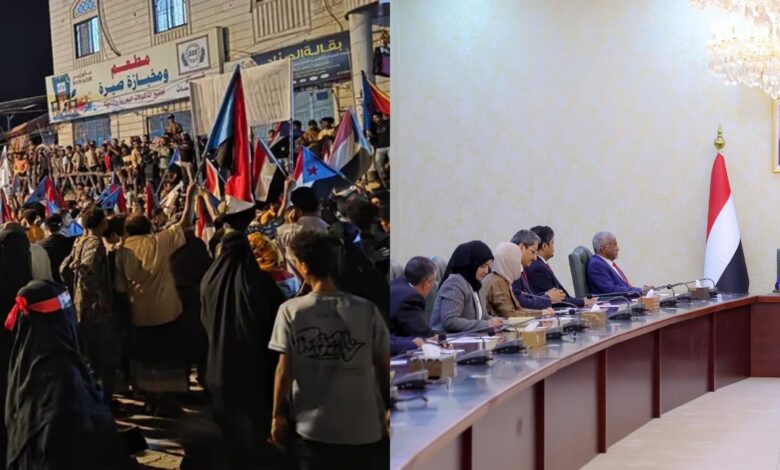
Dozens of supporters of the dissolved Southern Transitional Council (STC) demonstrated outside the gates of Al-Maashiq Palace. When some attempted to storm the palace, gunfire was directed toward them, resulting in one death and about 20 injuries.
The incident triggered varied reactions from the internationally recognized government, the security committee, the STC, the National Bloc of Yemeni Parties, and political analysts, amid warnings of attempts to exploit the chaos to disrupt stability and public services in the city.
“Regional Forces” and Chaos in Aden
The Presidential Leadership Council accused what it described as “regional forces” of seeking to reproduce chaos in areas under the internationally recognized government’s control, expressing regret over casualties resulting from incitement, armed mobilization, and attempts to attack state institutions.
An official source in the council said security forces exercised maximum restraint, dispersing gatherings, preventing road blockages and riots, and protecting sovereign facilities.
The source added that those funding, arming, and inciting the unrest bear political, moral, and legal responsibility for the bloodshed, warning that any attack on state institutions or disruption of their work constitutes a violation of constitutional legitimacy and will be met firmly.
The source also considered the new government’s convening a decisive message that the state is moving forward to restore regular functioning of its institutions and entrench stability, noting that escalation by some groups coincided with tangible improvements in services and preparations for the Southern Conference—raising questions about the role of certain regional actors in attempts to destabilize security.
Aden Security Committee Vows to Crush Disorder
In a strongly worded statement issued early Friday, Aden’s security committee warned against disturbing public order, affirming it would deal “with an iron fist” against anyone proven to be involved in incitement or attacks on security forces and sovereign facilities.
The statement noted that inciting calls had been monitored in recent days aimed at obstructing the government’s work, confirming that armed elements attempted to storm the gate of Al-Maashiq Palace on Thursday evening, describing the incident as a “planned and organized attack.”
It also pointed to external agendas behind the events and urged citizens and families not to be drawn into “suspicious calls” intended to spread chaos and disrupt reconstruction and stability efforts.
Authorities said security forces remained restrained but were compelled to take necessary legal measures after these elements insisted on crossing red lines, while maintaining security and stability.
The committee delivered a firm message to those responsible for the unrest, announcing the launch of legal action against instigators and confirming that names of those responsible had been identified.
Dissolved STC Demands Investigation
For its part, the dissolved STC condemned what it called excessive use of force against unarmed protesters, which led to one death and 21 injuries, describing it as a blatant violation of international conventions and human rights.
The council called for an urgent, independent, and transparent investigation committee to identify those responsible for the shooting and hold them accountable.
Its executive body also rejected any government meetings imposed on Aden outside the will of the southern population, demanding the immediate release of southern leaders detained in Riyadh—including the defense minister—ensuring their full freedom, and transferring any political consultations to the southern capital.
It also urged southern members of the Presidential Leadership Council to adhere to the political achievements realized by the STC.
Parties Warn Against Exploiting “Chaos”
Meanwhile, the National Bloc of Yemeni parties and political components warned of attempts by external actors to exploit recent unrest in Aden to undermine security and government stability, stressing that protecting state institutions and preserving security is a shared national responsibility.
In a statement, the bloc referred to the riots on Thursday evening, expressing regret over injuries and the panic caused among citizens—especially children—in nearby civilian facilities.
The statement emphasized that the right to peaceful expression is constitutionally guaranteed but warned that any escalation outside the law does not serve the city or its residents’ interests, and instead opens the door for opponents of stability to exploit it to obstruct government efforts and political solutions during this sensitive phase.
The bloc also praised recent tangible improvements in services in Aden and stressed the need to preserve these gains and build upon them as a key step toward restoring stability and improving citizens’ lives, noting continued support from Saudi Arabia in normalizing conditions, enhancing services, and alleviating residents’ suffering.
The Street as a Tool of Political Pressure
Hani Ali Salem Al- Beidh, son of the former Yemeni vice president Ali Salem al-Beidh, commented on using the street as a tool of political pressure, warning that mobilizing crowds at this stage is no longer effective and that citizens are seeking practical solutions to improve living conditions and restore services and stability—not engagement in open political conflicts.
In a post on the X, he said turning the street into a pressure tool could become a burden on residents, especially under the difficult conditions Yemenis face, and that politicizing suffering leads to mobilization without clear solutions.
He added that people can no longer endure more slogans or zero-sum battles; they want relief from crises and a return of services and stability. Turning the street into a pressure tool after years of setbacks will not convince citizens exhausted by conditions, who now look for real solutions rather than further escalation.
Recent events in Aden reflect a major challenge for the new government—balancing the restoration of security and state institutions with the need to address political and social tensions in the south—amid warnings of foreign interference and attempts to exploit protests to destabilize the situation.