Yemen Monitor / Washington / Exclusive:
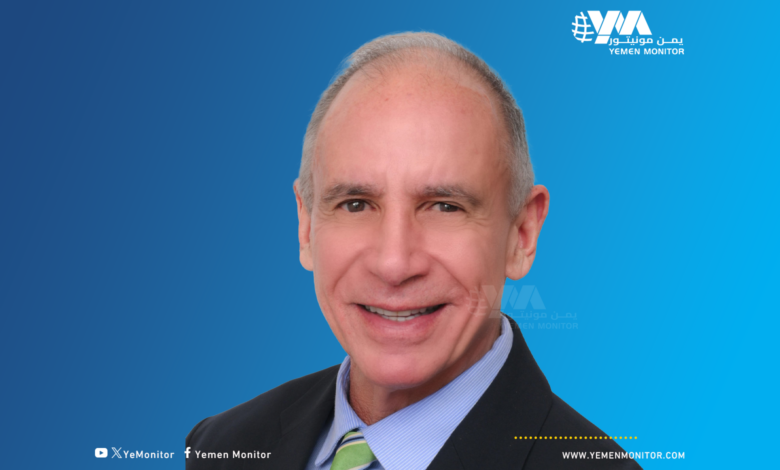
In a candid interview reflecting the current U.S. administration’s approach and Republican Party thinking on the complex Yemeni file, Adolf Franco — the chief strategic planner for foreign affairs in the Republican Party and former Deputy Administrator of USAID — outlined Washington’s roadmap for dealing with the Houthi movement.
In a televised interview on Yemen Shabab, followed by Yemen Monitor, Franco clarified the U.S. view of the Houthis, describing them as “a full-fledged proxy state for Iran.”
He said:
“Let’s speak with complete frankness: the Houthis control only a third of the country, but their operations against Israel, neighboring countries, and shipping cannot happen without Iranian support.”
Franco is a prominent Republican figure close to Republican decision-making circles and supportive of Donald Trump. He was a strong supporter of Trump’s withdrawal from the nuclear deal and publicly endorsed the 2020 assassination of Qassem Soleimani, calling it “a restoration of American deterrence.”
The Republican strategist explained that current U.S. policy is based on the belief that “any understanding with Iran will necessarily neutralize Yemen,” comparing the Iran-Houthi relationship to that between Cuba and Venezuela as sources of regional instability.
He added:
“When the Houthis do something, it is with Iran’s permission.”
Regarding Yemeni public questions about why the U.S. has not targeted Houthi leader Abdul-Malik al-Houthi despite labeling the group as a terrorist organization, Franco attributed that to calculations of “feasibility and risk.”
He likened the Houthi leader’s situation to that of “Osama bin Laden” in terms of hiding in caves and remotely directing operations.
Franco said:
“No one knows his exact location, and targeting him involves a delicate balance between hitting the heart of the organization and not creating a ‘martyr’ who could strengthen the movement.”
However, Franco did not rule out the option entirely, confirming:
“If the situation escalates to a certain level, yes, he would definitely become a target.”
In a notable point, Franco highlighted the depth of U.S.–Israeli coordination in military operations inside Yemen. He clarified that when Israel carries out strikes against Houthi targets (such as parliament buildings or command centers), they are conducted with full intelligence coordination with Washington.
He said:
“We don’t want our fingerprints to appear more than Iran’s. When shipping is attacked, people say ‘Yemen,’ and when there is retaliation, they say ‘Israel.’ But in truth, this is a conflict between Iran and the US.”
Franco strongly criticized the policies of previous administrations (Obama and Biden) toward Yemen, arguing that separating the “war on terror” from the Houthi issue was a strategic mistake.
Nevertheless, he stressed that the Trump administration and Republicans have no appetite for large-scale military intervention. He summarized the current strategy in three tracks:
- Covert action: conducting precise intelligence operations to neutralize direct threats.
- Economic pressure: using “prosperity” and sanctions as tools for leverage (the Trump method).
- Supporting opposition: secretly assisting factions opposing the Houthis to reduce the group’s effectiveness, without being drawn into a ground war.
He said:
“We will not repeat the mistakes of Iraq and Afghanistan. The Yemeni problem cannot be solved by the U.S. except within the framework of neutralizing terrorism.”
Regarding the future of Yemen’s internationally recognized government and U.S. support, Franco was realistic — and perhaps blunt — noting that Washington deals with the facts on the ground.
He explained that the U.S. will intervene only when its direct interests are threatened — such as international shipping or national security — while internal conflict and the form of government are “for Yemenis to decide.”
He concluded by warning that the latest ceasefire (brokered by Oman in May) and the temporary halt of Houthi attacks may be “deceptive,” cautioning that the group could be reorganizing. He stressed that the final solution to their “Iran-like Islamic dream” may ultimately come only through sheer force.