Yemen Monitor / Reports Unit / Exclusive:
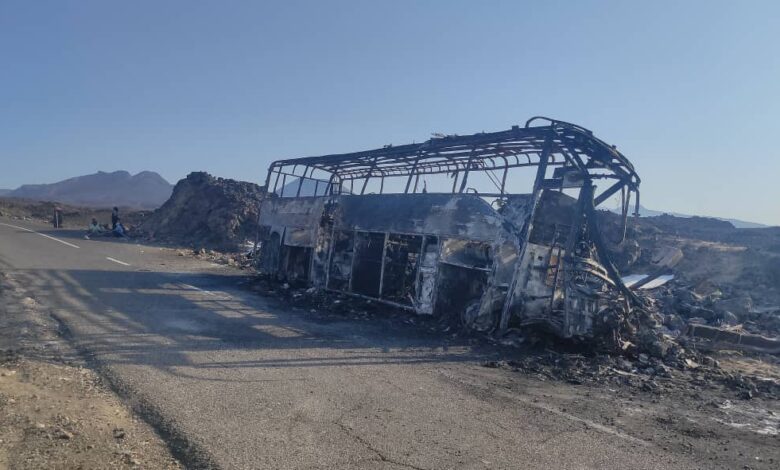
The recent tragedy in Abyan was not just a random traffic accident, but a new chapter in the series of death that haunts Yemenis on dilapidated roads that have turned into open graves. In moments, a passenger bus turned into a ball of fire, and the air filled with the screams of victims trapped by the flames on the “Al-Arqoub Pass,” one of the most dangerous roads in the south of the country.
More than twenty people burned to death, leaving behind a shocking scene that shook the conscience of the Yemeni public and brought back the postponed questions: Who is responsible? And why does this deadly scene repeat itself without change?
Collective Pain and Rising Anger
Pictures and clips from the disaster site swept across social media, accompanied by a wave of immense anger and grief. Activists described it as a “national catastrophe,” while others considered it evidence of the “erosion of state institutions” and their inability to perform their most basic tasks of oversight and rescue.
Lawyer Huda Al-Sarari described what happened as “a humanitarian catastrophe by all standards and a crime of negligence borne by state institutions,” noting that rescue teams did not arrive until after the fire had consumed the bus and its passengers. She added, “Even the equipment sent later broke down on the way, in a scene that summarizes the extent of the absurdity.”
Dilapidated Roads and Incapacitated Hospitals
The Al-Arqoub catastrophe is not the first, but it is the most tragic. “Abyan-Shabwa” road, used by thousands of travelers daily, lacks the most basic safety requirements: no lighting, no warning signs, and not even a communication network in large parts, making distress calls in emergencies nearly impossible.
Compounding the problem, the hospitals located along the international highway lack basic medical equipment, amid an absence of ambulances equipped to deal with critical injuries. A local paramedic says: “Survival in such accidents depends on luck, not on the system.”
“Death Buses” … Scrap Sold at the Price of Lives
Journalist Fathi Bin Lazraq revealed another dark aspect of the tragedy, stating: “Many of the public transport buses operating in Yemen are purchased from foreign auctions after their legal expiry date, then put back into service inside the country without any real oversight or technical inspection.”
He added that the Abyan disaster is not an exception, but rather one link in a chain of more than 14 accidents over the past six years, asking: “How do these buses obtain operating licenses when they are barely fit for transporting livestock?”
“The Road of Death” Bears Witness to Absence
Activist Najran Suwaid described the road linking Abyan and Shabwa as the “road of death,” confirming that the repeated accidents on the same route represent “a cry for help that has found no listening ears.”
Meanwhile, activist Fikri Maqfa’ reminded the public that this was the third accident at the same location, stressing that “the repetition of such a tragedy signals systemic failure, not mere coincidence.”
Calls for Investigation and Accountability
Shura Council member Alawi Al-Basha Bin Zibaa called for the formation of a fact-finding committee to hold all negligent parties accountable, from transport companies and road maintenance to civil defense and local authorities, emphasizing that “the blood spilled on the roads is not just numbers in traffic reports, but lives lost due to negligence.”
Unbearable Pain, Unending Silence
Between burning buses and official silence, Yemenis face a recurring nightmare: roads that swallow travelers, and hospitals that receive nothing but remains.
In the absence of clear plans for road maintenance or emergency preparedness, Al-Arqoub Road and others like it remain grim witnesses to a nation groaning under the weight of neglect—waiting for someone to act before the next bus goes up in flames.