Yemen Monitor / Reports Unit / Exclusive:
While Southern Transitional Council (STC) loyalists clashed with security forces in the streets of Al-Mukalla on April 4th, strategic eyes were fixed on the Bab al-Mandab Strait, specifically Mayun Island. It was no coincidence that the peak of STC anger in Hadramawt coincided with the “aerial humiliation” suffered by Abu Dhabi over Mayun Island just a few days prior.
The events in Al-Mukalla must be linked to what occurred in December 2025 and January 2026, when Saudi Arabia conducted airstrikes against Emirati weapon shipments at the Port of Al-Mukalla, followed by the formal expulsion of Emirati forces by a decree from the Presidential Leadership Council (PLC).
Consistent diplomatic and intelligence sources confirmed to Yemen Monitor that the current unrest in Hadramawt is the “most violent Emirati response” yet to the Saudi-Yemeni containment strategy. This strategy culminated in the denial of a military aircraft landing at Mayun. Abu Dhabi is attempting to leverage the military bases it was forced to vacate within the context of an expanding regional war, viewing itself as part of the Israeli-American axis.
“Day of Rage”: Activating Burnt Cards
The Hadramawt coast experienced an unprecedented state of tension on April 4th and 5th. Under the banner of a “Day of Rage” raised by the STC, massive marches in Al-Mukalla ended in bloody clashes, resulting in deaths and injuries.
According to an informed security source, gunmen believed to have come from outside the governorate initiated fire on security forces, leading to clashes that killed two protesters and injured others. The Chairman of the PLC ordered the formation of an investigation committee to compensate victims. Meanwhile, the Governor of Hadramawt stated that the STC bears full responsibility for mobilizing unauthorized protests.
Field sources told Yemen Monitor that the STC-called demonstrations were prepared for confrontation. Yemeni intelligence tracked intensive logistical and financial arrangements through Emirati channels linked to “humanitarian organizations” still operating in the region despite the official military withdrawal earlier this year.
A Gulf diplomatic source noted that the goal was clear: to destabilize the Riyadh-aligned local authority and demonstrate that the replacement Saudi forces are incapable of maintaining security without “Emirati blessing.”

Mayun (March 30): The Spark that Ignited the Coastal Gunpowder
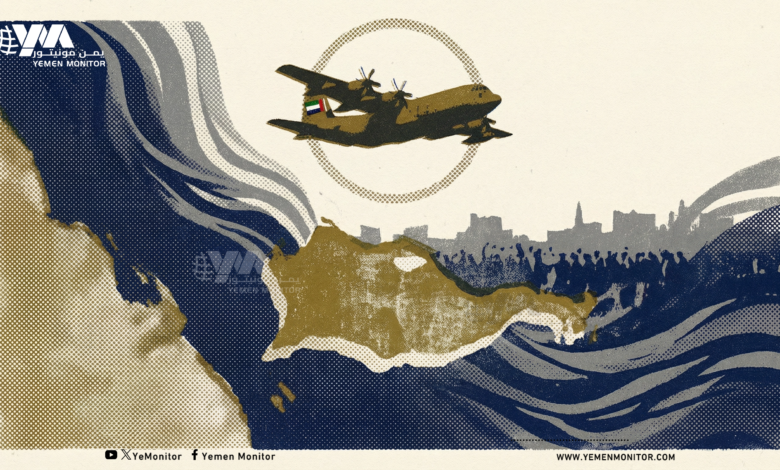
To understand “why now” in Mukalla, we must go back just five days. The Saudi newspaper Asharq Al-Awsat revealed that a military cargo aircraft was prevented from carrying out an airdrop operation on Mayun Island. Open sources showed a military cargo plane repeatedly attempting to land on the strategic island in the Bab al-Mandab Strait.
Yemen Monitor tracked three aircraft entering Mayun’s airspace between March 30 and April 1:
- The first was an Airbus A330-243 MRTT at around 11:25 GMT on March 30. It circled in a holding pattern over Bab al-Mandab and Mayun Island at about 7,000 feet, coming from the Horn of Africa (believed to be Ethiopia). After several loops without landing, it turned back.
- The aircraft appeared as military, with some ownership data concealed. Both Saudi Arabia and the UAE operate this type.
A senior Yemeni Defense Ministry official confirmed that the aircraft was Emirati and attempted to land on the runway developed by Abu Dhabi on Mayun Island.
The surprise, according to sources, was a firm order from the joint Saudi-Yemeni command refusing landing permission and forcing the aircraft to divert. Despite repeated Emirati pressure on Riyadh, the refusal remained decisive—representing a major political shock and humiliation for Abu Dhabi, which still considers Mayun one of its most important maritime influence bases.

The other two aircraft:
- March 31: a heavy cargo plane (Ilyushin Il-76TD) registered to Invicta Air Cargo, passing over Mayun en route from the Gulf (UAE) to the Horn of Africa.
- April 1: a Boeing C-17A Globemaster III (U.S. Air Force), observed crossing Mayun airspace from Djibouti.
Previously, Yemen Monitor reported Israeli intelligence activity along Yemen’s western coast—via UAE-linked entities—seeking contact with military leaders and tribal figures in areas under Presidential Council member Brigadier Tariq Saleh. Officials fear current UAE movements in Mayun may be part of Israeli activity in the Red Sea.
On Monday, the French newspaper Le Monde revealed that the UAE is building an advanced military base in Somaliland for use by the United States and Israel, amid efforts to control the Bab al-Mandab Strait.
The Yemeni government and Saudi Arabia reject using Yemeni geography in the regional war between Iran on one side and Israel and the United States on the other, despite Houthi announcements of participation in support of Iran.
Regional Context and Strategic Calculations
Ninety-six hours after the Mayun incident, the STC leadership in Abu Dhabi issued directives to mobilize the street in Hadramawt. Strategically, the two events cannot be separated.
Preventing Abu Dhabi from accessing Mayun—key to controlling the strait—amounts to a final Saudi declaration ending any Emirati presence on Yemeni soil. The UAE response came quickly using its traditional tools: “spreading chaos in Hadramawt,” the economic and symbolic capital of the Saudi-backed government.
A Yemeni Defense Ministry official said the UAE is now operating under an “Anti-Access” strategy: since Saudi Arabia blocked it from islands (Mayun and Socotra), it will respond by preventing Saudi stability in ports (Mukalla and Aden).
The implicit Emirati equation:
“If we are denied control of Mayun and Socotra, we will not be denied burning the coasts (Mukalla and Shabwa).”
Mobilizing the STC in Mukalla aims to raise the cost of Saudi presence in Hadramawt and turn governance into a security and human rights nightmare for Riyadh through the lens of “protester suppression.”
Sources spoke on condition of anonymity due to the sensitivity of the issue.
Developments indicate a new phase in the Saudi-UAE conflict in Yemen, one no longer masked by diplomacy:
- In Mayun: Saudi Arabia will seek to establish a new military reality ending any indirect Emirati presence, possibly deploying “Nation Shield” forces or Saudi-trained Yemeni units alongside naval forces.
- In Mukalla—and possibly other cities: unrest is unlikely to subside soon. Abu Dhabi will continue using its tools to mobilize protests under various banners (services, salaries, southern rights) to exhaust opposing forces and weaken local authorities.
Abu Dhabi, expelled from Hadramawt and southern Yemen, is now attempting a return through the “window of an angry street”—a high-risk gamble that could push Hadramawt’s coast into widespread security chaos, with the Houthis as the biggest potential beneficiary.