Yemen Monitor / Newsroom:
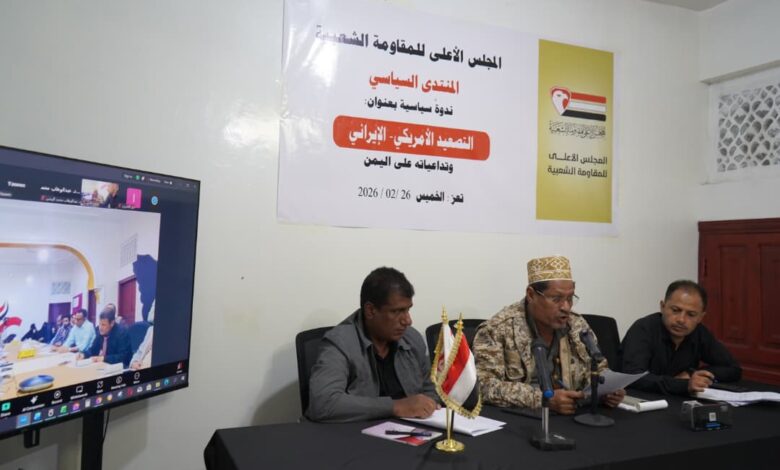
A political seminar held today in Taiz discussed the dimensions of escalating tensions between United States and Iran and their direct implications for the Yemeni scene. The event featured three research papers presented by a group of political and military analysts and researchers.
The seminar, titled “U.S.–Iran Escalation and Its Repercussions on Yemen,” was organized by the Supreme Council of Popular Resistance and attended by military experts, academics, politicians, and researchers — some participating via video link. Discussions focused on fundamental shifts in the structure of the Yemeni conflict and its direct exposure to U.S.–Iran tensions, while outlining strategic scenarios for future developments.
The first paper examined the nature of the militia’s relationship with Iran. Presented by Dr. Abdulwahab Al-Yemeni, it explained that the Houthis use ideology and anti-American rhetoric as tools for popular mobilization and military recruitment, while their major decisions remain subject to pragmatic calculations imposed by Iran according to its broader strategic needs.
In his paper titled “Patterns of Houthi Military Escalation and the Limits of Deterrence,” Colonel Abdulbasit Al-Baher argued that the group follows a strategy of “economy of attrition,” employing low-cost drones and missiles to force international coalitions to expend expensive interceptor missiles — creating a cost imbalance that primarily serves Iranian interests.
He noted that future scenarios range between continued management of controlled tension and a slide toward expanded strikes and a comprehensive regional war if self-restraint mechanisms between Washington and Tehran collapse. He added that Yemeni decision-makers should capitalize on international concern to support restoring the state, ending the Houthi takeover, and preventing Yemen from becoming a permanent proxy battlefield.
The third paper, titled “The Impact of Regional Escalation on Yemen and the Options of Yemeni Decision-Makers,” focused on the erosion of sovereign national decision-making. Researcher Abdul Salam Qaed warned that Yemen risks becoming a “bargaining chip” in international deals.
He stressed that the internationally recognized government should link global stability to the restoration of the Yemeni state, emphasizing that sustainable security of international navigation in the Red Sea cannot be achieved without ending the Houthi takeover and restoring legitimate institutions. He also warned against any regional understandings that treat maritime security as an international issue detached from Yemen’s core political problem.
During the seminar, participants emphasized that the current regional moment represents a historic opportunity for the Yemeni state to reorder its priorities, unify national ranks, and leverage international shifts to advance the battle to restore state authority, end the Houthi coup, and prevent any regional arrangements that bypass the essence of the Yemeni issue.