Yemen Monitor / Newsroom:
President Rashad Muhammad Al-Alimi, Chairman of the Yemeni Presidential Leadership Council, has renewed the call to strengthen the Yemeni-Gulf partnership by comprehensively integrating Yemen into the Gulf Cooperation Council (GCC). He emphasized that the road toward this goal begins with internal reconciliation and the criminalization of sectarian tendencies and unregulated weaponry.
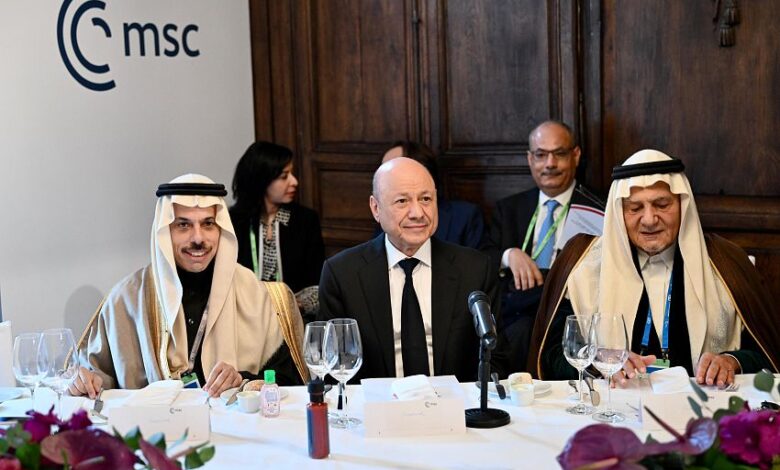
This came during a discussion session organized by the Gulf Research Center in cooperation with the International Crisis Group regarding the growing role of Gulf states in conflict resolution. The President expressed Yemen’s aspiration to develop its Gulf relations into a comprehensive strategic partnership, institutional integration, and full geo-economic merger.
The President called for the launch of what he described as a “Gulf Marshall Plan” for the reconstruction of Yemen, drawing on the specialized experience of the Saudi Development and Reconstruction Program for Yemen (SDRPY), in alignment with the ambitious development visions of the GCC countries, foremost among them Saudi Vision 2030.
He stated that while current circumstances may not yet allow for full Yemeni membership in the Council, this should not prevent a gradual expansion of involvement in GCC institutions and the activation of cooperation across various levels. He noted that the “Saudi Gateway” represents the secure path for this integration.
Al-Alimi explained that Riyadh is an inevitable partner in engineering recovery and serves as a strategic weight for reshaping the regional system to limit the geopolitical threats that have affected Yemen more than any other nation. He considered Saudi-Yemeni relations a potential launching pad for rebuilding a partnership model that could be extended to the rest of the Gulf states.
The President stressed that historical shifts in Yemeni-Gulf relations have led to an increasing realization of Yemen’s importance within the Gulf and regional security framework, especially in light of rising Iranian influence and threats from terrorist groups—primarily the Houthi militias, Al-Qaeda, and ISIS.
He pointed out that Operation Decisive Storm in 2015 served as clear evidence that the stability of the Yemeni state is an integral part of Gulf security, and that any imbalance in Yemen directly reflects on the entire regional system.
In the context of political strategy, the President highlighted the alignment of the Yemeni vision with the orientations of the Kingdom of Saudi Arabia and most GCC countries. This vision is based on balance, integration, stability, support for national state institutions, and combating armed entities operating outside the state framework, alongside adopting ambitious national development projects and support plans for countries suffering from crises and fragility.
He praised the Gulf role—particularly Saudi Arabia’s—in mediation and peace efforts, starting from the Gulf Initiative, through Kuwaiti mediation, and reaching the proposed Peace Roadmap led by Saudi diplomacy. He emphasized that any future efforts will remain incomplete unless they include the dismantling of armed militias and an end to destabilizing Iranian interventions.
Concluding his remarks, the Yemeni President presented his vision for a secure future for Yemen within its Gulf neighborhood. He asserted that the true beginning lies in Yemenis reconciling with one another, zeroing out internal disputes, and ceasing the depletion of future generations’ resources.
He also stressed the importance of reconciling with the Gulf neighborhood and sending clear reassuring messages that Yemen is deeply committed to the security and interests of the Arabian Peninsula. This, he noted, requires ridding the country of hostile, sectarian, and dynastic tendencies, and criminalizing unregulated weapons in both the constitution and the law.
Al-Alimi concluded by stating that Yemen’s strength has never resided in “reckless weapons,” but rather in its ancient history and human resources, which can make it an active partner in the region’s security and stability and one of the greatest beneficiaries of its economic and developmental boom.