Yemen Monitor / Newsroom:
A recent study has revealed decisive pathways for asserting state authority in eastern Yemen following sovereign decisions described as unprecedented. It noted that the process of “taking over military camps” represents a phase of “imposing state authority” and cutting off illegal funding channels for armed formations operating outside official institutions.
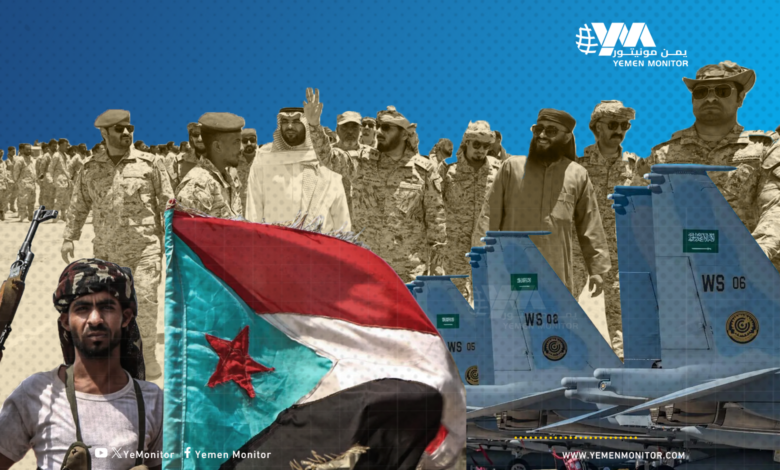
The study, issued by the Mokha Center for Studies and titled “From Incursion to Open Confrontation: Limits of Escalation and Pathways to Resolution in Eastern Yemen,” explained that the setback suffered by Southern Transitional Council (STC) forces in Wadi Hadramawt, along with the takeover of strategic sites by the “Nation’s Shield” forces, has led to a new geopolitical reality in the region.
The study outlined three potential scenarios for the next phase. The first and most likely is a scenario of “gradual resolution” in favor of the internationally recognized government, through continued field advances toward the Hadramawt coast with direct Saudi support, ultimately leading to the military neutralization of the STC within the governorate.
In contrast, the second scenario warned that the STC may resort to “limited escalation” by engineering security tensions and mobilizing protests in an effort to exhaust the state and obstruct the consolidation of stability.
The third scenario anticipates a shift of the conflict into the political arena, alongside intensified Saudi–Omani coordination to regulate the security situation in Al-Mahra and prevent any power vacuum.
The study concluded with a key recommendation calling for capitalizing on rapid field superiority to consolidate state authority in Hadramawt and Al-Mahra, stressing the need to open a disciplined political or military track that would end any separatist arrangements imposed by force, given the threat they pose to Yemen’s national and regional security.
The study noted that this shift began with decisions issued by the Chairman of the Presidential Leadership Council, Rashad Al-Alimi, on December 30, 2025, which included the cancellation of the defense agreement with the United Arab Emirates in response to the STC forces’ incursion into Hadramawt and Al-Mahra.
It also pointed out that the Southern Transitional Council’s announcement of entering a transitional phase toward secession came as a “leap forward” after it lost the initiative on the ground and saw a decline in direct Emirati support, amid increasing Saudi pressure.