Al Jazeera and the STC: Reframing Yemen’s Reality Through the Logic of Interests
by/ Mareb Al-Ward

Yemen Monitor/Special Writings:
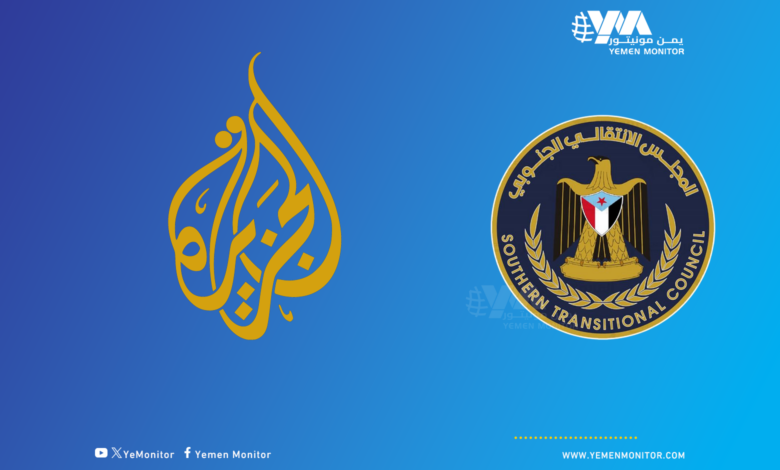
Observers of the Qatari network Al Jazeera and its website, Al Jazeera Net, will note that the channel’s coverage of developments on the ground in Yemen—particularly in the southern and eastern governorates since early December—differs markedly from its approach over the past few years. One of the most striking features of this shift is that the Qatari network, one of the most powerful instruments of soft power in Qatar’s foreign policy, has begun referring to the Southern Transitional Council (STC) by its official name, without labeling it a “militia” and without linking it to regional backing—specifically that of the United Arab Emirates, which has supported the council financially, politically, and media-wise since its establishment in May 2017.
This change can hardly be dismissed as a mere linguistic adjustment or a new editorial standard justified by modernization or professional development. Rather, it appears to be a direct reflection of the improvement in relations between Doha and Abu Dhabi, which has in turn produced a clear media de-escalation between the two sides. Attacks, escalation, and the exchange of accusations in official or funded media—whether on the Yemen file or others—have largely disappeared. Since relations improved following the end of the diplomatic crisis that erupted in 2017 between Saudi Arabia, the UAE, and Bahrain on one side and Qatar on the other, and as this improvement has continued through reciprocal visits and expanded cooperation, the impact of this shift has been plainly visible in media coverage.
During the years of the Gulf crisis, Qatari media—including Al Jazeera and other Qatari outlets—described the STC as a militia. That description was grounded in the fact that the council is neither a political party nor a licensed civil society organization recognized by relevant government authorities such as the Ministry of Social Affairs and Labor or the Committee on Political Parties. At best, it constitutes an irregular armed formation. Even after it joined the government under the Riyadh Agreement, brokered by Saudi Arabia and its allies following military confrontations between the council and the government—which resulted in STC forces seizing control of the interim capital Aden and nearby cities—and later gained greater recognition and influence within the authority that emerged from the Riyadh Consultations in April 2022, producing the Presidential Leadership Council (PLC), in which the STC holds three seats, its underlying military nature did not change.
Despite its political participation, the STC continues to reject the integration of its armed forces as stipulated by the Riyadh Agreement and the Riyadh Consultations, and it also refuses to merge its security and intelligence apparatuses into the newly formed state security structure. Accordingly, by any realistic definition, the council still commands irregular armed formations, even as it remains politically part of Yemen’s internationally recognized authority represented by the Presidential Leadership Council.
Against this backdrop, the change in how Al Jazeera refers to the STC does not signal a fundamental transformation in the council’s nature or position, nor does it mean that it has suddenly become a normal civilian political actor. Rather, it is a direct by-product of improved relations between Doha and Abu Dhabi. In our region, media have long served as tools of their financiers and their agendas—how much more so when the financier is itself an active party to the conflict.
In earlier phases, Al Jazeera devoted space to coverage and content that STC supporters and leaders viewed as hostile, with some even accusing the channel of inciting against the south, based on the council’s own narrative portraying itself as the representative of the south despite being unelected. Instead, it has relied on claims of “popular mandate,” derived from demonstrations by its supporters and the subsequent assertion that “the people” had delegated authority to its leadership. Yemeni experts and observers have also accused Al Jazeera of exploiting Yemen’s internal divisions as part of political score-settling between Doha and its Gulf neighbors on the Yemeni stage. When reconciliation occurs, the media agenda changes—and when tensions rise, it changes again. In all cases, Yemenis pay the price, in their social cohesion, their fragile harmony, and their already slim prospects for peace.
Looking more closely at the contours of this editorial shift at Al Jazeera and its website, it is evident that the network no longer presents the STC as an instrument funded and backed politically and militarily by the UAE. Instead, it treats the council as an independent Yemeni actor pursuing its own political project, while overlooking the role of its sponsor and the latter’s interests and agendas—foremost among them the project of dividing Yemen and the geopolitical ambitions linked to Yemen’s strategic location, from the Bab al-Mandab Strait to Mayun Island, the Gulf of Aden, the Indian Ocean, and the Socotra archipelago, where regional and international ambitions intersect and where functional actors such as the UAE play clear roles.
Such stripped-down coverage entails a high degree of misrepresentation by conveying a fragmented picture of the context and ignoring the influence of sponsors and regional players—chief among them the UAE—in steering the STC toward imposing secessionist steps with confidence and reassurance derived from that backing. This runs counter to the national constants of the Yemeni people, above all national unity. Today, the STC constitutes the largest local threat to unity, given the military power it wields to impose faits accomplis and its external ties to a backer that does not conceal its ambitions in Yemen.
Yemenis openly question—particularly in discussions on social media—the reasons behind this shift in Al Jazeera’s discourse and how media can manipulate facts on the ground in service of political calculations, at the expense of an entire people’s interests. If Al Jazeera is adhering to media de-escalation resulting from improved interstate relations, that should not come at the expense of truth, nor at the expense of Yemenis. What is required of any professional media outlet is to convey reality as it is, and to describe actors in Yemen—local and external alike—with accuracy and objectivity, as Al Jazeera once did in adherence to professional standards. Otherwise, it risks losing the trust of its Yemeni audience, which already bears the cost of this manipulation in its land, lives, livelihoods, and security.
A third aspect of this shift is that Al Jazeera now treats the STC as though it were an ordinary political organization or a party without a secessionist agenda, in clear disregard of the separatist project that defines its purpose and drives its actions day and night. This has come as a shock to the Yemeni public, which once regarded Al Jazeera as a platform with a high ceiling of freedom that spoke for the interests of peoples. Instead, this unprofessional coverage practices deception and misrepresentation, presenting a distorted image that conceals facts and portrays actors as if they were pursuing legitimate interests, despite lacking constitutional and legal foundations and undermining national constants and public freedoms.
Through such coverage, Al Jazeera is squandering what remains of its credibility among Yemeni audiences. The loss of reputation and trust is an exceptionally serious matter for any media outlet and cannot easily be repaired, as it strikes at the core of the legacy accumulated over years of establishment. The further Al Jazeera drifts toward politicized and falsified media, the farther it moves away from the image it once cultivated as a platform that speaks for peoples and enjoys broad margins of freedom.