Al-Alimi Directs Yemeni Diplomacy to Unify Discourse, Protect Sovereignty, and Warns Against Unilateral Actions

Yemen Monitor / Newsroom:
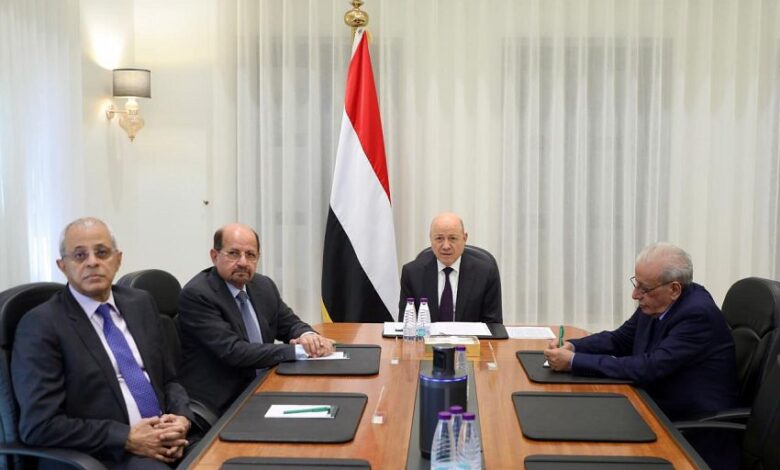
On Tuesday, Yemeni President Rashad Mohammed Al-Alimi, Chairman of the Presidential Leadership Council (PLC), briefed Yemeni diplomatic missions abroad on the latest developments, primarily the “dangerous unilateral measures” taken by the Southern Transitional Council (STC) in the governorates of Hadramout and Al-Mahrah, warning of their repercussions on national sovereignty and unity of decision-making.
During an expanded meeting with leadership from the Ministry of Foreign Affairs and heads of diplomatic missions—attended by Minister of Foreign Affairs and Expatriates Dr. Shayea Al-Zindani—President Al-Alimi emphasized that diplomatic action at this stage represents the “first line of defense” for the state and its legal status against any attempts to impose a political reality outside the framework of legitimacy and consensus.
The PLC Chairman explained that the measures taken by the STC have reached a “critically dangerous level,” noting their efforts to push official institutions and state bodies to issue political statements supporting the division of the country. He stated these bodies are adopting sovereign positions outside their jurisdiction in a “transparent attempt to create a parallel authority and undermine the unity of national decision-making.”
Al-Alimi stressed that these actions represent an “explicit rebellion against the state,” asserting that political partnership cannot be turned into a tool to impose a fait accompli by force. He clarified that high-level political positions are determined exclusively by the Presidential Leadership Council and competent constitutional institutions, foremost among them the Ministry of Foreign Affairs.
The President warned that this divisive path does not only threaten the Yemeni interior but also impacts the state’s obligations toward the security of neighboring countries and international efforts to protect maritime lanes and global trade in the Arabian Sea, Red Sea, and Gulf of Aden. He called for a clear international stance to deter such practices.
Al-Alimi affirmed that the references for the transitional phase are clear—most notably the Declaration of Transfer of Power and the Riyadh Agreement—stressing the rejection of any bypass of these frameworks under any pretext. While reaffirming the justice of the “Southern Cause” and the Council’s commitment to resolving it politically within a national consensus, he warned that “unilateral adventures” threaten the gains made for the cause and return it to a “square of clash and chaos.”
The Chairman noted that any division within the “legitimacy camp” grants the Iran-backed Houthi militias a new opportunity for mobilization and escalation. He concluded by directing the diplomatic corps to unify their external discourse, establish “clear red lines” against unilateral actions, and refocus national efforts toward the primary battle: ending the Houthi coup and restoring state institutions.