Different Details, One Shared Anguish: 120 Abductees in Houthi Prisons in Ibb.. Tragic Stories of Families Worn Down by Waiting

Yemen Monitor / Monitoring Unit / Exclusive:
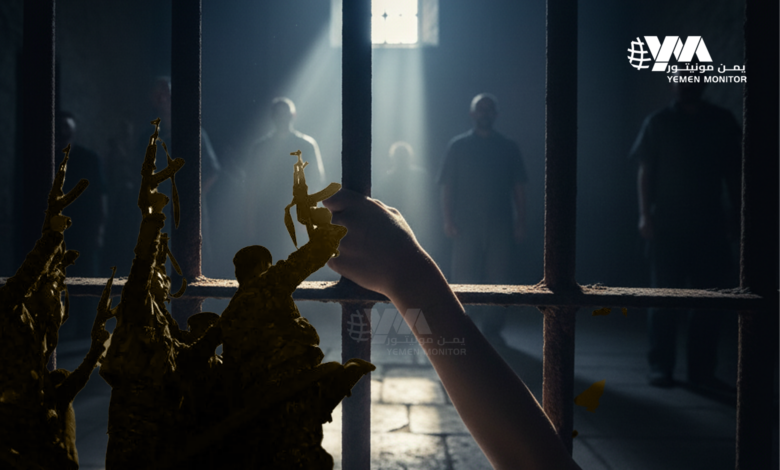
The humanitarian and human rights crisis is escalating in Ibb province in central Yemen, as the Houthi group continues to forcibly hide more than 120 abductees, who were arrested in a widespread campaign launched by the group in early July last. Dozens of families live through compounded daily suffering, where the bitterness of enforced disappearance intersects with anxiety over the fate of their loved ones, amid a complete absence of official information and the disregard of their repeated demands.
The abductees, who include academics, teachers, and scientific and educational personnel, are held in Houthi prisons without their families knowing their place of detention or the charges against them. This constitutes a blatant violation of humanitarian law, human rights, and Yemeni norms. The stories of these families are scattered, each with its own details narrating a chapter of shared pain, bound by painful questions: “Where are they? Why were they abducted? And how long will this absence last?”
A Wait That Wears Down Mothers and Shatters Hope
Among these poignant stories is the case of the mother of abductee Nashwan Mohammed Abdo Al-Haj, who has been living since July 21st “suspended between an endless wait and evaporating promises,” as his brother Majed describes. Majed demands to reveal his brother’s fate, expressing the pain of Nashwan’s children who ask daily about their father’s return, questioning what law permits disappearing people without guilt or knowledge of their whereabouts.
Majed says that his brother has children who ask about his return every day, and that his mother is exhausted from waiting, while the family does not know the reason for his detention or his location. He adds, “All we hear are promises that are not fulfilled. What law allows people to be disappeared without guilt?”
Children Facing Absence and Pain
The tragedy is embodied in other images. Nusseibah, the daughter of abductee Mohammed Aqlan, recounts the anguish of an absence that has “weighed down the days and lengthened the nights.”
She recalls her father’s voice after every call to prayer, calling out to them “Prayer, prayer.” She laments, saying, “Everything in the house misses you, Father.” Nusseibah recounts the details of the family’s patience as they live without their father, not forgetting to send a message of reassurance, hoping it reaches him: “Patience does not mean we have forgotten you; rather, we await God’s imminent relief.”
This tragedy is doubled in the case of the seven-year-old daughter of educational professional Ahmed Shalan, who suffers from Type 1 diabetes. The little girl, who used to wait for her father daily to inject her with the necessary dose of insulin, now lives with the separation from her father, who exerted double the effort to secure her medicine. The family finds itself facing a dual challenge: the illness and the enforced disappearance.
Educators Who Devoted Their Lives to Serving Education
In a similar context, Abdulrahman, the son of abductee Abdulmalik Iskander, reveals a painful paradox. His father, who spent 35 years in the education sector and continued teaching students without pay despite the suspension of salaries, is rewarded with abduction and enforced disappearance for four months.
Abdulrahman asks incredulously: “How is someone who devoted his life to generations rewarded with abduction?”, pointing out that the family does not know the reason for the arrest or the father’s whereabouts, and they are denied the right to ask or defend him.
In another example, the family of abductee Abdulaleem Abdulilah has been living the ordeal of loss since he was abducted from his home four months ago. His nephew, Ayman, describes his uncle as having been “a father and a guiding light for the family,” speaking of “a man who spent his life in education and instilling values, and who believes that the spirit within him will continue to soar behind bars, despite the jailer.”
Ayman expressed the family’s faith in “the moment of relief and the return of the uncle who has become a symbol of patience, faith, and steadfastness,” despite the daily suffering and the wait with every sunset.
These families cling to hope, despite human rights reports confirming that more than 120 people, most of them skilled professionals, remain behind Houthi bars without any legal basis. This casts heavy shadows over the human rights and social scene in Ibb province.
Ibb is known as the “Green Province,” and its population density makes it a center of social and educational influence. The abduction campaigns aim to break any potential societal influence or silent opposition to Houthi rule, especially from the category of academics and intellectuals, to ensure complete ideological control over educational institutions and society.