Yemen Monitor / Newsroom:
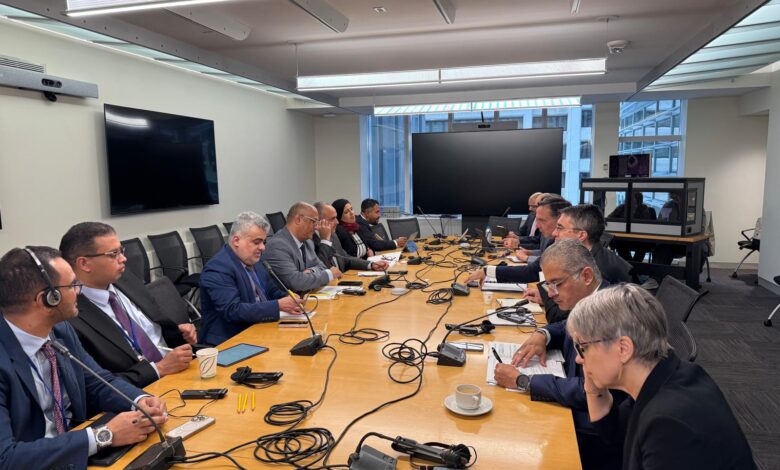
Yemeni Minister of Planning and International Cooperation, and the country’s Governor to the World Bank Group, Waed Badhib, held a meeting today with Ricardo Puliti, Vice President of the International Finance Corporation (IFC) for the Middle East and Central Asia, to discuss ways to strengthen the role of the private sector and expand investment in Yemen. The meeting took place on the sidelines of the World Bank and International Monetary Fund Annual Meetings held in Washington, D.C.
During the meeting, Minister Badhib reviewed the Yemeni government’s efforts to implement economic reforms aimed at stabilizing the national economy and improving the business environment, despite the major challenges facing the country.
He explained that the government is working to stabilize the national currency, improve the investment climate, and launch a package of reforms that includes the Public-Private Partnership Law, reform of state-owned enterprises, and modernization of the financial system by expanding the use of electronic payment systems. The reforms also include simplifying investment and licensing procedures.
The minister highlighted that the Yemeni private sector has demonstrated remarkable resilience throughout years of conflict, as small and medium enterprises and family-owned businesses have continued to provide jobs and sustain livelihoods. He noted that this resilience forms a strong foundation for achieving comprehensive economic recovery.
Badhib called on the IFC to expand its investments in key sectors, including public-private partnership projects, by providing both technical and financial support to implement successful model projects. He also emphasized the importance of supporting women’s economic empowerment by assisting female entrepreneurs and women-led businesses, describing this as a national priority.
He further urged the expansion and extension of the Fisheries Sector Project due to its economic and social significance, and called for investment in the telecommunications and submarine cable sectors, which he described as essential pillars of the digital economy and job creation.
The minister also stressed the need to enhance investment in renewable energy, particularly solar power projects, to help bridge the country’s large electricity supply gap.
Badhib expressed his hope that IFC Vice President Puliti would visit Yemen to gain firsthand insight into investment opportunities and on-the-ground challenges, affirming the government’s readiness to provide all necessary facilitation to enable the IFC to expand its operations in the country.
For his part, Ricardo Puliti commended the economic reforms being implemented by the Yemeni government and its commitment to improving the business environment and promoting transparency. He affirmed the IFC’s keenness to continue supporting Yemen’s private sector through financing, technical advisory services, and risk mitigation tools.
Puliti praised the resilience of Yemen’s private sector amid difficult conditions, noting that the IFC will work with the government and private stakeholders to identify priority investment opportunities in labor-intensive sectors.
He explained that the World Bank Group’s integrated approach aims to deliver comprehensive solutions that combine political and reform support from the World Bank, direct investments from the IFC, and investment guarantees from the Multilateral Investment Guarantee Agency (MIGA).
Puliti noted that the IFC’s current portfolio in Yemen stands at $15.9 million, distributed across the food and health sectors, and reaffirmed the institution’s readiness to expand its investments into other promising sectors that contribute to job creation and economic recovery.