Yemen Monitor / Istanbul / Exclusive:
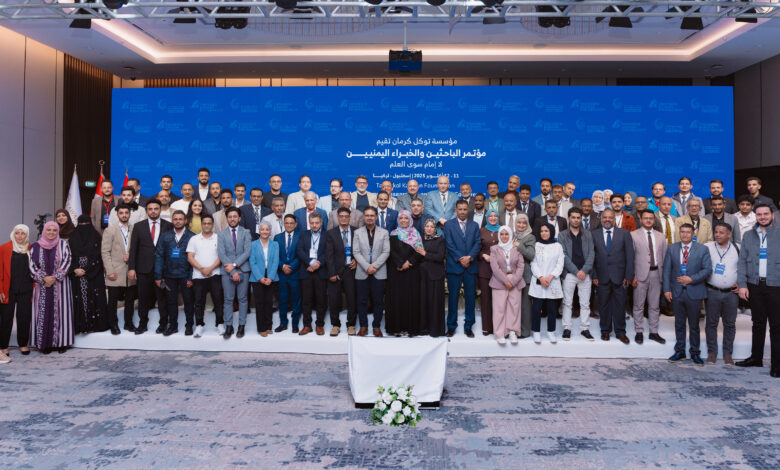
The conference of Yemeni researchers and experts, organized by the Tawakkol Karman International Foundation in Istanbul (October 11-12), concluded by issuing a comprehensive final statement that laid out a detailed “roadmap” for addressing the multi-dimensional crisis in Yemen. It emphasized that restoring the state begins with a “unified national leadership” that adopts a vision based on citizenship and competence, and ensures turning the page on the past through national reconciliation and transitional justice.
The conference, which brought together academics and researchers from inside Yemen and 15 other countries, focused its sessions on the urgent issues plaguing the country, from institutional and political collapse to development challenges and food security.
Call to End Militarization and Build a Civil State
In the political sphere, the final statement called for adherence to national constants, foremost among them the republican system, unity, and democracy, while demanding an end to all manifestations of militarization. It also stressed the importance of building a civil state by disarming armed groups and rehabilitating and integrating fighters into state institutions.
This emphasis comes amidst the stalemate dominating the main peace tracks and the increasing complexities of the regional scene, which have led to the freezing of political negotiations, thereby increasing the importance of internal solutions proposed by Yemeni elites.
The experts also urged the launch of a national project for a unifying identity and the criminalization of hate speech, considering this the foundation for confronting extremism and building a rational, inclusive discourse.
Unifying the Central Bank: A “Safety Valve” for the Collapsed Economy
The economic file formed the most urgent point in the statement, with experts linking “ending the war and establishing sustainable peace as the foundation for a sustainable economy.”
Among the most important economic recommendations was the unification of economic institutions, foremost among them the Central Bank. This demand is of utmost importance given the continued monetary division between the Central Bank in Aden and its counterpart in Sana’a—a division that has led to dual decision-making, increased challenges for the banking sector, expanded the parallel market, weakened supervisory capacity, and exacerbated citizens’ suffering and the currency’s decline.
Additional recommendations included the establishment of a national fund for reconstruction, activating governance, combating corruption, restoring basic services, diversifying the national economy, and enhancing the role of the private sector and investment.
Reforming Education and Health for the Future
The conference did not neglect the developmental and social aspects, recommending the necessity of establishing a comprehensive national vision for reforming university education and scientific research to align with the requirements of future development, while providing an educational environment that reinforces national identity.
The statement also emphasized the need to expand health services to reach rural areas, restructure health financing, and address the psychological and physical impacts on war victims through an integrated national system. Experts highlighted the importance of activating artificial intelligence tools and digital medicine to improve the efficiency of health services.
Regarding the energy file, participants called for the adoption of a comprehensive national policy based on reviewing oil and gas agreements, expanding renewable energy projects, enhancing food security, and the urgent need to develop a national policy for environmental protection.