“The Journalists’ Massacre” in Sana’a: Israel Kills and the “Houthis” Abandon Their Responsibilities!

Yemen Monitor/Sana’a/Exclusive:
The targeting of journalists in Yemen has become a “deadly pattern” that is repeated with impunity for the perpetrators. Last week, a report by the Committee to Protect Journalists (CPJ) condemned the deaths of 31 Yemeni journalists in an Israeli airstrike, describing it as the “second deadliest single attack on the press ever.”
The CPJ report stated that this raid points to a “deadly pattern” of targeting reporters and newsrooms on the ground.
One newspaper described the attack as an “unprecedented massacre of journalists.” Commenting on the report, Nico Jafarnia, Yemen and Bahrain researcher at Human Rights Watch (HRW), deplored the “extremely horrific” attack, noting that Israeli forces “have been targeting journalists in Gaza for two years, and in Palestine for longer, and in Lebanon, and now in Yemen.” She stressed that “the international community is not doing enough to stop this pattern.”
In an interview with the English-speaking Sky News (UK), monitored by “Yemen Monitor,” Jafarnia explained that “there is talk of 31 potential journalists killed,” confirming that CPJ has so far documented the names of nine of them, while other groups indicate the number 31. She affirmed that this constitutes a “very potential violation of the laws of armed conflict.”
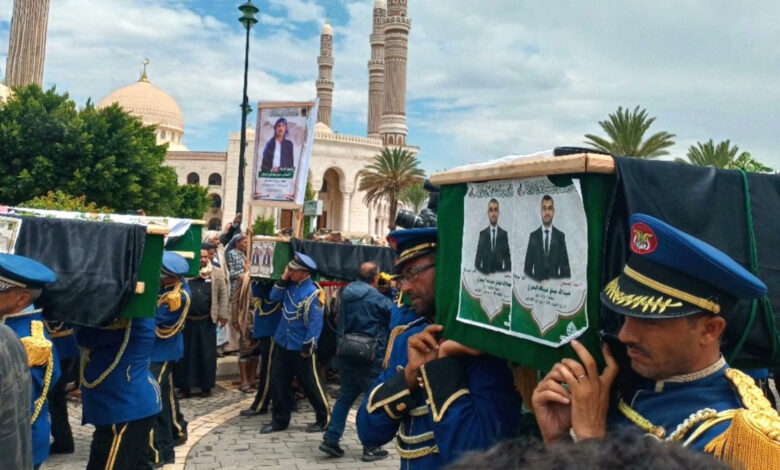
Last week, residents of Sana’a and the Houthis held a funeral for the 31 journalists and workers at the September 26 journalistic institution, which belongs to the army and is controlled by the Houthis.
Houthis Abandon Their Responsibilities
Two family members of the killed journalists told “Yemen Monitor” that the Houthis had not contacted their families after offering initial condolences, and had not “discussed the future of the children, the sustenance they could receive, or even finding housing for the two families after their sole breadwinner died.”
Aisha, the sister of one of the killed journalists, said that they “don’t even respond to our calls, and the martyrs’ blood has not dried yet. My brother used to support his family of six—his mother and sisters—by working for more than one newspaper to earn an amount that kept us covered.”
“Now, we have nothing. We might be evicted from this rental house by the end of the month and left homeless,” Aisha added.
Mohammed, the son of one of the journalists killed in the Israeli attack, indicated that “my father worked for a state institution until the end of his life. Leaving us to face our fate is an insult to more than two decades of his work.”
Mohammed added, “All his friends we knew were killed in the attack. Where do we go? Even when my father was working, we lived in a rental house and he was late paying. Now they won’t keep us in the house.”
Aisha and Mohammed appealed to the Journalists Syndicate and organizations to pressure the Houthis to care for their relatives.
It appears that the issue concerns most of the families of the journalists killed in the Israeli raids, as the Houthis refuse to bear their responsibilities.
Multiple Risks for Yemeni Journalists
Regarding the escalation in targeting journalists, HRW’s Nico Jafarnia mentioned that “what we are seeing very clearly over the last two years is the killing of around 200 journalists,” according to CPJ documentation.
HRW itself has documented incidents of “direct targeting” of journalists by Israeli forces in Lebanon and Yemen, even while they were sleeping. She stressed that the “lack of an end to this pattern is because many Western governments, especially the US, continue to arm and support Israeli forces while they commit these abuses,” even after the use of their weapons in some of these attacks has been revealed.
Jafarnia indicated that journalists in Yemen face threats not only from Israeli forces but also from the Yemeni authorities themselves. She noted that “all parties to the conflict in Yemen, including the Houthis, the Southern Transitional Council (STC), and the Yemeni Government, have committed very serious human rights abuses against journalists throughout the 11-year conflict.” These violations included “arbitrary detention, torture, enforced disappearance, and even killing.”
HRW had issued a report last week documenting these abuses in detail after a year of research. Jafarnia revealed the testimony of one journalist who told them that “a prison official told him that they are praying to God by torturing journalists.” Other journalists reported being subjected to “severe torture, including being beaten with cables and suffocated.” Some have been killed by the authorities during these 11 years.
Calls for International and Local Justice
Jafarnia called on the Yemeni authorities to “respect and protect freedom of expression,” asserting that “the Yemeni people deserve to be able to speak out about what is happening in their country and abroad without fear of being silenced, harmed, and having their rights violated in this incredibly brutal way.”
At the international level, Jafarnia confirmed that HRW has been documenting “violation after violation in Gaza primarily, but also in Lebanon, Yemen, and Syria, and Iran by Israeli forces” for 23 months. She added that the organization has also documented “many violations by armed groups and Iranian authorities within Israel.”
Jafarnia criticized the “inaction of the international community,” which she said is limited to “some statements here and there.” She warned that “as long as Western countries continue to fund, support, and arm Israel and refuse to draw a red line to end these judgments and support, we will see these violations continue.”