Yemen Monitor / Newsroom:
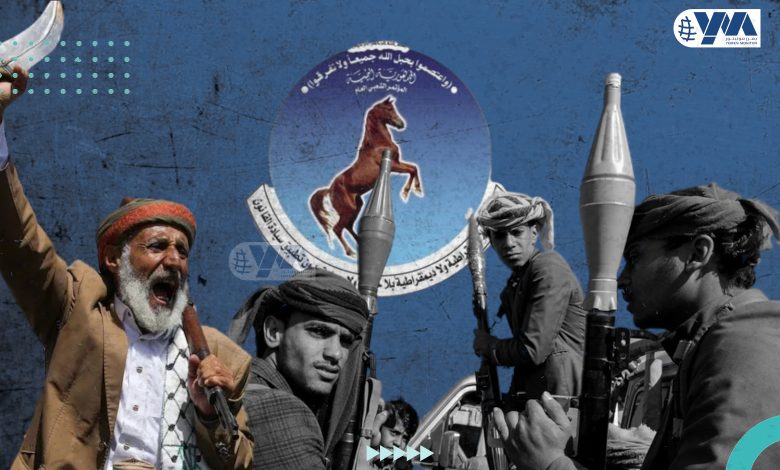
A recent report by the Mokha Center for Strategic Studies revealed escalating tensions between the Houthi group and the General People’s Congress Party (GPC) – Sana’a wing, noting that the recent wave of arrests and pressures is not a passing dispute, but rather part of a systematic Houthi strategy aimed at weakening any political entity that could pose a threat to their future dominance.
The report stated that the roots of the conflict date back to the Houthis’ takeover of the capital, Sana’a, in September 2014, when they began marginalizing the GPC and monopolizing power and resources.
It also highlighted that the relationship between the two sides has gone through complex phases, most notably the clashes that led to the killing of former president Ali Abdullah Saleh in December 2017, which confirmed the Houthis’ tendency toward absolute rule.
According to the report, the current escalation carries added symbolic weight as it coincides with key national and party occasions, including the anniversary of the GPC’s founding on August 24 and the anniversary of the September 26 Revolution against the Imamate regime. The Houthis are seeking to erase these occasions in favor of reinforcing their own narrative tied to September 21, in an attempt to reshape national identity and political history in line with their ideological project.
The paper revealed several forms of Houthi targeting of GPC members, including pressure to sever the party’s ties with the family of the late president, the issuance of a death sentence against his son Ahmed Ali on charges of “treason,” as well as the banning of national and party events. These included storming a meeting of the GPC’s Permanent Committee, confiscating funds allocated for the anniversary celebration, and arresting prominent leaders.
The report also shed light on a wave of arrests and harassment targeting GPC leaders, among them Secretary-General Ghazi Al-Ahwal and his office director Adel Rabid, in addition to placing other leaders under house arrest and raiding the homes of prominent figures in Sana’a and other regions.
Measures have also extended to the confiscation of the party’s assets, including lands, properties, and main headquarters, with the aim of stripping the GPC of its resources and preventing it from carrying out any independent political activity.
As for possible outcomes, the paper presented three scenarios:
- The dissolution of the party in Sana’a once the Houthis have extracted what they want from it, though this carries the risk of a popular backlash.
- The continuation of the party as a mere façade fully controlled by the Houthis, through sidelining dissenters and appointing loyalist leaders. This is considered the most likely scenario.
- A popular mobilization in support of the GPC, though this is deemed unlikely due to the party’s organizational weakness and declining popular influence.
The report concluded that the political scene in Sana’a reflects the Houthis’ determination to dismantle any independent political structure, monopolize the public sphere, and reconstruct the national narrative in a way that ensures their absolute control over the state and society. It stressed that the future of the relationship between the Houthis and the GPC depends on the latter’s ability either to endure or to fully submit to the mounting pressures.