Education in Houthi-Controlled Areas: Schools Looted and Poor Children Excluded (Special Report)

Yemen Monitor / Reports Unit / Exclusive:
Millions of Yemeni students in areas under the control of the Houthi armed group have started a new academic year amid dire economic conditions, a deteriorating educational system, and a complete abandonment of responsibilities by relevant authorities, as the group maintains full control over state institutions—including the education sector.
Despite announcements by the Houthi-run Ministry of Education claiming “full preparedness” for the new school year 1447 AH, the reality on the ground reveals a deepening crisis. Parents are being forced into difficult choices: either pay exorbitant fees imposed by the authorities to cover the group’s failure to pay teachers’ salaries, or enroll their children in private schools that have turned into profit-driven businesses, operating without oversight or clear educational standards.
A De Facto Government Abandons Education
The Houthi-affiliated Ministry of Education has abandoned its basic obligations, most notably the printing of educational curricula. Textbooks are now sold on the black market and sidewalks, leading some to mock the official inauguration of the school year.
Regarding this, citizen Omar Al-Qadi stated, “Is it logical for an academic year to open while students are searching for their books on the black market? This has never happened in Yemen’s history. Education has turned into a business!”
Activists also pointed out that while the ministry promotes superficial interests like university rankings, basic education is collapsing under the weight of neglect and mismanagement.
Exorbitant Fees and Declining Education
This year, parents are facing unprecedented hikes in school fees. Some private schools are charging up to 150,000 Yemeni rials (approx. $283) for first grade and over 280,000 rials (approx. $528) for high school—amounts that far exceed the average monthly income, while failing to offer quality education or qualified teaching staff.
Mohammed Al-Qasimi commented that these high fees do not even cover books, uniforms, or transportation, making education an unbearable burden for families. Meanwhile, teachers themselves earn meager salaries—often not exceeding 75,000 rials per month (about $140)—despite their high qualifications.
Public Education: A Fading Option
Due to the poor state of public education, many parents are reluctantly turning to private schools, despite the heavy exploitation. Bashir Al-Mahyoub noted, “Private schools force parents to buy uniforms, headscarves, and notebooks at inflated prices. They treat education as a commodity, not a right.”
On the other hand, public schools suffer from a lack of qualified staff due to unpaid salaries. Classrooms are overcrowded beyond capacity, and schools now impose monthly registration fees of up to 1,500 rials—undermining the principle of free public education.
Outcry Amid Deaf Ears
Many activists and human rights advocates have called for stronger regulation of private schools, fair fee structures, and an end to the exploitation of families. Badr Al-Din Al-Olfi stated, “Private school fees exceed those of some international universities, while teachers earn mere scraps. Where is the oversight? Where is the conscience?”
Mohammed Muqbil Al-Bukhaiti stressed the urgent need for regulatory bodies to impose reasonable fee caps and improve education quality, which remains far below what parents are paying for.
Activist Hisham Sinan shared a shocking example: one family in Ibb governorate paid 760,000 rials to enroll five children in elementary school—an amount that is simply unaffordable for the vast majority of Yemenis.
Collapse Threatens the Future of Millions of Children
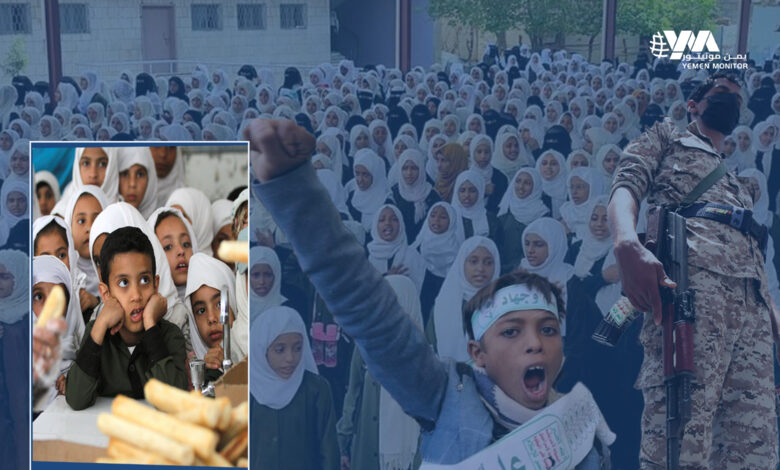
This worsening reality is part of a severe educational crisis in Houthi-controlled areas. Public schools have been hollowed out and transformed into environments that repel learning, while the Houthi group invests in private education through its affiliated entities. This turns the educational process into a tool for profit and a means to spread ideological influence.
Previous official reports confirm that the Houthi group has distorted school curricula to serve its sectarian agenda, in addition to depriving over two million children of education and arresting or killing thousands of education workers.
Millions Out of School
According to recent data from the U.S. Agency for International Development, approximately 4 million Yemeni children are out of school, including 1.5 million girls. This is a direct result of the prolonged conflict, the collapse of educational infrastructure, displacement, and economic pressures.
The United Nations Population Fund (UNFPA) has indicated that this lack of education particularly exposes girls to risks such as child marriage and early pregnancy, depriving them of a safe educational and professional future.
The Houthis have effectively turned education in Yemen from a basic right into a class-based privilege and a tool for financial and ideological extortion. With state institutions in collapse and the complete disregard for the needs of millions of students, Yemen’s youth now face an uncertain future. Many have already been forced out of school—drifting between unemployment, hard labor, or recruitment into the group’s ideological summer camps and military training centers, posing a generational threat.