Houthis Amidst Regional Military Shifts: The Impact of the Iran-Israel Conflict on the Yemeni Movement
By: Ameed Al-Mahyubi

Yemen Monitor | Reports Unit :
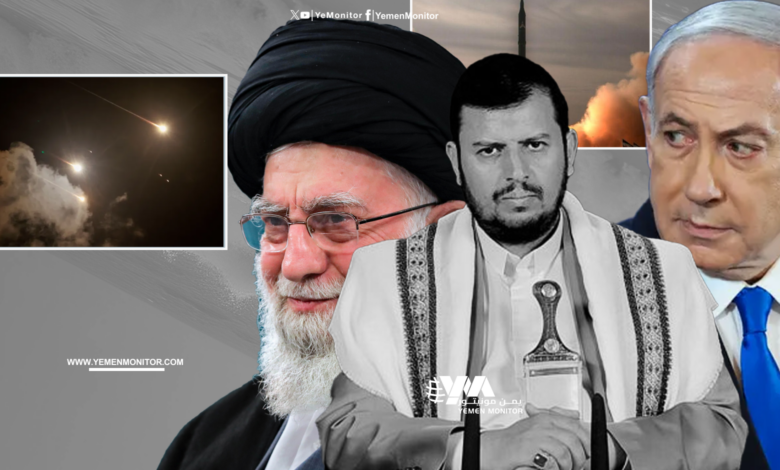
Amid escalating military tensions between Iran and Israel, unprecedented repercussions are emerging in the Yemeni arena, with sources reporting sudden airstrikes targeting senior leaders of the Houthi movement.
Local reports stated that Israeli airstrikes targeted a secret meeting of the group in the capital, Sanaa, early Sunday morning. No official statement has been issued by the Houthis to confirm or deny the losses, raising questions about the extent of casualties among their leadership.
Rising Regional Tensions Disrupt the Houthis
In this context, political activist Waleed Al-Jabzi told Yemen Monitor that “the recent regional escalation has caused noticeable confusion within the Houthi group, one of Tehran’s most prominent allies in the region.”
Al-Jabzi indicated that “Israeli aircraft carried out precise airstrikes in the early hours of Sunday, targeting a secret meeting of Houthi leaders in Sanaa. The militia has yet to release any official statement about the outcome of the attack, which supports the theory that sensitive targets were hit and the group suffered significant losses.”
He added that “this Houthi confusion is a direct result of Iran being preoccupied with its own regional front and the absence of its usual direct support and field involvement. This situation presents a strategic opportunity for the internationally recognized Yemeni government to strengthen its position on the ground and recapture areas still under Houthi control—before the country turns into a new battleground for proxy wars.”
Meanwhile, UN Envoy to Yemen Hans Grundberg continues his efforts to revive the political process in the country.
Al-Jabzi believes that “the chances of success for the UN initiative remain limited as long as weapons remain in the hands of the Houthis. Any just political settlement must include the disarmament of militias and guarantees against the recurrence of coup and rebellion scenarios that threaten Yemen’s stability and future.”
Since their rise to power in 2014, the Houthis have heavily relied on Iranian support across multiple sectors—from military funding to oil supplies, and media and political backing. However, Israel’s escalation against Iran—including strikes on military and economic infrastructure deep inside Iranian territory—could hinder Tehran’s ability to support its foreign proxies. This may transform the Houthis from a pressure card into a strategic liability, placing their military and political future at serious risk in the coming phase.

Houthis: From Pressure Card to Strategic Burden
Abdelwasea Al-Fatiki, a journalist specializing in political affairs, stated that: “The military escalation between Israel and Iran directly impacts the Houthis, who have relied on Iranian support since their inception as an armed group and one of Iran’s most prominent military proxies in the Arabian Peninsula. This connection provided the Houthi group with significant capabilities, enabling them to seize control of the capital Sana’a and Yemeni state institutions on September 21, 2014.”
He added that “the Israeli strikes targeting Iran’s infrastructure, including refineries and vital facilities, deepen its escalating economic crisis due to sanctions, making it difficult for Iran to continue funding its external allies with the same intensity as before.” He suggested that “Tehran is likely to restructure or reduce its external spending, prioritizing securing the domestic front and cutting expenditures on its external proxies.”
Al-Fatiki explained that “smuggled Iranian oil represented one of the most prominent indirect funding tools for the group, through its sale on the black market inside Yemen. However, the war and increasing international pressure make this method less effective and possibly subject to cessation.”
He continued, saying: “If the escalation against Iran continues, financial and military support for the Houthis is likely to decline, which may put the group to a difficult test regarding its ability to maintain its combat and political structure.”
Al-Fatiki believes that “the coming phase may witness a shift in the perception of the Houthis, not just as an Iranian pressure proxy, but as a strategic burden if Iran’s ability to provide support declines.” He pointed out that “the group faces an existential challenge in light of a new equation imposed by regional changes, and the coming months may be decisive in determining its political and military future within Yemen.”

Amid Regional Military Shifts
Brigadier General Abdulrahman Al-Rubaie, a political analyst specializing in military affairs, believes that any direct confrontation between Iran and Israel will have both direct and indirect repercussions on the Houthi movement in Yemen. Al-Rubaie predicts that Tehran and its allies will suffer significant strategic losses as a result of this conflict.
In a statement to Yemen Monitor, Al-Rubaie explained that Iran is the primary backer of the Houthis and has played a major role in establishing and fueling numerous armed proxies across the region—negatively affecting stability in four Arab countries, including Yemen.
He noted that Iranian influence in the region is gradually declining. This is evident in the waning influence of Hezbollah in Lebanon and the reduced Iranian presence in Syria and Iraq. Additionally, the Houthis have suffered continuous strikes from U.S. forces during both the administrations of President Joe Biden and the current President Trump.
Al-Rubaie added that Israel has recently targeted vital Iranian infrastructure and economic facilities, directly affecting ports under Houthi control—such as Al-Salif, Ras Issa, and Hudaidah—which have now gone out of service. This has placed the Houthis under a severe naval and aerial blockade.
Regarding possible scenarios for how the conflict might end, Al-Rubaie believes that if military operations between Iran and Israel cease, Tehran will likely return to the negotiating table under stricter conditions. These may include three core issues: Iran’s nuclear program, the limitation of its long-range missile capabilities, and a reduction in the influence of its regional proxies—most notably the Houthi movement.
Al-Rubaie pointed out that Iran will then be forced to fully abandon its support for these groups, which would effectively cut off the Houthis from all external backing.
He also stressed that any attempt by the Houthis to target shipping routes or close Bab al-Mandab Strait would be a failed gamble, given the ongoing naval and air blockade and the presence of European forces and British aircraft carriers in the Red Sea.
Al-Rubaie concluded his statement by referencing the prediction of Presidential Leadership Council Chairman Rashad Al-Alimi that 2025 will be a decisive year. Al-Rubaie believes current developments on the ground indicate that this scenario is unfolding—starting with dismantling the armed proxies and ending with “the head” itself (Iran).