International Blackmail in the Red Sea and Expanding Influence Amidst the Gaza Conflict: Former British Ambassador to Yemen Analyzes Houthi Behavior

Yemen Monitor/Marib/Exclusive:
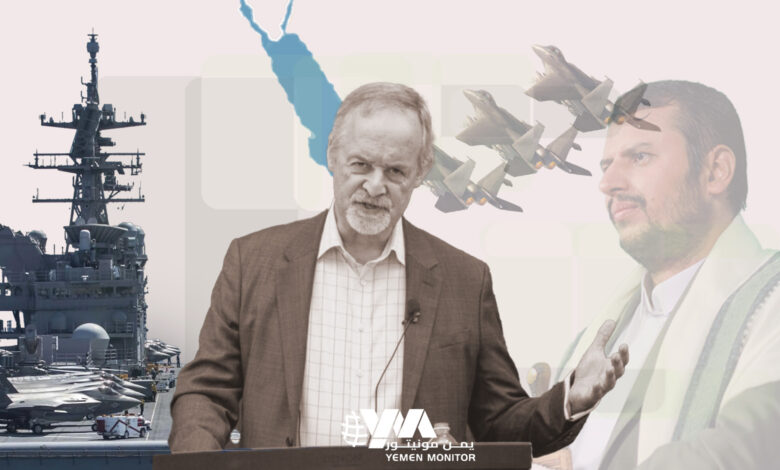
Edmund Fitton-Brown, former British Ambassador to Yemen, stated that the Iranian Revolutionary Guard Corps (IRGC) is the most influential foreign entity in Yemen, primarily through its relationship with the armed Houthi group.
Speaking in a podcast interview with the BICOM research center, Brown said that “the Houthis’ campaign in the Red Sea against shipping in late 2023 and early 2024 was a Houthi initiative. They didn’t do it at Iranian instruction; they were doing something that they thought was beneficial to them, and to their reputation.”
He added that the Houthis are flexing their muscles and demonstrating their ability to blackmail the international community using their access to the Red Sea. He noted that this Houthi behavior preceded October 7th, and it appears that the Israeli attack on Gaza has allowed them to expand this blackmail.
Brown is a seasoned British diplomat who served as the UK Ambassador to Yemen between 2015-2017.
Brown further explained: The Houthis had previously used Red Sea attacks for gains, and that was before October 7th. Therefore, it cannot be said that it is directly linked to Houthi solidarity with the Palestinians. In any case, over time, and with the Biden administration, supported by the British government, deploying a naval force in the Red Sea, the Houthis suffered heavy losses – not huge, but significant damage to their military facilities.
He continued: “And although people criticized the initial US response as being overly cautious, and I think it probably was, it did have some effect, and it was a very strong statement of intent. And I think the Houthis then realized that, but they continued to prove their bona fides in saying that they really are, you know, champions of the Palestinian cause against Israel.”
However, Brown states: They had to exert more effort to directly attack Israel. Thus, over time, they began to use drones and missiles to try and penetrate Israeli defenses and strike Israeli territory. They had indeed done so in the past; they have experience doing this against Saudi Arabia during the civil war, and they have experience doing this against the United Arab Emirates.
Therefore, Brown believes the Houthis said, “Let’s see if we can hit Israel.” He added: Clearly, Israel has very strong defenses, and very few of these attacks succeed. But when they do succeed, they obviously cause significant disruption. And when the Israelis incur any losses or cause serious disruption, they then feel the need to respond.
He pointed to the bombing cycle that occurred from mid-March to early May during Trump’s second term. He said: Then Donald Trump came to say that the previous rules of engagement were insufficient, that the United States should not be underestimated, and that the Houthis would be destroyed if they did not stop threatening international navigation in international waters. He also explicitly stated that he would hold Iran responsible for everything the Houthis did, so Iranians should also expect to be militarily attacked if they continue to facilitate and support Houthi attacks on the international community.
Preventing Houthi Troop Mobilization
The former British diplomat in Yemen said, “I think the most important thing that the American campaign achieved, which people haven’t talked about much, is the fact that it prevented the Houthis from mobilizing troops to make progress in the civil war, because the civil war continues in Yemen, and the current Houthi goal is to control the city of Marib, and Marib is a very strategically important city.”
He added: Marib is a very large city, and it would also open the way for the Houthis to advance eastward towards Yemen’s oil fields, and southward towards the Gulf of Aden or the Indian Ocean coast. So, it is very important to prevent the Houthis from winning the civil war. It is very important that they do not succeed in seizing Marib.
He continued: “And of course, when the Americans launched this extensive and aggressive air campaign, the Houthis realized that their forces, which were mobilizing to take control of Marib, were very vulnerable, and that they could be completely crushed from the air. So, they had to abandon the siege of Marib and abandon the engineering works they were undertaking to support that siege.”