Yemen Monitor/Reports Unit/Special:
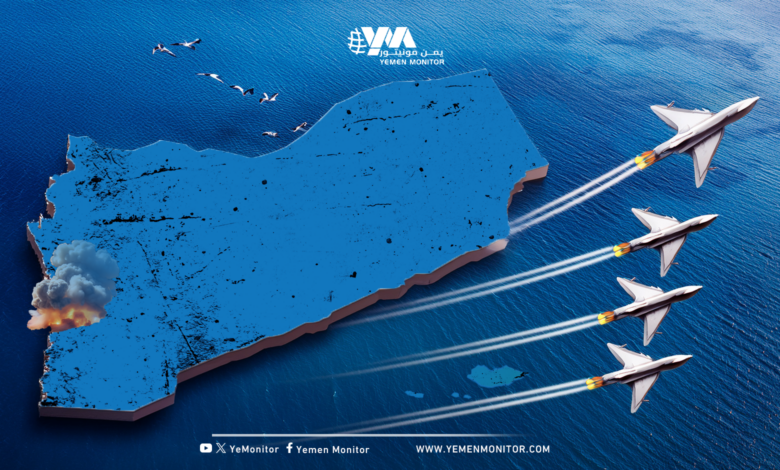
On Sunday evening, the Israeli occupation issued a humiliating order to the Houthis to evacuate the ports of Hudaidah, and the remaining civilians in the three ports: Ras Issa oil port, Al-Salif port, and Hudaidah port in western Yemen “until further notice.” This appears to be part of a psychological game often used by the occupation army.
Shortly after, local, Arab, and international websites and news agencies broadcast news of Israeli occupation airstrikes on the three ports, especially Ras Issa. However, what happened was part of an extensive disinformation campaign initiated by Israeli media and then Houthi media.
Official Houthi media outlets, such as Al-Masirah TV, the Al-Masirah Urgent News account, and the Houthi-run Saba News Agency, did not report the Israeli warning. They continued to translate what the occupation’s media was saying about the impact of Houthi attacks and threats.
Arab television networks such as Al Jazeera, Al-Araby TV, Al-Hadath, Sky News Arabia, Al Mayadeen, Al-Manar, and others broadcast news of the start of the raids. Most Yemeni websites and channels later revealed that there were no raids until the editing of this material at midnight Sunday/Monday, with statements from Israeli journalists quoting the occupation army spokesman as saying that no raids had been carried out.
Later, Houthi leaders took to social media to deny the occurrence of the raids and launched an attack on the outlets, websites, and channels that published the news.
Mohammed al-Bukhaiti, a leader in the Houthi group, said in televised statements: “There is no attack on the ports (under the group’s control) at the present time, but we do not rule out the occurrence of attacks.”
The Israeli Broadcasting Corporation said: “It seems that the announcement by the Israeli army spokesman in Arabic is part of a psychological game.”
An official in the Israeli Defense Forces told the corporation: “We did not announce that we would attack Yemen ‘in the near future,’ but rather we announced the evacuation of three sites ‘until further notice.'”

How did the news of the raids begin to spread?
The “Security Media” affiliated with the Houthi Ministry of Interior, and the news service on “26 September Mobile” affiliated with the Houthi Ministry of Defense, published the news. While the mobile service retracted, the Houthi Interior Ministry sufficed with deleting the tweets.
Yemen Monitor tracked Houthi-affiliated media websites and pages that published news of the raids, such as the Houthi Civil Defense on its Facebook page, which had not deleted it by the time of this article’s editing, stating that raids had occurred on the ports.
Al Mayadeen TV, which is close to the Houthis, also broadcast calls with its correspondent in Sana’a about the existence of the raids, and Al Jazeera TV and its correspondent in Sana’a cited the news quoting Houthi media. The correspondents of Al Mayadeen and Al Jazeera agreed on citing from media outlets about the occurrence of the raids and also agreed on not knowing the number of raids.
Houthi Data Discrepancies in Several Issues
This is not the first time this has happened. Last week, the director of Sana’a International Airport said that the number of aircraft destroyed in the Israeli raids on Sana’a airport was six. It later turned out that three of them were in active service for Yemenia Airways, while the Houthi Deputy Minister of Transport, Yahya Al-Sayyani, said the day after the raids that the destroyed aircraft were seven. Open sources and satellite images show the number of destroyed aircraft to be approximately nine.
In the issue of de-escalation with the US and the truce between them mediated by Oman, Houthi justifications varied. While Mahdi Al-Mashat said that they had informed the US that Trump’s trip to Saudi Arabia and the Gulf would be affected by the continued escalation, Mohammed Abdulsalam, on the other hand, said that the US was the one that requested de-escalation through the Sultanate of Oman, and that they did not submit any request.
As for the issue of the raids on a Houthi prison in the Special Forces “Central Security” camp in Saada on April 29, statements varied even within the Saba News Agency itself. Yemeni journalist Fares Al-Hemyari published tweets clarifying these contradictions. Al-Hemyari said in a tweet on his X platform: “The Houthi group’s media coverage of the crime at the African migrant detention center was unusually confused, as it published conflicting figures and incorrect statements.”
Al-Hemyari published images of these contradictions within the Saba News Agency, where it published news of a press conference at the shelter center stating that the number of dead was 65 and the injured were 68, all of whom were African migrants, and that the International Organization for Migration (IOM) was aware of this and managed the shelter center. The IOM denied managing the center. Satellite images published by Wael Al-Badri indicated that the targeted location was nothing more than a headquarters inside the Central Security camp in Saada.
Meanwhile, the Houthi health authorities said that the number of deaths in those US raids was 60 and the injured 47. The Houthi Civil Defense said that the dead were 68 and the injured 47. The Houthi Interior Ministry said that the center was under the management of the International Organization for Migration and the Red Cross.
Regarding the casualties of the April 17 US airstrikes on Ras Issa, Houthi figures similarly varied and contradicted each other. The General Union of Oil, Minerals and Petrochemicals Workers – Hudaidah branch – said on April 18 that the dead were 60 and the injured 130.However, a statement from the Coordination Committee of Unions in the Sana’a Oil Ministry said on April 19 that the dead were 82 and the injured 106. The Oil Company Workers’ Union in the Houthi-controlled part of Taiz spoke of dozens of deaths and hundreds of injuries. The Petroleum Stations Owners’ Union spoke of 80 dead and 150 injured. Sana’a Oil Ministry Employees’ Union said on April 19 that the dead were 90 and the injured 150.
Even the Houthi leader, Abdulmalik al-Houthi, was involved in contradictions in terms of data and figures, although he never mentions figures related to Yemeni losses, victims, and deaths. However, he raised the number of events and activities carried out by his group since the “Tophan Al-Aqsa” to one million and nine hundred thousand activities, an increase from seven hundred thousand activities on the first anniversary of the Tophan Al-Aqsa, although he later retracted that figure.