Al-Hudaidah Electricity: Citizens Between Summer Hell and Houthi Levies as Bills Jump 300%

Yemen Monitor / Al-Hudaidah / Exclusive:
Official documents have revealed massive financial revenues collected by the Houthi group in exchange for electricity services from the residents of the coastal Al-Hudaidah Governorate (western Yemen), amid a worsening humanitarian crisis and a severe heatwave hitting the city during the summer season, drawing widespread criticism for doubling the burden on citizens.
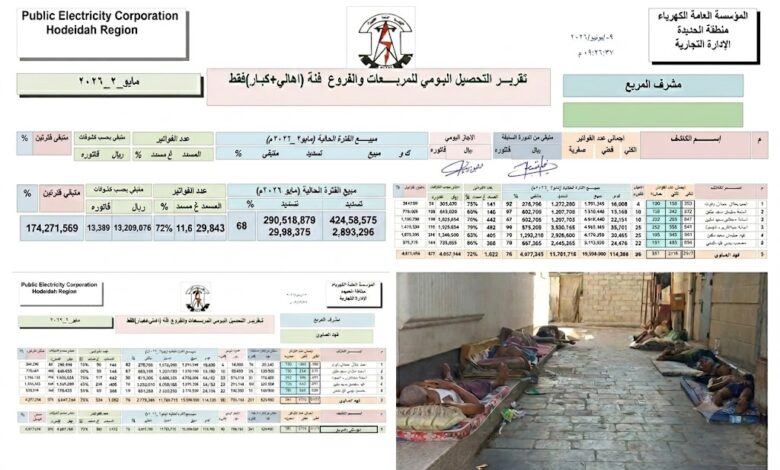
Detailed analytical data from the daily collection logs of the Public Electricity Corporation (under the group’s control) in a residential and commercial block in Al-Hudaidah city—managed by a Houthi supervisor named “Mohamed Amin”—reveals the technical mechanism through which electricity bills have turned into an exorbitant financial burden on hundreds of low-income families.
According to the documents, the financial value of the electrical energy imposed on residents in this block alone during last May reached approximately “30 million and 9 thousand Yemeni Rials” (in the old currency edition circulating in areas under the group’s control), in exchange for a total technical consumption valued at “213,000 kWh.”
The figures indicate that collection committees affiliated with the Houthi supervisor managed to extract “20 million and 990 thousand Rials” in cash from subscribers (an achievement rate exceeding 70%), while hundreds of poverty-stricken families defaulted on payments, accumulating a current debt of “9.5 million Rials” for the same month.
According to Yemen Monitor’s tracking of the geographical sectors and the movement of the group’s collectors (meter readers) in the same block, the committees divided the residential neighborhoods precisely to ensure comprehensive collection. Sales in collector “Raafat Majed Fadel’s” sector reached over 5.7 million Rials, followed by “Waleed Ibrahim Rajeh” at 4.7 million Rials, and “Shadi Ahmed Hajari” at approximately 3.2 million Rials.
Field indicators are not limited to current bills; technical logs also showed previous accumulated debts and arrears for two periods in the same block amounting to “12 million and 190 thousand Rials.”
The group had raised the electricity tariff during this current month of June, while also imposing bi-monthly payments on citizens and launching campaigns to disconnect the power of those late on payments, right in the middle of the summer season.
These increases have sparked widespread local outrage. Yemeni journalist Baseem Al-Janani considered the justifications of the group’s officials—who blamed differences in consumption days—as “clear evidence incriminating them of robbing citizens,” explaining that some bills witnessed insane jumps reaching 300% (threefold).
According to local sources in Al-Hudaidah , the accumulated debts belong to destitute families who are now threatened with permanent electricity disconnection and the confiscation of their meters, depriving them of basic cooling during Al-Hudaidah ’s harsh summer, where temperatures rise to record levels.
The sources accused the Al-Hudaidah Electricity Corporation, under Houthi control, of turning into a tool to exhaust citizens during the summer, amid a continuous absence of stable service and employees dealing with residents using oppressive methods.
Two years ago, activists and media outlets affiliated with the group promoted talk about establishing a solar energy project that would end power outages in exchange for a nominal consumption fee since it relies on clean energy. However, residents have not seen any such project realized on the ground to this day.
Al-Hudaidah Governorate, which hosts the only ports that generate billions of Rials in revenue for the group, alongside fertile agricultural areas and several of the most important factories (including dairy and juice plants), is considered deprived of these returns, which are never reflected in any improvement of basic services for its citizens.