Yemen Monitor/Newsroom:
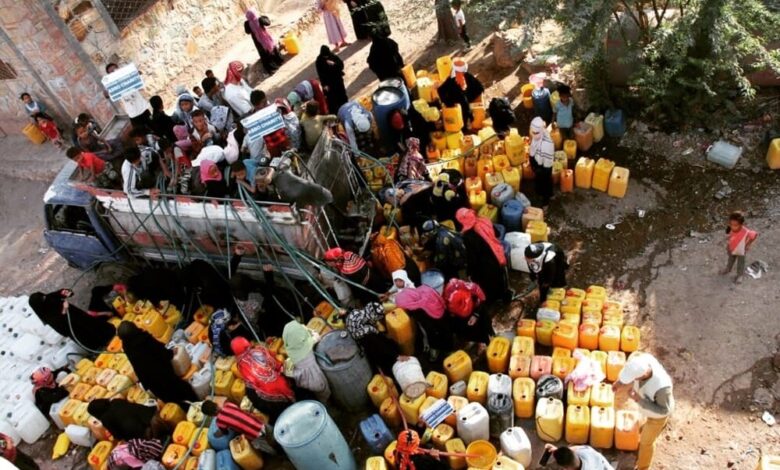
The local authority in Taiz Governorate announced on Sunday a package of urgent measures to tackle the severe water crisis that has gripped the city for years.
In an official statement issued by the Governor’s Office for Services Affairs, the authority revealed the fundamental reasons behind the crisis, which has recently worsened due to a shortage of rainfall and the drying up of wells.
The office explained that a specialized team conducted a comprehensive study of the water crisis and concluded that the most prominent reasons are the Houthi group’s continued cutting off of supplies via the Al-Hawjalah basin, which is the primary source of water for the city. This is part of the systematic blockade policy they impose on the residents of Taiz.
Other reasons cited include the scarcity of rainfall and the drying up of Al-Dhabab wells, the deterioration of infrastructure, and administrative irregularities such as weak water resource management by the Water and Sanitation Corporation, along with poor rationing and distribution.
The statement indicated that the assigned team developed a set of urgent measures to alleviate the crisis, including: stopping the filling of water tankers from the corporation’s wells, resuming pumping through the ready local network, and feeding the Al-Sabeel (free waters provided to the public as a charity) reservoirs.
The Water Corporation was also tasked with improving pumping efficiency and expanding coverage through a plan that includes repairing networks, reducing waste, and ensuring fair distribution under the supervision of a specialized committee.
Among the solutions is the establishment of five central water collection points. From these points, the network and Al-Sabeel reservoirs will be supplied, and water tankers will be filled at the official price, starting today, Sunday, June 1, 2025, at the following locations: the Corporation’s reservoir in University District – Industrial City, Sina area point, Jabal Jarrah reservoir at the Corporation’s headquarters – Sala, and Al-Maqhaya – Al-Dhabab point.
The authority also instructed the involvement of district managers in supervision and implementation, the provision of necessary supplies for plan execution, and the setting of unified prices for filling from official points or private wells at 1 Yemeni Riyal per liter (i.e., 1000 liters for 1000 Riyals, 6000 liters for 6000 Riyals).
Official prices for selling water to citizens were also set as follows: 1000 liters for 5000 Riyals, 2000 liters for 10000 Riyals, and 6000 liters for 30000 Riyals.
The statement warned against exceeding these prices, confirming that any violation would be met with deterrent measures. It also tasked the Trade and Transport offices with monitoring prices and allocated an operations room to receive complaints and reports.
The statement affirmed that there are directions to find sustainable solutions to the water crisis, most notably: completing the Al-Dhabab line project, forming a technical team to solve the problems of the Talooq project, supporting Governor Nabil Shamsan’s efforts to resume pumping from Al-Hawjalah wells, and coordinating with central authorities to activate the desalination project as a long-term strategic solution.
The statement concluded by emphasizing that these measures are “urgent and immediate” and will be continuously evaluated and developed to alleviate the suffering of residents and establish a radical and sustainable solution to the water problem in Taiz Governorate.