Yemen Monitor / Aden / Exclusive:
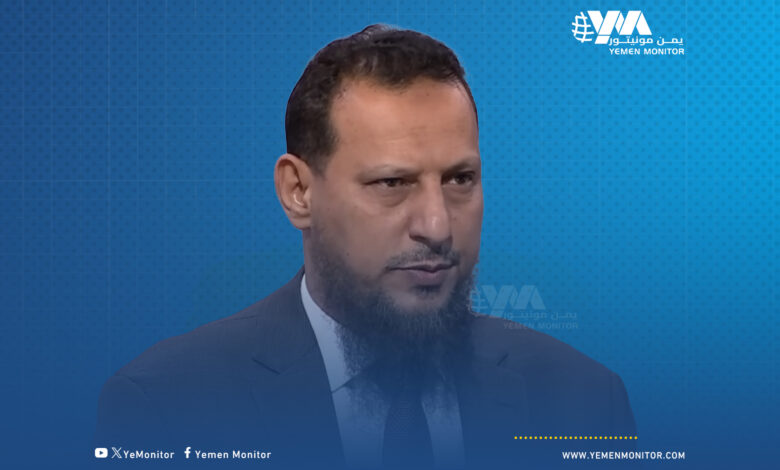
The Governor of Aden, Abdulrahman Sheikh al-Yafai, has announced the temporary capital’s full readiness to receive the Presidential Leadership Council (PLC) and the Government to exercise their official duties. He emphasized that the coming phase will witness a radical shift toward strengthening the city’s civilian character and ending all forms of security and military instability.
In an interview with Al-Hadath TV, monitored by Yemen Monitor, the new governor revealed the outlines of his urgent plan for the next three months. He stressed that stabilizing security, regulating the carrying of weapons, and improving public services represent the cornerstone of his mission to restore the civilian and economic identity of the temporary capital.
Security and De-militarization
The Governor explained that the Supreme Security Committee is in the process of approving a comprehensive plan to collect weapons and prohibit their possession except by officially licensed entities. Al-Yafai stressed the need to stop the “militarization of politics” that has damaged Aden’s economic status, affirming that his goal is to restore the city’s developmental and civilian function as Yemen’s primary economic gateway.
He added that the temporary capital has moved past a critical stage of security tensions over the past few days, thanks to the “awareness of the popular base” and the coordination of security agencies under a unified operations room. The Governor noted that the security vacuum left by the withdrawal of certain forces was filled within a few hours, praising the role of the Giants Brigade (Al-Amaliqa), the Security Belt, and Facility Protection forces in securing vital institutions.
Public Services and Infrastructure
Abdulrahman Sheikh noted that improvements in the electricity and water sectors are closely linked to the stability of roads and ensuring the safe arrival of fuel supplies from the governorates of Marib, Shabwah, and Hadramawt. He clarified that the local authority is working to increase operational efficiency and overcome past accumulations, relying on the generous support provided by “the brothers in the Kingdom of Saudi Arabia to strengthen the city’s budget and develop its dilapidated infrastructure.”
Administrative Vision: Accountability Over Politics
In a reassuring message to local officials, the Governor confirmed that he will not make any changes to leadership positions in district offices or executive bureaus based on political affiliation. Al-Yafai set a three-month period as a trial and evaluation phase for all facilities, asserting that “performance and achievement” are the only criteria for remaining in office.
The Governor summarized his priorities into three key points:
- Stabilizing Security: Prohibiting the carrying of weapons for non-licensed parties according to a plan to be approved soon.
- Improving Services: Specifically electricity, water, and telecommunications.
- Providing Resources: Noting that Aden does not just need “authorities,” but financial support and a budget that matches its status as a capital.
Status of Services and Ports
Governor Al-Yafai reassured investors, traders, and citizens that the Central Bank and government facilities are operating normally. He confirmed that all of Aden’s ports (the Caltex Container Terminal, Ma’alla Port, and the Oil Port) are working at full capacity, with the exception of the Tourist Port, which has been damaged since the 2015 war. He emphasized that Aden represents the country’s primary economic gateway and that work is underway to restore its leading role.
Regarding the service situation, Al-Yafai admitted it is difficult, describing it as “cumulative” over many years. He explained that the electricity sector suffers significantly due to its reliance on fuel coming from other governorates, making service stability dependent on road safety and the flow of supplies. He revealed that electricity is currently operating at a rate of 12 hours on versus 12 hours off under the best circumstances, but there are strenuous efforts to improve this with the arrival of new fuel shipments. He concluded by confirming that schools and hospitals are operating normally and that there is currently relative stability in the health and education sectors.