Yemen Monitor | Al-Jawf / Exclusive:
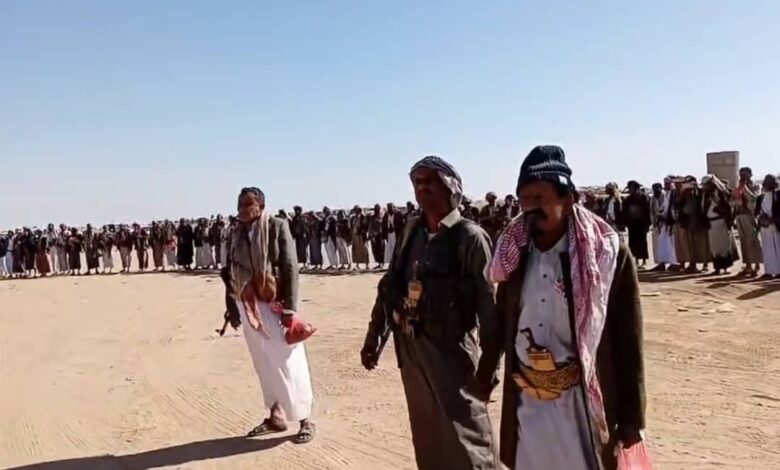
Large tribal crowds gathered in Al-Jawf governorate in response to a call by the Bani Nawf tribes, demanding justice for several of their members who have been sentenced to death by Houthi-affiliated military courts in cases the tribes described as fabricated and based on false accusations.
Participants in the gathering said the rulings were the result of clear manipulation of judicial procedures and verdicts, lacking even the most basic standards of justice and legal safeguards. They described the cases as acts of tribal and political targeting that fall within a broader policy of intimidation and elimination of opponents.
Sheikhs and elders of Al-Jawf tribes stressed their categorical rejection of the politicization of the judiciary and its use as a tool of revenge. They demanded the immediate annulment of the death sentences, the release of detainees, and a review of the cases through an independent and impartial judiciary that guarantees the right to defense and a fair trial.
Members of the tribes stationed at the protest encampments held the Houthi group fully responsible for the safety of those sentenced and of detainees held on false charges, calling for justice for tribal members and treatment that ensures their legitimate rights.
The demonstrators reaffirmed the unity of the tribal stance in Al-Jawf and vowed to continue tribal actions until justice is achieved and the oppressed are vindicated, warning of the consequences of persisting with this approach on social peace and the tribal fabric.
Earlier, the Bani Nawf tribes—one of the largest tribes in Al-Jawf governorate—had called for the establishment of tribal protest encampments in the Al-Jarr area east of Al-Hazm, the provincial capital. Tribal groups from across the governorate have continued to mobilize in response to the call in solidarity with Bani Nawf.
According to a statement issued by the protest encampments, a Houthi-controlled military court issued death sentences against Ismail Afaj and Marzouq Afaj, both members of the Bani Nawf tribes, in connection with the killing of a Houthi leader identified as Aqeel Al-Matari.
The Bani Nawf tribes asserted that the military trial was invalid and based on insufficient evidence, rejecting the verdict issued by the Houthi-controlled Third Military Region Court and the charges claiming the defendants had political motives. The statement noted that both men had turned themselves in in the hope of receiving a fair trial.
The tribes of Al-Jawf also demanded justice in the case involving Sultan Ahmed Saleh Al-Santail and Mohammed Qaed Al-Santail, who were sentenced by a Houthi military court in connection with the killing of Hail Hussein Al-Naqeeb. According to the tribal statement, the court relied on testimony from members of a Houthi military site, undermining the fairness of the trial. The tribes emphasized that the defendants had voluntarily surrendered and called for the formation of an impartial committee to review the case and ensure justice for tribal members.