Yemen Monitor / Newsroom:
Yemeni Presidential Leadership Council Chairman Rashad Mohammed Al-Alimi affirmed that the security of the Red Sea and the Gulf of Aden begins with the stability of the Yemeni state and its legitimate institutions, not through legitimizing parallel entities or unilateral actions that threaten state unity and undermine efforts to overturn the coup.
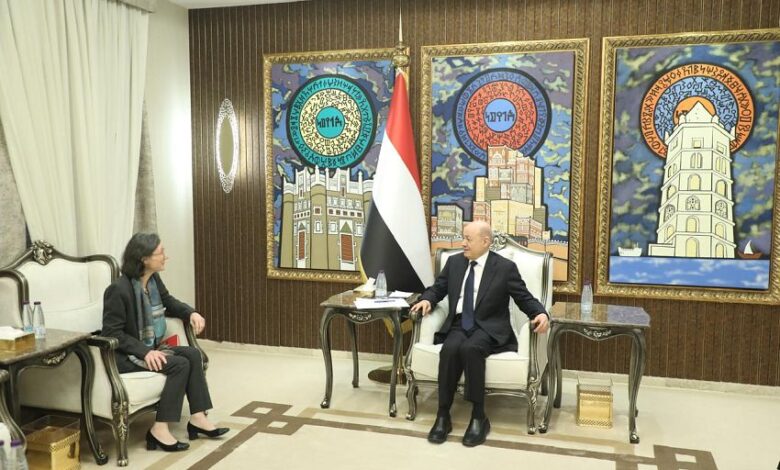
This came during his meeting on Wednesday with the French Ambassador to Yemen, Catherine Corm Kammoun, where they discussed developments in the local situation, foremost among them the developments in the eastern provinces. They also discussed the role expected of the international community in supporting de-escalation efforts led by the Kingdom of Saudi Arabia, and restoring normalcy in the Hadramawt and Al-Mahra provinces.
Al-Alimi praised the supportive French stance towards the Presidential Leadership Council, the Yemeni government, and Yemen’s unity and territorial integrity, as stated in yesterday’s UN Security Council statement. He expressed his high appreciation for the historical relations between the two countries and France’s steadfast positions alongside the Yemeni people and their political leadership in international forums.
He expressed his confidence in the continuation of this support, in line with the principles of international law and the UN Charter, pointing to the complex challenges facing national forces in their battle to overthrow the Houthi coup.
The meeting addressed the unilateral actions taken by the Southern Transitional Council (STC) outside constitutional frameworks and the mandates of the transitional phase, foremost among them the declaration of a transfer of authority and the Riyadh Agreement, warning of their serious repercussions on the national front and on efforts to restore the state and end the coup.
Al-Alimi stressed that the state will fully carry out its duty to protect its legal and constitutional standing, calling on the international community to adopt a clearer stance in supporting the legal and constitutional measures of the Yemeni state. He valued the advanced characterization of the Yemeni crisis included in the briefing by UN Secretary-General António Guterres.
He warned that any internal fragmentation would enhance the influence of extremist groups and create dangerous security vacuums along one of the most important international shipping routes, affirming that Yemen’s stability is a fundamental pillar of regional and global security.
President Al-Alimi clarified that the restraint exercised by the leadership over the past years was not a sign of weakness, but rather a national commitment to political agreements and a keenness to avoid further violence and exacerbating the suffering of the Yemeni people.
He reiterated the Presidential Leadership Council’s commitment to a just solution for the southern issue in accordance with popular will, and openness to peace, partnerships, and just political solutions. At the same time, he emphasized the absolute rejection of dismantling the state, imposing faits accomplis, or rewarding parties that have rebelled against the mandates of the transitional phase.