Yemen Monitor / Aden / Exclusive:
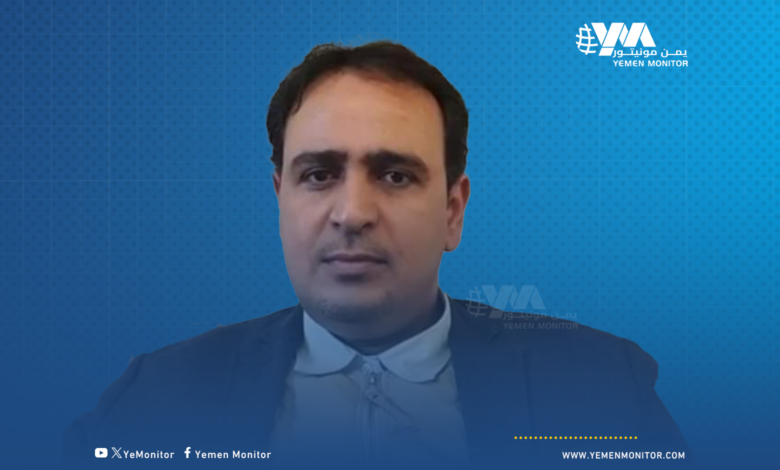
Salem bin Jadhnan Al-Nahdi, an advisor to Yemen’s Minister of Interior, described the Southern Transitional Council’s (STC) recent military and security moves in the governorates of Hadramawt and Al-Mahrah as a fully fledged “militia-style, coup-like scene.”
In an interview with Saudi television channel Al-Hadath, monitored by Yemen Monitor, Al-Nahdi said the developments in eastern Yemen amount to an open rebellion against the state and the internationally recognized government, closely mirroring the scenario of the fall of the capital Sana’a to the Houthi group in September 2014 through the use of armed force to impose a new political reality.
He revealed that detailed field reports have been received documenting a series of serious violations committed by STC-affiliated elements in the city of Seiyun in Wadi Hadramawt.
Al-Nahdi explained that these violations went beyond security abuses to include systematic attacks on sovereign state institutions, including the storming of the Interior Minister’s residence and the ministry’s building, as well as the seizure of weapons and ammunition depots, which were left in the hands of chaotic elements and individuals involved in criminal and drug-related cases.
He warned that such practices have led to a dangerous deterioration in social cohesion, triggering a sudden wave of “reverse displacement.” Hadramawt—once a safe haven for thousands of Yemenis fleeing Houthi repression in Sana’a and its outskirts—has, due to the recent escalation, turned into an area people are now fleeing. Residents and displaced families have begun leaving amid military dominance and attacks on private property and civil society organizations, raising fears of a new humanitarian and social catastrophe.
Coordination with the Houthis and “Escaping Forward”
In his political assessment, Al-Nahdi said the STC is engaging in an “escape forward” by deliberately undermining all de-escalation efforts led by Saudi Arabia as the leader of the Arab Coalition.
He argued that the STC has exhausted all available political opportunities and has now moved into a phase of open confrontation with the state, exploiting media and military tools to impose a secessionist agenda at a particularly sensitive moment for the country.
The advisor accused the STC of tacit coordination with the Houthi group, asserting that the STC’s continued strength in Aden serves as a “lifeline” for the Houthis in Sana’a. “Whenever the Houthis approach military defeat,” he said, “the STC moves to strike the legitimate government from within.”
He added that recent history shows a recurring pattern: whenever the internationally recognized government nears a military or political breakthrough against the Houthi project, the STC opens internal fronts in liberated areas, undermining stability and dispersing government efforts—making the roles of both sides complementary in weakening the Yemeni state.
Fragmentation of the Presidential Leadership Council and Erosion of Legitimacy
On the structure of power, Al-Nahdi leveled sharp criticism at the current state of the Presidential Leadership Council (PLC), describing the situation as a “constitutional coup.”
He said the alignment of PLC members—such as Faraj Al-Bahsani and Abu Zara’a Al-Muharrami—under the umbrella of the STC as “deputies” to Aidarous Al-Zubaidi constitutes a clear violation of the outcomes of the Riyadh Consultations and the Declaration of the Transfer of Power, effectively stripping the council of its consensual foundation.
Al-Nahdi warned that the continuation of this situation leaves the legitimate government besieged between “two coups”—one in the north and another in the south. He noted that the mutiny has also extended to state media institutions in Aden, which he said have begun speaking in the voice of the coup.
He stressed the need for Saudi Arabia and the international community to submit documented reports to the UN Security Council on these violations, which he said threaten the three reference frameworks and UN Security Council Resolution 2216.