Yemen Monitor / Sana’a / Exclusive:
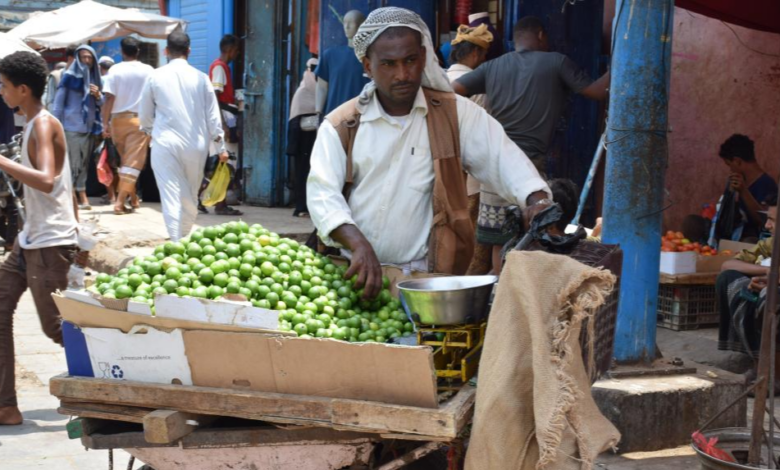
The Joint Monitoring Report on Food Security and Nutrition in Yemen (JMR), issued in November 2025, revealed a catastrophic escalation in the cost of basic food commodities in areas controlled by the Ansar Allah group (Houthis), confirming that residents there are paying prices that exceed global averages by almost more than double.
This indicator serves as evidence of deep imbalances in supply chains and the arrival of imports to the northern regions, threatening to increase the number of people vulnerable to hunger.
The report—which Yemen Monitor obtained a copy of—is issued by several UN organizations, including UNICEF, the Food and Agriculture Organization (FAO), and ACAPS.
This significant divergence between local and global prices (measured in US dollars) in Houthi-controlled areas is considered proof of “market isolation” or a major “disruption.”
More than half of Yemen’s population, or 18.1 million people (52% of the population), are expected to face Crisis levels (Integrated Food Security Phase Classification [IPC] Phase 3 or above) between September 2025 and February 2026. These figures reveal a continued deterioration, representing an increase of one million people (5.8%) compared to the May–August 2025 period.
41,000 people in Houthi-controlled areas are expected to face Catastrophe levels (IPC Phase 5), the highest classification of food insecurity. These most vulnerable pockets are concentrated in four key districts: Abs and Khushar (Hajjah), Al Ushayyah (Amran), and Az Zohrah (Al Hodeidah).
The level of food consumption remains extremely alarming, with 61% of households nationwide unable to meet their minimum food needs in September 2025. Furthermore, 42% of households nationwide resorted to severe food-based coping strategies, including reducing portion sizes (67%), reducing the number of meals (60%), and restricting adult consumption to prioritize children (50%), indicating a widespread exhaustion of coping capacities.
It is estimated that approximately 9.4 million people (27% of the population) currently live in areas at risk of sliding into Emergency levels (IPC Phase 4 and above) of food insecurity. The majority of these, about 7.3 million people, live in Houthi-controlled areas.
The report’s future outlook frameworks anticipate that the narrowing of humanitarian space in the North will exacerbate the situation. The report noted that the Houthis’ continued detention of UN and humanitarian organization staff in Sana’a and Al Hodeidah in late August and early October 2025 has disrupted operations and increased concerns regarding protection.