Between the Legends of “Dragon’s Blood” and Mysterious Rock Formations — Socotra Retains Its Title as “The World’s Strangest Island”

Yemen Monitor / Newsroom:
Socotra Island, located in the Indian Ocean about 350 kilometers off the coast of Yemen, is one of the most unusual natural destinations on Earth. Renowned for its extraordinary biodiversity, it has earned the nickname “The Galápagos of the Indian Ocean” and has held a special place on UNESCO’s World Heritage List since 2008.
According to a report by India’s Maharashtra Times, the island’s natural landscape raises questions about whether it could be described as “the home of alien beings”—not because extraterrestrials exist there, but because of its otherworldly features. Spanning 3,796 square kilometers and rising up to 1,500 meters in elevation, clouds envelop the Haggeher Mountains, while the limestone formations of the Dixam Plateau ignite visitors’ imaginations with their resemblance to alien sculptures.
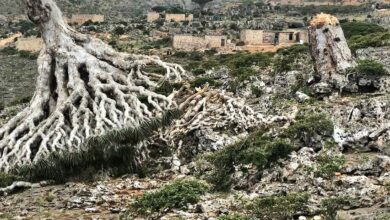
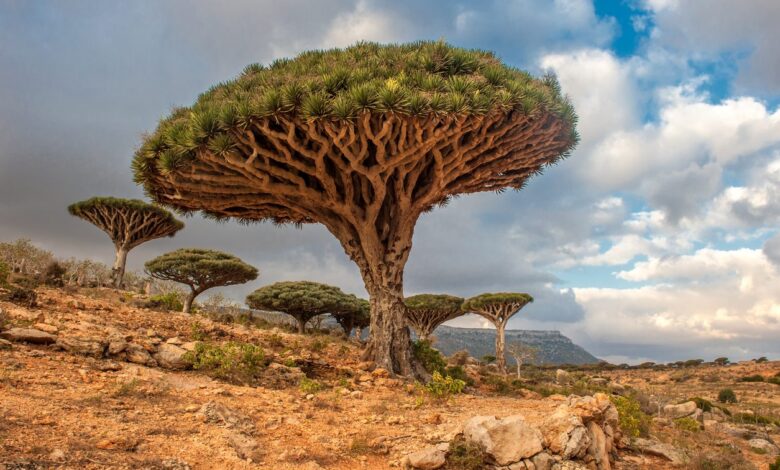
The report explained that the island’s most distinctive tree is the Dragon’s Blood Tree (Dracaena cinnabari), known for the dark red sap that oozes from its bark when cut—evoking the image of real blood. This sap has been used since ancient times in medicine, dyes, and varnishes, and was even mentioned in Egyptian mummification practices.
The tree, now a symbol of the island, has twisted branches and umbrella-shaped canopies, storing water within its trunk to survive in the harsh climate.
The paper noted that over 5,000 of these trees still exist today, but they are threatened by worsening drought and overgrazing. The island is also home to other uniquely shaped plants, such as the Desert Rose (Adenium obesum socotranum), which resembles a bottle with its thick stem, and the Cucumber Tree (Dendrosicyos socotranus), the world’s only cucumber species that grows as a tree—an adaptation that helps it retain moisture in the arid environment.
In terms of wildlife, the report highlighted that 90% of Socotra’s reptiles are endemic, including the Socotra chameleon (Chameleon monachus), which changes color to blend with its surroundings. New species of geckos and lizards have also been discovered, while 98% of the island’s land snails exist nowhere else on Earth. Endemic insects include the Emperor butterfly, the Socotra butterfly, and the dragonfly, and the island serves as a bird sanctuary thanks to the clear Detwah Lagoon.
The newspaper affirmed that Socotra’s biodiversity is astonishing: 37% of its plants, 90% of its reptiles, and 95% of its snails are found only there. While the island has not been identified as a source of extraterrestrial life, its extraordinary natural features resemble another world—making it a destination for scientists, researchers, and lovers of nature and exploration.
The report concluded by emphasizing that the information was presented for educational and cultural purposes, noting that the newspaper does not bear responsibility for the accuracy of the data—but aims to highlight the beauty of the Earth and its incredible natural wonders.