Yemen Monitor/ Newsroom:
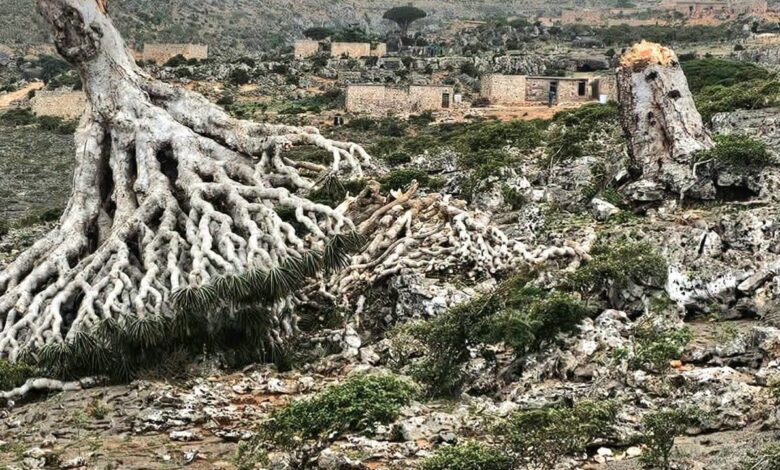
An activist interested in environmental affairs in the Socotra Archipelago, Abdullah Badahen, said that a giant “Dragon’s Blood” tree fell a few days ago in the Diksam area in the center of the island, estimating that its age exceeded five centuries, in an incident he described as an extension of the increasing cases of death and fall of this rare species during recent years.
Badahen added, in a post on his Facebook page, that the fall of the tree “was not a surprise to those who follow the environmental reality in Socotra”, pointing out that the incidents being documented usually occur near public roads, while mountainous areas, valleys, and plateaus far from view witness the fall of other trees “in larger numbers without being documented.”
He indicated that the Socotra Archipelago, listed on the UNESCO World Heritage list, faces what he described as a “state of environmental neglect”, considering that national authorities and concerned international organizations have not taken sufficient measures to protect the unique trees for which the island is famous.
The activist noted that during field inspections of some trees that fell or suffered sudden death, an infestation of insects was observed on the trunks and inside the trees, which raises questions about the causes of the phenomenon, and whether it is linked to new pests, climate change, or human factors, stressing that the absence of scientific studies prevents reaching an accurate explanation.
Badahen called for executing urgent field studies to determine the causes of the death and fall of “Dragon’s Blood” trees, and to identify the nature of the insects that appeared on them, in addition to preparing a protection plan for the remaining sites, and establishing protected agricultural spaces to contribute to preserving this rare species and compensating for part of the lost trees.
The “Dragon’s Blood” tree is considered one of the most prominent natural symbols in the Socotra Archipelago, and is characterized by its slow growth, which makes the loss of any perennial tree from it an environmental loss that is difficult to compensate for.