Yemen Monitor/Reports Unit/Exclusive:
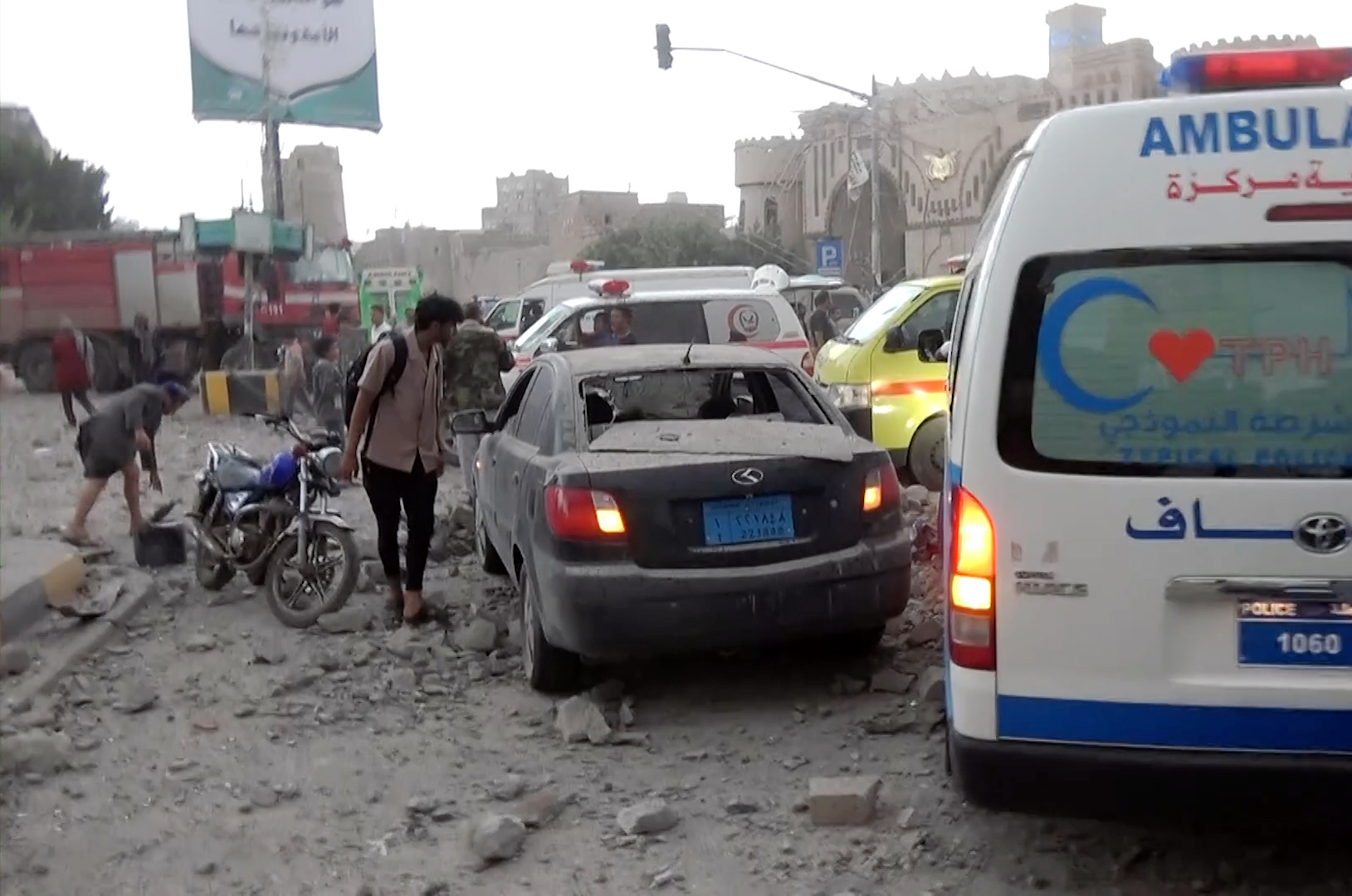
As Friday dawned, the voices of rescue teams still echoed through the alleys of the Al-Tahrir neighborhood in the heart of Sanaa. Residents, along with civil defense teams, continued to clear rubble in search of potential survivors. According to Houthi health officials, the death toll from the Israeli attack on Sanaa and Al-Jawf governorate has risen to 46 dead and 165 wounded.
A spokesman for the Houthi-affiliated Ministry of Health said on Friday morning that the victims include five children and 11 women, while 31 children and 29 women sustained various injuries. He noted that the “toll is not final” as rescue operations continue, while sources in the civil defense mentioned that “entire families are still under the rubble.”

35 Hours of Searching: Hope Fades as Casualties Mount
Two sources confirmed to “Yemen Monitor” that the number of dead and wounded from the September 26th newspaper (the Houthi-controlled army newspaper) has risen to 26 journalists and employees. The newspaper and its printing press were directly targeted.
Yemeni journalists have been posting continuous condolences for their deceased colleagues on social media, while the fate of others remains unknown as of Friday morning.
A senior civil defense official told “Yemen Monitor” that, in addition to the employees of the Houthi-controlled Moral Guidance Department, “entire families are still under the rubble in Al-Tahrir neighborhood, and some families were completely killed in the Israeli aggression.”
Two workers at the attack site said they were able to pull out “children and women unharmed 24 hours after the attack.”
Despite more than 35 hours having passed since the strike, civil defense officials said that “hopes are slim of finding new survivors,” but they emphasized that teams are still working day and night with the help of volunteers from the neighborhood’s residents.
Testimonies from the Heart of the Tragedy
Hilmi Mohammed, a resident of the neighborhood and a member of the rescue teams, said he had only slept for two to three hours since the attack and continues to clear rubble and help ambulance teams.
He added, “A complete massacre was committed by the Zionists.”
Mohammed noted that most of the neighborhood’s residents do not get along with the Houthis or their corrupt authority, but “at the moment, revenge is necessary. The people’s anger and fury must turn into revenge, or they will pay the price.”
Earlier on Thursday, the Israeli occupation army announced the interception of a missile and a drone launched from Yemen, operations for which the Houthis later claimed responsibility.
For her part, Samia Murad, a survivor of the bombing, recounted the details of the first moments of the attack, saying, “It was doomsday. We were watching the national team’s match before the rubble suddenly fell on us. We were stuck in the dust and screams until someone came and rescued us.”
She added to “Yemen Monitor” that her family’s house was severely damaged but did not completely collapse. Her sister and two younger brothers suffered moderate injuries, while she was injured in her hand from falling furniture.
She said she “still feels the Israelis” will return to kill her, despite her and her family having moved to her married sister’s house on the outskirts of the capital.

Media Blackout and Confiscation of Documentation
“The Houthis were not up to the event,” said Ahmed Masoud, a community leader in the Al-Tahrir district who is in contact with the movement. He added, “They prevented the documentation of the crime,” angrily questioning, “Why did they prevent people from filming a war crime and the bombing of civilians and a civilian institution?”
The Houthis arrested at least five citizens in the first hour of the Israeli bombing who were close to the scene and filmed “the crime with their phones,” according to eyewitnesses who spoke to “Yemen Monitor.”
Meanwhile, supporters of the group said they “do not understand this policy of a media blackout,” emphasizing that “people’s documentation of a war crime as it happens is more credible and important than filming a later narrative.”
Despite the Houthi media blackout, videos and photos of the crime scene spread on social media, although they do not convey “the full scale of the tragedy.”
As public anger intensifies in Sanaa and Al-Jawf, the scene remains open to further humanitarian disaster with the continuation of search and rescue operations. Residents of the affected neighborhoods fear the collapse of other homes that have been cracked by the strikes, while a state of panic and fear of renewed attacks prevails.