Yemen Monitor / Analysis Unit / Exclusive:
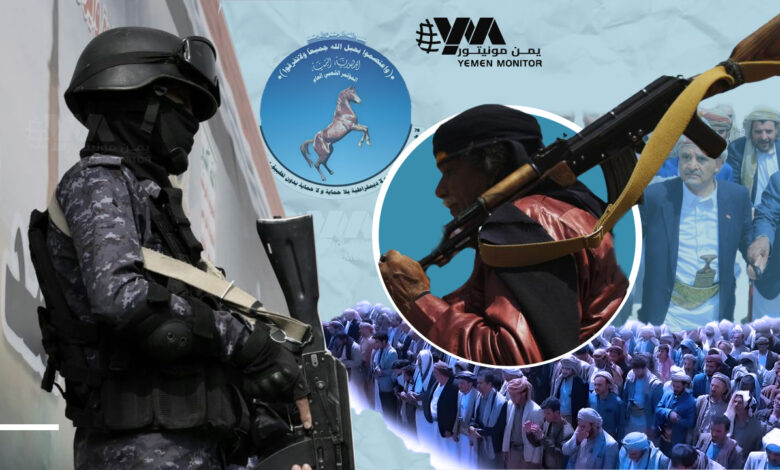
Recent developments in areas under Houthi control reveal a critical escalation of tension between the Houthis on one side, and the General People’s Congress (GPC) Party and Yemeni tribes on the other. This tension is not just a passing dispute; it represents a dangerous turning point that threatens the stability of the “domestic front,” which the group considers the cornerstone of its strategy to remain in power. It is the most serious challenge the Houthis have faced since the 2017 uprising led by their ally, former President Ali Abdullah Saleh, which ended with his death.
On July 31, 2025, Houthi leader Abdul-Malik al-Houthi addressed this tension with a stern warning “to anyone who dares stand with the Israeli enemy among the tools of treachery, betrayal, and criminality,” stressing that their position would be “firm and decisive against those tools.” Group officials spoke of intelligence reports about a “US/Israeli plan funded by Saudi Arabia and the UAE” to destabilize the domestic front through “local tools supported from abroad, operating under partisan and social banners that outwardly appear to serve citizens’ interests—through protest, expression, and political activities—but are in reality conspiratorial and treasonous, serving the Zionists.”
On August 15, Houthi leader Hezam al-Asad confirmed that “our internal front is a red line,” and that we “are not all infallible or perfect,” but we understand our country’s situation and that “the external enemy is still besieging our people, looting their wealth, doubling their suffering, using mercenaries to harm them, and conspiring with the Zionist and US enemy to target them again with the aim of stopping the support for Gaza.”
On August 2, al-Asad explained that “this venture is not speculation, but a plan being activated now, intended to begin gradually starting this August, which coincides with the anniversary of the founding of the GPC Party, continuing through next September (the September 26 Revolution), and into next December, which in 2017 witnessed the turmoil and assassination of former President Ali Abdullah Saleh.”
Al-Asad argued that “the instruments of conspiracy are using the anniversary of the party’s founding as a launch point to inflame and mobilize the Yemeni street, along with elements tied to the remnants of Saleh’s project, raising slogans that exploit economic hardship as civil demands. In reality, however, they are an intelligence arm serving Israeli projects, aiming to trigger internal public unrest, followed by external military action against Ansar Allah and Sana’a’s stance in support of the resistance in Gaza.”
Sources of Concern
The Houthi threats were not sudden; they are a result of several triggers. The movement feels great anxiety that its position and existence are being harmed by its current international isolation since the beginning of the year and by the messages it receives from the GPC and its tribal gatherings.
The tension between the Houthis and the General People’s Congress likely stemmed from two main events:
First, a documentary film titled “The Last Battle” about the late President Ali Saleh was broadcast on Al-Arabiya TV. The film narrated the story of his killing at the hands of the Houthis in an armed ambush outside Sana’a in 2017. This coincided with the appearance of Saleh’s son, Madian, as a witness in the film, and it was close to the anniversary of the founding of the GPC Party (August 24). The Houthis believe this signals regional arrangements “to re-change the Yemeni scene by introducing elements and symbols who enjoy influence and acceptance in the Yemeni street and in the center of power in Sana’a, including the army, security, tribes, and partisan forces.”
Second, a Houthi military court issued a decision to execute Ahmed Ali Abdullah Saleh, Saleh’s eldest son and the deputy head of the GPC Party in Sana’a. This decision was surprising to party members and other Houthi allies, as it is seen as a political decision par excellence, aimed at permanently removing Ahmed Ali from the scene. Although he has maintained his silence and distance from political and military life since 2015, his recent movements, which included meetings with politicians and officials in Abu Dhabi and Cairo, have raised the group’s concern.

Forming a Counter-Front: From Exile to Sana’a
Amid Houthi restrictions, factions loyal to the GPC and tribal leaders have begun using social occasions as platforms to express defiance and revive alliances. Though civil in nature, these events carried deep political significance, revealing new power dynamics in the Yemeni landscape, as outlined below:
The Cairo Wedding:
The wedding of Sakhr, son of Ali Abdullah Saleh, in Cairo turned into a major political gathering that brought together hundreds of politicians and military figures. The attendance was striking, as it marked the first time in years that Ahmed Ali Abdullah Saleh and Tareq Saleh appeared together, alongside prominent members of the Presidential Leadership Council. Most symbolically, General Hashim bin Abdullah al-Ahmar, brother of the paramount sheikh of Hashid, appeared alongside Tareq Saleh, and also met with Ahmed Ali Abdullah Saleh.
The Houthis considered this gathering a “show of strength” and the possible formation of a new alliance. The meeting of Ali Abdullah Saleh’s sons with the sons of the paramount Hashid sheikh—bitter rivals since 2011—reflects a unification of ranks against a common enemy. For this reason, the gathering was more than just a family event; it was a demonstration of power and a confirmation of alliance-building. Abdu al-Janadi, spokesman for the GPC in Sana’a, said: “It is a political demonstration.” He added: “The GPC cannot heed the barking voices seeking power today through parties and celebrations, while Gaza is facing a real tragedy.”
The Funeral of Sheikh Zaid Abu Ali: A Symbol of Implicit Popular Referendum
Inside Yemen, the situation mirrored the mobilization abroad. The funeral of prominent tribal sheikh and GPC Standing Committee member Zaid Abu Ali, on July 17, 2025, revealed the depth of accumulated popular resentment. The funeral drew an unprecedented turnout of hundreds from various governorates and most of the country’s tribal leaders.
Unlike previous gatherings, members of the GPC and tribal sheikhs openly spoke during the condolence ceremonies, in an unusually candid tone, declaring that “Houthis are the imamate,” and that party members loyal to the Houthis were “returning to the embrace of the GPC and the tribe,” according to tribal leaders and attendees at the large funeral held in al-Tawaila district of al-Mahwit, as reported to Yemen Monitor.
Houthi Counter-Strategy: Repression and Conspiracy Rhetoric
In response to these multiple challenges, the Houthi group has resorted to a dual strategy that combines direct repression and military deterrence with a media discourse aimed at justifying these measures and unifying their ranks.
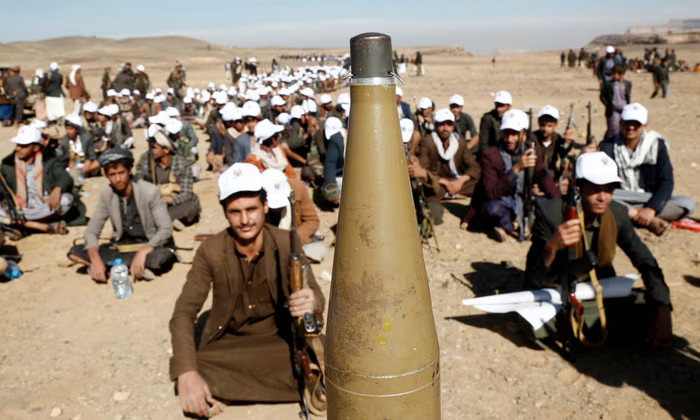
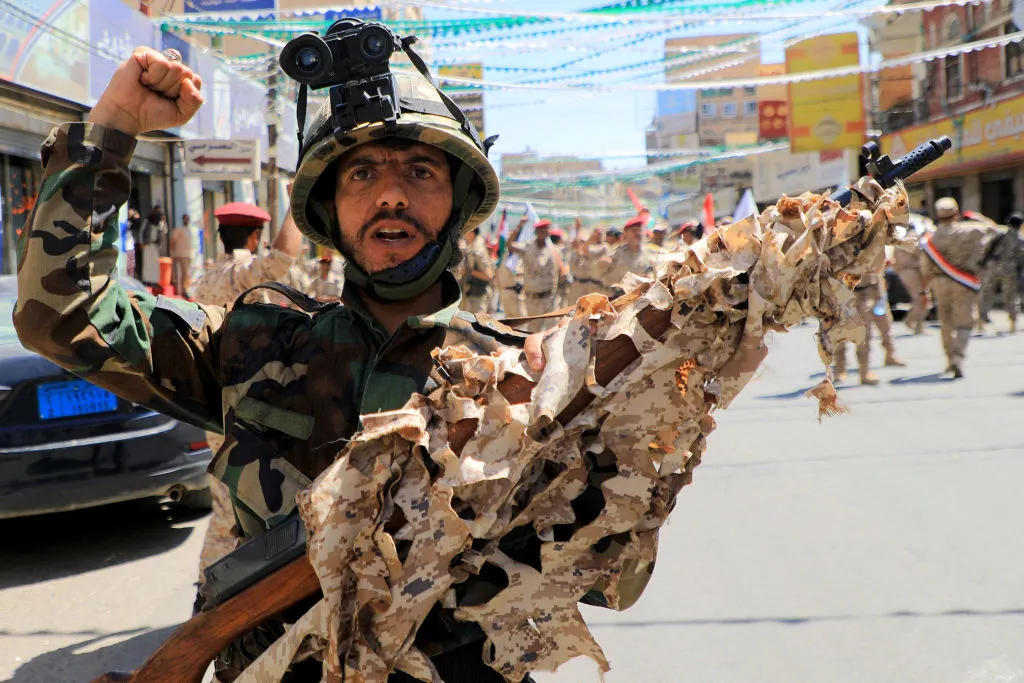
Military Parade in Front of Al-Ahmar’s House: In a move that seemed like a direct response to external and internal threats, the Houthis on August 13 organized a provocative military parade in front of the house of Sheikh Hemyar al-Ahmar, the sheikh of the Hashid tribes (brother of Hashim), in a veiled threat against his movements.
This coincided with a major campaign by Houthi officials on social media against Sheikh Hamyar al-Ahmar. Osama Sari, a prominent Houthi media official, posted a picture of al-Ahmar and called him “an idiot,” saying that he “decided to get involved cheaply in the ranks of betrayal and direct collaboration with the Israeli enemy to implement the enemy’s plot to target the internal front.”
This also coincided with a large show of force with a military parade by special security forces in the Houthi stronghold of Saada governorate.
Storming a GPC Meeting and Seizing Funds: On August 2, 2025, the Houthis stormed a meeting of the General People’s Congress’s permanent committee in Sana’a, forcibly dispersing a meeting that was being planned for the party’s founding anniversary celebrations later this month.
In addition, sources told “Yemen Monitor” that the Houthis conducted comprehensive surveys of the GPC’s properties, including the permanent committee and a number of buildings in Sana’a, in preparation for their acquisition through a judicial ruling.
“The US/Israeli Plot”: Houthi leaders resorted to employing the discourse of an external conspiracy to justify their repressive measures. Dozens of members of the GPC and Islah parties were arrested in governorates under Houthi control, and high surveillance measures were imposed on the leaders of the Congress and tribal sheikhs.
Hezam al-Asad, a Houthi leader, and other leaders in the movement said that there is “a US/Israeli plot funded by Saudi Arabia and the UAE” to destabilize the internal front, through “local tools” operating under partisan and demanding slogans.
This rhetoric serves several goals: First, it links any internal opposition or popular movement to external conspiracies, describing it as treason in service of the “Zionists,” which justifies repression and arrests under the guise of defending the homeland.
Second, it diverts attention from the group’s internal failures, such as corruption, mismanagement, and the economic crisis suffered by citizens.
Third, it strengthens the group’s position as the sole protector of national sovereignty in the face of “aggression.” This rhetoric has become an essential tool for the Houthis to secure their grip on power and unify their popular base behind the slogan of “supporting Gaza,” which has become a pretext for rejecting any internal opposition.
The Strategic Paradox
Recent events indicate that the “disintegration of the internal front” for the Houthis is no longer just a narrative; it has become a real and existential threat. The emergence of a unified opposition fronts abroad, combining factions of the GPC and tribes led by the sons of Saleh and al-Ahmar, represents the most dangerous challenge since the 2017 uprising. This front draws its legitimacy from Saleh’s legacy, which remains alive in popular memory, and from the growing public discontent in Houthi-controlled areas due to corruption, governance failure, and the end of services and taxes.
The threat is not purely military; it is also political and symbolic, as the internally-formed “front”—if we can call it that—works to exploit the gaps left by the Houthis, whether in the political sphere (the General People’s Congress) or the social one (the tribes).
The paradox lies in the fact that the Houthi measures, which aim to eliminate the emergence of this “front” and prevent its development, may be the main reason for accelerating its unification. Decisions such as the execution ruling against Ahmed Ali Saleh, the show of force in front of Sheikh Hamyar al-Ahmar’s house, and the widespread arrest campaign will not succeed in intimidating opponents; they might even push the hesitant into the arms of this “front.” The Houthis’ actions eliminate any chance for political work or cooperation from within and force the “front” to take a more hardline stance.