Yemen Monitor / Reports Unit / Exclusive:
On June 6, the Houthis ended a nearly seven-month pause in attacks on commercial vessels in the Red Sea with a strike on two cargo ships. One was sunk in Sunday’s attack, and four were killed in an assault on a second ship the next day, raising the death toll from recent Houthi attacks on ships to eight.
The renewed strikes suggest a potentially sustained Houthi campaign, increasing risks to maritime security, raising shipping costs, and reviving the specter of renewed U.S./Western military intervention—further destabilizing an already volatile region.
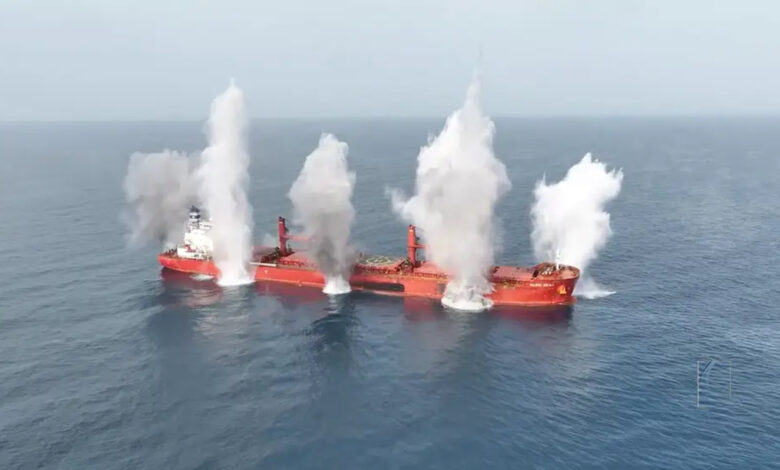
The Houthis attacked the Magic Seas, a Liberian-flagged, Greek-owned cargo vessel, on Sunday using drones, missiles, rocket-propelled grenades, and small arms fire, forcing its 22-member crew to abandon the ship. The Houthis later announced that the ship sank in the Red Sea along with its cargo of fertilizers and steel bars bound for Turkey.
Footage from aboard the Magic Seas captured the moments after the Houthi assault earlier this week—alarm sirens blaring as crew members donned life vests and evacuated the bridge, shattered glass from the windows scattered across navigation equipment. On Tuesday, the Houthis released photos appearing to show a team boarding the vessel after the crew had left and detonating explosives onboard.
Another attack occurred Monday night, targeting the Eternity C, a Greek bulk carrier. The EU naval mission in the area said the Houthis fired rocket-propelled grenades from speedboats and dropped explosives from drones, killing three crew members, with a fourth dying from injuries sustained in the assault.
The Houthis did not immediately claim responsibility for the Eternity C attack. However, Yemen’s internationally recognized government and the EU naval force accused the group of carrying it out. The Houthis often delay claiming responsibility by hours or days.
The EU force reported the casualties, noting that one wounded crew member lost a leg in the attack. The remaining crew remains stranded aboard the ship, which is now adrift in the Red Sea.

The Houthis are still around the ship!
Ellie Shafee, Head of Intelligence at maritime risk management firm Vanguard Risk Solutions, confirmed that the situation on Tuesday remained unsafe, noting that Houthi boats continue to circle the ship, making intervention, assistance, and evacuation of the crew very difficult.
In a statement, a Houthi military spokesperson said they attacked to prevent any ship dealing with the “Israeli enemy.” These attacks are part of an ongoing campaign carried out by the Houthis in response to Israel’s war on Gaza. They have targeted over 100 commercial vessels with missiles and drones.
These two attacks are the Houthis’ first on ships since November 2024, and they could signal the start of a new campaign threatening the waterway, which had begun to see more ships passing through in recent weeks due to the truce between the Houthis and the US.
After the Eternity C was attacked, Liberia’s delegation to the United Nations expressed its outrage, describing the attacks as “absolutely unacceptable, unjustified, and irrational” for targeting ships for political reasons.
Table 1: Major Houthi Attacks on Commercial Ships (July 2025)
| Ship Name | Date of Attack | Flag/Ownership | Attack Methods | Results | Houthi Justification |
| MV Magic Seas | 07/06/2025 | Liberia/Greek | Drones, missiles, explosive boats, small arms | Damaged, crew abandoned, Houthis declared it sunk, crew rescued | Previously docked in Israel |
| MV Eternity C | 07/07/2025 | Liberia/Greek | Naval drones, speedboats, bomb-carrying drones, small boats | 4 dead, crew trapped and besieged, drifting | Implied connection with Israel |
Houthi Messages
Experts believe that these attacks could be a message from the Houthis, affirming their ability to target maritime navigation regardless of diplomatic developments. Some also see them as aiming to push for a broader truce in Gaza and to assert the Houthis’ role as a leading force in the “Axis of Resistance” against Israel and the West. These attacks indicate the potential start of a new campaign that threatens the vital waterway.
Mohammed Al-Basha, founder of Basha Report (a Virginia-based risk consulting firm), believes in an interview with “NPR” that the attacks coincided with Israeli Prime Minister Benjamin Netanyahu’s visit to the White House. Al-Basha suggests that the Houthis are seeking to use this moment to send a calculated message to encourage both the Israelis and the US administration to push for a broader truce with Gaza to solidify talks.
Al-Basha adds that with militias like Hezbollah significantly weakened by the war with Israel in Lebanon and Gaza, Houthi attacks on ships also aim to send a message that they have now become the leading militia against Israel and the West in the region.
This reinforces their emerging role as the vanguard of the Axis of Resistance. Al-Basha suggests that as long as the war in Gaza continues, attacks in the Red Sea are likely to persist.
Table 2: The US-Houthi Truce: Conflicting Interpretations and Actions
| Side | Declared US Interpretation | Declared Houthi Interpretation | Houthi Actions During Truce (Before July 2025) |
| Red Sea Shipping (Non-Israel-linked) | Cessation of attacks | Continuation of attacks (except US ships only) | Relative calm until July 2025 |
| US Ships | No targeting | No targeting | No targeting |
| Israel-linked Ships | Implicit cessation | Continuation of attacks | Continuation of attacks on Israel itself |
| Overall Declared Stance | Houthis “surrendered” | US “backed down” | Continued support for Gaza |
Has the Truce Ended?
The two attacks and a round of Israeli airstrikes early Monday morning targeting Hudaidah have raised concerns about a renewed Houthi campaign against shipping, which could once again draw in US and Western forces. This is especially true after the administration of US President Donald Trump targeted the Houthis in a major airstrike campaign between March and mid-May, leading to an agreement for the Houthis to halt shipping attacks in exchange for a cessation of US airstrikes. However, the Houthis stated that this agreement did not include attacking Israel or its ships.
The recent attacks on the ships Magic Seas and Eternity C on July 6 and 7 show that they were not necessarily a breach of an existing truce and are subject to interpretation by both sides, as the Houthis believe they did not attack US ships. Nevertheless, the U.S. has not yet deemed these attacks a violation, even though the Magic Seas had no clear and direct connection to Israel, which contradicts the Houthis’ justification for their attacks.
The US Embassy in Yemen described the attack on the Eternity C as “the Houthis’ most violent attack to date” and stated that they “once again show blatant disregard for human life, undermine freedom of navigation in the Red Sea, defy Security Council resolutions, and threaten regional stability.”
The May 2025 truce, which was largely a tactical pause, has proven unsustainable in its broader application to commercial shipping, due to the Houthis’ unwavering commitment to their strategic use of the Red Sea as leverage. A major attack resulting in a large number of casualties or the sinking of a major vessel could lead to a more robust and sustained military response from the U.S. and its allies, potentially leading to a wider regional conflict.