Houthi Priorities Exposed: Has Yemen Become a Shield for Iran in War?
By/ Abdullah Abdulmalik

Yemen Monitor/Analysis Unit:
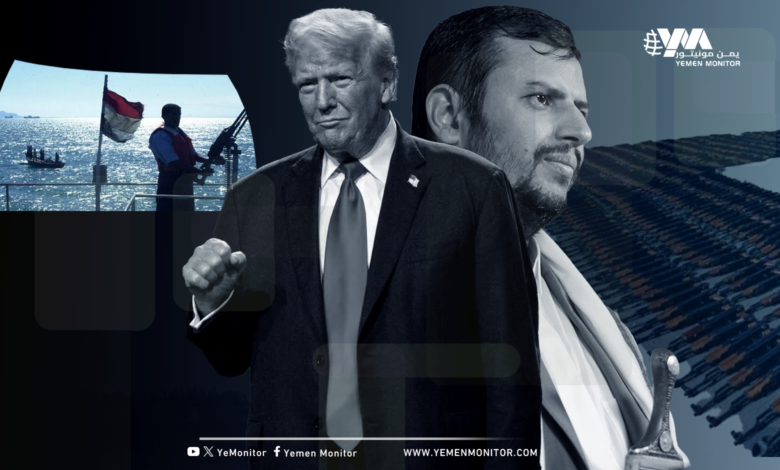
The Houthis in Yemen pledged on Saturday to resume attacks on US ships if American forces join Israel’s war on Iran. This marks the first time the Yemeni movement has announced operations in solidarity with Iran. In the past, they had limited their statements to their naval operations being in solidarity with the Gaza Strip or for self-defense.
The Houthis stated, “Should the Americans get involved in the attack and aggression against Iran alongside the Israeli enemy, our armed forces will target their ships and warships in the Red Sea.”
Last month, US President Donald Trump stated that the Iran-backed Houthis had “surrendered” and that America would halt strikes on the rebels after they agreed to stop attacking ships in the Red Sea. This was a major US operation called “Operation Rough Guardian,” which began in mid-March and concluded in early May.
However, escalating regional tensions appear to signal a return to war and potentially larger, more powerful strikes on Yemen. Following Israeli strikes on Iran on June 13, the Houthis declared their support for Tehran, sparking widespread anger among Yemenis. Many Yemenis believe the group is once again trying to drag the country into new wars, with the Yemeni people bearing the cost. On June 15, the Houthis announced launching an operation with several ballistic missiles against Israel in coordination with the Iranian army. This was the first such announcement regarding the increasing relationship between the two parties. This claim came hours after the capital Sana’a was subjected to Israeli strikes targeting Houthi leaders, including the group’s Chief of Staff, Mohammed Abdul Karim Al-Ghamari, amidst a blackout on the operation’s results.
This development reveals a new phase of the war, entering into new conflicts far removed from the movement’s main claims of defending and adopting the Palestinian cause, which usually garnered widespread local support. However, standing with Iran in this war and dragging the country into a new situation might not gain any popularity and contradicts the Houthi denial that they are not Iranian proxies in the region.
A Critical Necessity
However, the situation appears more complex for the Houthis. A senior Houthi official in Sana’a told Yemen Monitor that “the decision to resume military operations in the Red Sea was difficult, as we are well aware of the heavy price we will pay from U.S. strikes if we do. But if the regime in Iran collapses or is weakened, we will be the next target.” He added, “We will play our card of closing the Bab al-Mandab Strait before it’s lost.”
The relationship between the Houthis and Iran has significantly evolved over the years—from limited support to a strategic alliance within the so-called “Axis of Resistance.” Since October 7, 2023, the Houthis have positioned themselves as a major regional force, shifting their focus from local concerns to increasingly regional ambitions. With much of the Axis of Resistance in Lebanon and Iraq weakened—including Iran’s primary proxy, Hezbollah—and the collapse of Bashar al-Assad’s regime in Syria with the rise of Syrian revolutionaries, Iran appears to have turned inward and grown weaker.
The Houthis’ latest announcement reveals the evolving nature of Iranian sponsorship, transitioning from covert support to strategic entanglement. The relationship has grown from secret arms shipments to a more overt “strategic alliance,” where Houthi actions—such as Red Sea attacks—directly serve Iran’s “forward defense” strategy. This shift signals deeper operational and technical integration, moving beyond mere arms provision to a shared destiny that threatens both the Houthis and Iran.
This alliance reflects mutual dependence: Iran sees the Houthis as a strategic asset for projecting power and pressuring adversaries, while the Houthis rely on Iran for advanced weaponry. It also allows Iran to distribute risk, engaging in indirect confrontations with plausible deniability—though that advantage is increasingly eroding amid recent developments. This means that any major disruption to Iran’s capabilities, as seen in Israeli strikes, will inevitably impact the Houthis. Yet, the deeply rooted operational ties and mutual reliance make the relationship hard to sever. The Houthis may adapt by increasing local production or diversifying their networks, but the strategic alignment remains intact.
An Armament Crisis?!
The Houthis possess a large military arsenal, and experts confirm that their capabilities “remain intact, with local production and diversified smuggling routes from China, Latin America, and Russia to the Horn of Africa.” They also maintain security ties with Shiite militias in Iraq and the al-Shabaab movement in Somalia, as well as established diplomatic relations with Russia and China.
Nevertheless, their capabilities are expected to be indirectly affected by the Israeli strikes on Iran. These strikes have caused significant damage to Iranian missile storage facilities—most notably the destruction of multiple buildings at a major Islamic Revolutionary Guard Corps (IRGC) missile base in Kermanshah, which served as a hub for storing missiles destined for Iranian proxies. This indicates that the Houthis may have to rely more heavily on their existing supply chains to carry out Red Sea attacks, and uncertainty looms over the future sources of missile shipments.
To address this, the Houthi official stated that the group has explored alternative channels for acquiring weapons in case Iran is unable to supply them further. “But certainly,” he said, “efforts toward boosting local production will increase, with the possibility of securing spare parts and essential materials through new routes that reduce dependency on Iran—including the production of new air defense weapons.”
A Shared Fate
Beyond claims of supporting the Palestinian cause to gain local and Arab backing, the Houthis are presenting themselves as an Iranian tool to close the Bab al-Mandab Strait. This is a crucial element in building an unassailable image as a regional power and the crown jewel of the “Axis of Resistance.” However, this new intervention will unleash a Pandora’s box of evils upon the Republic of Yemen and the wider region.
As usual, Yemen will pay a heavy price, despite the already unbearable suffering of citizens in Houthi-controlled areas.