Yemen Monitor/Associated Press/Exclusive:
The humanitarian crisis in Yemen’s displacement camps has deepened after the World Food Programme (WFP) halted food shipments and suspended distribution, affecting nearly every aspect of displaced people’s lives — including living and health conditions. The impact extends beyond Houthi-controlled areas to territories governed by the internationally recognized government.
The UN suspended food assistance in Houthi-controlled areas following the looting of one of its warehouses, resulting in an estimated loss of $2 million in aid — the latest in a series of confrontations between the Houthis and the United Nations.
In recent months, the Houthis have detained dozens of UN employees and individuals linked to aid agencies and civil society organizations in Sana’a.
UN agencies had already suspended operations in the Houthi stronghold of Saada in February after the arrest of seven WFP employees and another UN staffer, one of whom later died in custody.
While limited operations have continued in other Houthi-held areas, the suspension has dealt another blow to the war-torn country, where hunger is steadily rising.
The WFP also provides food assistance to around 1.6 million people in southern Yemen — areas controlled by the internationally recognized government and its allies.
However, the agency says this aid is also under threat due to the U.S. decision to cut funding for its emergency programs in Yemen.
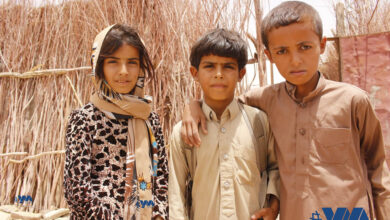
Approximately 2,000 displaced families reside in Al-Suwaida Camp — Yemen’s second-largest displacement camp — in Marib province, located about 120 kilometers east of the capital, Sana’a.
According to an October 2022 survey by the Camp Coordination and Camp Management Cluster, the camp then hosted 1,645 displaced families, comprising 8,772 individuals.
The region hosts nearly 60% of the country’s war-displaced population, according to Khaled Al-Shujani, assistant director of the Displacement Unit in Marib province, as reported by the Associated Press.
He added that thousands of people in the area are at risk of hunger as they depend on aid to meet their daily food and medical needs.
Museda Hadi, a displaced woman in Al-Suwaida camp, urged the WFP to resume distributions so she can feed her children.
“We can’t afford flour, sugar, or oil — not even a single egg, which now costs 500 riyals. Where can we get it from? We have no farmland and no water well,” she said.
Al-Shujani stated that the situation worsened further after former U.S. President Donald Trump’s administration cut humanitarian aid.
“The latest blow was the U.S. decision to halt many life-saving humanitarian activities and projects, whether in the health sector or in water and sanitation,” he added.