Yemen Monitor/Analysis Unit/Exclusive:
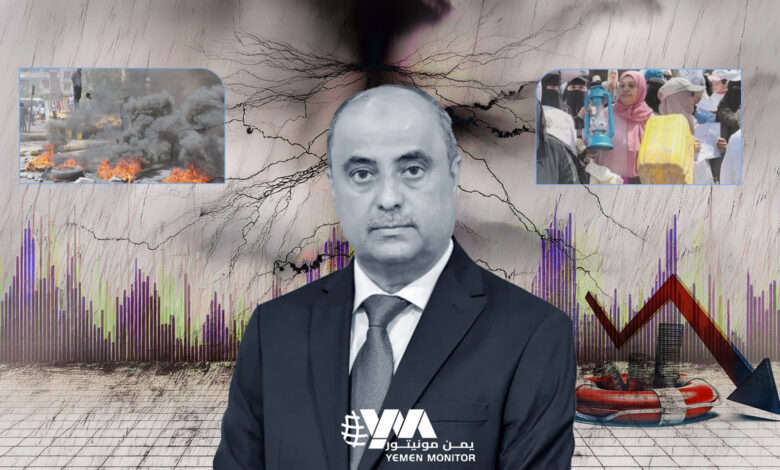
Yemeni Prime Minister Salem bin Brik arrived in the capital, Aden, on Sunday, accompanied by the head of the Presidential Leadership Council, Rashad al-Alimi. This marks his first visit to the country since his appointment, coming at a time when his government is confronting a storm of economic and political problems and challenges.
On Saturday, women’s demonstrations erupted in Aden and Taiz, demanding electricity, water, anti-corruption measures, and the payment and increase of salaries amid the collapse of the national currency’s value. This reflects growing public dissatisfaction in areas controlled by the legitimate government, as living conditions in the country continue to deteriorate.
Bin Brik had stated in mid-May that he would not return to Aden “without a real breakthrough in financial support and pending issues.” However, he has returned without details regarding the promises of support he may have received.
A source from the Presidential Office stated that Rashad al-Alimi held meetings with the government presidency, local authority leaders, and relevant parties to share plans and policies aimed at enhancing comprehensive reforms, improving public state resources, containing economic and service deterioration, especially in the electricity and water sectors, and supporting the battle for liberation and the restoration of state institutions.
What are the challenges facing his government?

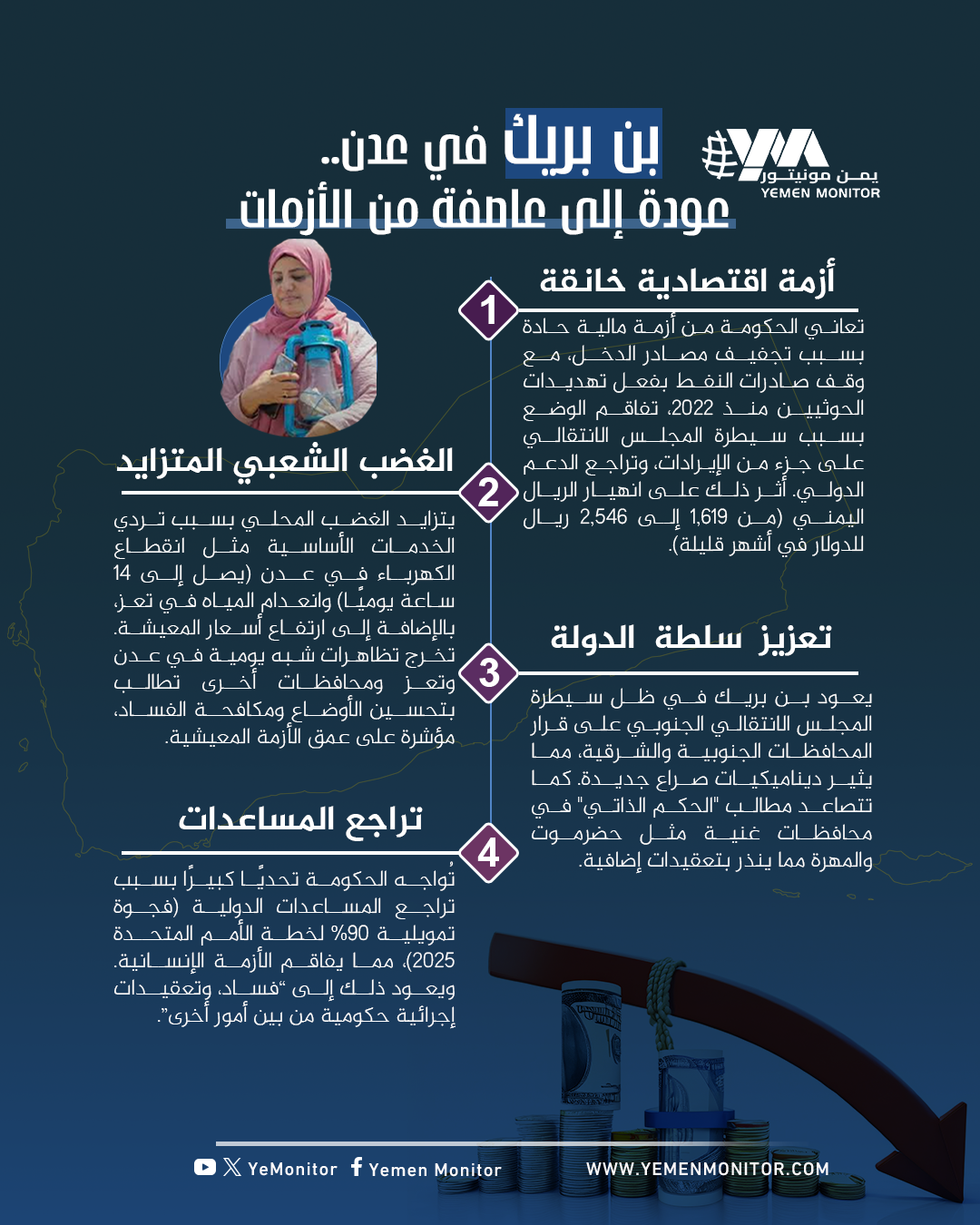
Severe Economic Crisis
The Yemeni government is facing a suffocating financial crisis due to the drying up of its revenue sources, further complicating the country’s economic and humanitarian situation. Several factors have directly or indirectly contributed to the sharp decline in government revenues.
One major factor is the suspension of oil exports since the end of 2022, due to Houthi threats to bomb export terminals. This led to a 42% drop in the internationally recognized government’s revenues in the first half of 2024, preventing it from providing essential services to the population.
Additionally, the Southern Transitional Council (STC)—which is backed by the UAE and is a partner in the government—controls part of the port revenues and tax collections in governorates that are nominally under the legitimate government’s authority. This has further contributed to the revenue decline. Compounding the issue is the reduction or suspension of financial support from Saudi Arabia and the UAE.
The crisis has also been worsened by the diversion of commercial shipping routes from Aden Port to Hudaidah Port, where the Houthis forced traders in February 2023 to officially conduct transactions through Hudaidah and sign binding commitments to that effect. This shift has negatively impacted the economy and accelerated the collapse of the local currency in government-held areas.
As a result, the value of the Yemeni riyal in the Aden market plummeted from 1,619 riyals per U.S. dollar in January 2024 to 2,546 riyals per U.S. dollar on June 1, 2025.
Growing Public Dissatisfaction
The Yemeni Prime Minister’s return to the interim capital, Aden, comes at a time of escalating local anger towards the government and its allied factions. This widespread discontent stems from deteriorating living conditions, increasing power outages in coastal governorates, and a lack of water in Taiz governorate.
On the eve of Salem bin Brik’s arrival in Aden, demonstrations erupted in both Aden and Taiz, demanding essential services and accusing the government and local authorities of corruption. These protests have been occurring almost daily for weeks, with no effective government measures to address the issues.
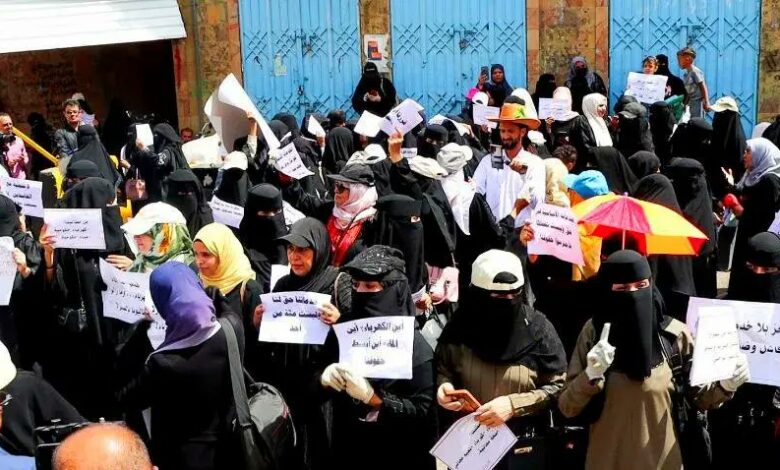
In Aden, protesting women, amidst tight security from the STC, demanded electricity, water, improved living and educational conditions, and the payment of delayed salaries.
In Taiz, protesting women called for the provision of potable water, as the price of a water tank has soared to over 50,000 Yemeni Riyals. They also demanded permanent solutions for water and electricity, which currently relies on commercial power.
Both Aden and Taiz cities are experiencing a significant decline in service levels—similar to neighboring coastal governorates like Hadramout, Abyan, Shabwah, and Al Mahra. The most prominent issue is prolonged power outages, lasting up to 14 hours daily compared to just one to one and a half hours of operation, all under scorching temperatures exceeding 45 degrees Celsius. They also suffer from a drastic increase in food prices due to the currency’s collapse and meager salaries, with an average government employee earning less than $50 per month.
Local Governance and Conflict Dynamics
Salem bin Brik returns to Aden amid the STC dominance and control over decision-making authority in the southern and eastern governorates since 2020—raising new conflict dynamics.
The STC, backed by the United Arab Emirates, is part of the internationally recognized government structure, yet it consistently blames the government for failures while evading its own responsibilities. At the same time, it refuses to recognize the legitimacy of the current internationally recognized government, pushing instead for the realization of its goal: an independent southern state.
In an unprecedented move, the STC, which effectively governs Aden and surrounding provinces, addressed the UN Security Council, calling for “urgent and immediate international intervention to rescue the deteriorating living conditions and escalating service collapse in Aden.”
Meanwhile, the southern governorates—particularly Hadramawt, Mahrah, and Shabwah—are witnessing a growing wave of discontent, both toward the legitimate government and the separatist STC.
The most pressing challenges are emerging in Hadramawt, a resource-rich governorate, where the Hadramawt Tribal Alliance is demanding autonomous governance, backed by tribal forces and local armed groups—raising fears of an impending explosion of unrest.
In March, during a visit to Mukalla (the governorate’s capital), STC President Aidarous al-Zubaidi accused the Hadramawt Tribal Alliance of treason—sparking outrage among the region’s tribal communities.
Although the roots of this conflict go back nearly eight years, it has escalated significantly since April. The Hadramawt Tribal Alliance has begun organizing large-scale rallies across its areas of influence in eastern Hadramawt, publicly raising slogans demanding “autonomy” and “self-determination.” This marks the first openly political mobilization of its kind, after years in which its demands were limited to rights-based grievances.
These developments are drawing interest and support from tribal and popular groups in other governorates that oppose the STC’s separatist agenda and its attempts to bring more regions under its control—hoping to replicate Hadramawt’s experience.
Ibrahim Jalal, a fellow at the Middle East Institute in Washington, stated that confronting this challenge requires:
“Strengthening ties between the central government and local authorities, rebuilding trust, and improving responsiveness—particularly through dialogue between governors and the government (as the Governors’ Conference once provided a platform for coordination).”
Jalal also emphasized the need for:
“A government-led, internationally supported reform program with a renewed focus on national cohesion—to reduce fragmentation and reinforce state legitimacy.”

Decline in Aid
The internationally recognized Yemeni government is facing a major crisis due to the decline in international aid this year, exacerbating an already catastrophic humanitarian situation in Yemen and posing a significant challenge to the government.
This decline stems from several factors related to the protracted conflict and slow governance progress. A key blow came when the US halted its aid to Yemen, despite being the largest contributor to UN programs and international relief organizations—directly impacting humanitarian operations.
The United Nations and aid organizations report that the 2025 Humanitarian Response Plan for Yemen is suffering from a severe funding shortfall. For instance, in May 2025, the UN’s funding gap was estimated at 90% or more of the total amount required to carry out humanitarian response efforts.
Ibrahim Jalal emphasized the need to “streamline government procedures to facilitate and ease international support, while ensuring responsiveness and flexibility that donors expect.” He noted that this approach must include:
“Clear mechanisms for accountability, efficiency, transparency, continuous monitoring and evaluation, and capacity building of government institutions.”
He added:
“By aligning international interventions with national recovery goals, ensuring conflict-sensitive and stability-oriented programming, and coordinating with local authorities and relevant ministries, aid efforts can become more development-sensitive and effectively contribute to comprehensive recovery in Yemen.”
A Difficult But Possible Path
As Prime Minister Salem bin Brik returns to Aden, the arduous responsibility of navigating this critical phase falls upon him. The sheer scale of challenges facing the Yemeni government demands a concerted effort from all local, regional, and international parties. It’s essential that the government works to restore income sources, combat corruption, and listen to the legitimate demands of citizens for basic services.
Ibrahim Jalal stated: “Yemen’s stability and recovery depend on an integrated approach: economic reforms, popular legitimacy, local participation, and international cooperation.”
He added: “Prime Minister Salem bin Brik faces a difficult path, but with the right priorities, progress can be achieved.”