Yemen Monitor/Reports Unit:
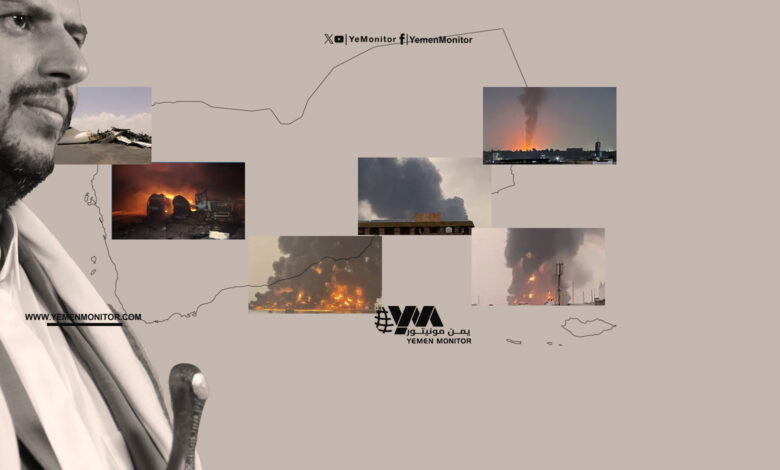
Over 52 days, US coalition warplanes launched more than 1,100 air strikes on the Houthi group, classified on terrorism lists, after it resumed its attacks on Yemen on March 15th. The strikes came despite former US President’s warnings to the Houthis to “eliminate them” if they did not stop targeting ships passing through the Red Sea, before a ceasefire mediated by Oman was announced last Wednesday.
Military and Political Path
The Houthis have been carrying out missile and drone attacks on Israel and its affiliated ships “in support of Gaza” since November 2023, and have expanded their targeting to include US and British vessels. Under the latest agreement, the Houthis announced that they would refrain from targeting US ships in exchange for a halt in US strikes against them.
This de-escalation is interpreted as one of the requirements for securing the US President’s visit to the Arabian Gulf, according to political experts, who believe it came in the context of US-Iranian nuclear talks and does not reflect Washington’s abandonment of the option of force, but rather a repositioning that gives Israel the “green light” to continue its mission against the Houthis.
Tactical Shift or Strategic Change?
The U.S.s’ decision to halt its air strikes on the Houthis is considered a tactical shift that rearranges political and military priorities, without indicating a change in strategic objectives. This decision may lead to multiple scenarios, most notably the return of the Yemeni parties to the negotiating table.
In this report, “Yemen Monitor” discusses with Yemeni and Arab political analysts the repercussions of the US de-escalation on the Yemeni negotiations, future scenarios, and Iran’s role in the decision.
Return to Negotiations
Adel Dasheela, a researcher at Columbia University’s Middle East Institute, believes that the cessation of air strikes will not bring about a radical change in the negotiations, explaining that the Houthis seek to impose their project through military force and refuse political partnership unless it is in their favor.
In an interview with “Yemen Monitor,” Dasheela points out that Saudi Arabia presented a political roadmap that was met with Houthi rejection, despite concessions from the Yemeni government and the parties aligned with it.
For his part, Dr. Mohammed al-Qubati, the former Minister of Information, warns that the de-escalation has given the Houthis an opportunity to reposition and entrench themselves as a regional actor, claiming victory over the US despite heavy losses.
He expects this to lead to a raising of their demands and their intransigence in negotiations, which complicates the possibilities of a return to dialogue.
Potential Repercussions: Between Nuclear Security and International Navigation
Dr. Fares Al-Beel, in his comments to Yemen Monitor, attributes the de-escalation decision to security concerns linked to the U.S. President’s visit to the region, noting that the airstrikes posed a threat to the safety of the visit. He also connects the decision to progress on the Iranian nuclear file, stressing that the agreement is temporary and dependent on the outcome of ongoing negotiations.
Meanwhile, Dr. Abdel Qader Al-Khali views the halt in strikes as a tactical maneuver aimed at absorbing international pressure on the Trump administration, which has faced criticism for the failure of military escalation to rein in the Houthis and for further complicating the situation in the Red Sea.
According to Al-Khali, the U.S. decision is primarily intended to secure maritime navigation rather than move toward resolving the Yemeni crisis.
Material Destruction and Its Political Consequences
The U.S. strikes have caused widespread destruction to Yemen’s infrastructure without significantly impacting the Houthis’ military capabilities.
In this context, Dasheela warns that such destruction bolsters the Houthis’ narrative as “victims of Western aggression,” which increases their local popularity and facilitates the recruitment of fighters.
The Houthis and Iran: A Relationship of Shared Interests
In this context, Mustafa al-Nuaimi, a researcher on Iranian affairs, reveals that Tehran uses the Houthis as a pressure card in the nuclear negotiations, and leaks understandings with Washington to them to ensure their adherence to directives.
Al-Nuaimi points out that Iran may escalate through the Houthis if its interests are threatened, especially in areas close to oil and nuclear facilities.
For his part, Amin Bashir, a Lebanese political analyst, explains that Iranian influence over the Houthis does not depend on direct orders, but rather on technological and military support that allows for the management of the level of escalation. Iran benefits from the de-escalation to ease US pressure on the nuclear issue, while maintaining its regional presence.
Muscat and the Iranian Game
In the current round of negotiations in Muscat, Tehran is trying to market itself to the West as a “regulator of its allies’ behavior” without offering tangible concessions, according to political analyst Abdul Wase’ al-Fatiki, who describes the understanding as an unwritten “silence deal”: the Houthis reduce their attacks in exchange for a reduction in US pressure, while Iran retains the right to reactivate them as a future pressure card.
Al-Fatiki adds that Tehran seeks to “redefine the role of the Houthis” so that they remain a flexible tool in its negotiations with major powers, especially in the absence of a unified Arab project capable of confronting the growing Iranian influence.
Looking Ahead: Future Scenarios
Abdul Qader al-Khili outlines three possible future scenarios: a sustained truce based on mutual commitments, though fragile without concrete economic steps; a renewed escalation if the Houthis restart their maritime attacks, potentially leading to renewed US strikes and the internationalization of the conflict; and a third scenario of military deadlock, where the conflict evolves into a political and economic war of attrition, considered the most probable in the short term.
Ultimately, political analyst Mustafa al-Nuaimi expresses skepticism about the longevity of the truce, citing the Houthis’ track record of violating agreements, unless a fundamental agreement is reached with Iran – the key actor capable of controlling them, as the US views the Houthis solely as a proxy for Tehran.
The report concludes that recent developments illustrate how the Yemeni crisis has become contingent on the calculations of regional and international powers, with nuclear issues and maritime security interwoven with the domestic conflict, thereby complicating the path to a resolution and leaving Yemen teetering on the edge of collapse.