Yemen Monitor / Newsroom:
Yemeni President Rashad Mohammed Al-Alimi, Chairman of the Presidential Leadership Council, affirmed that Yemeni state institutions are witnessing tangible progress in unifying security and military decision-making and improving basic services in the liberated governorates, with generous and direct support from Saudi Arabia. He stressed that the stability of state institutions is immediately reflected in citizens’ daily lives.
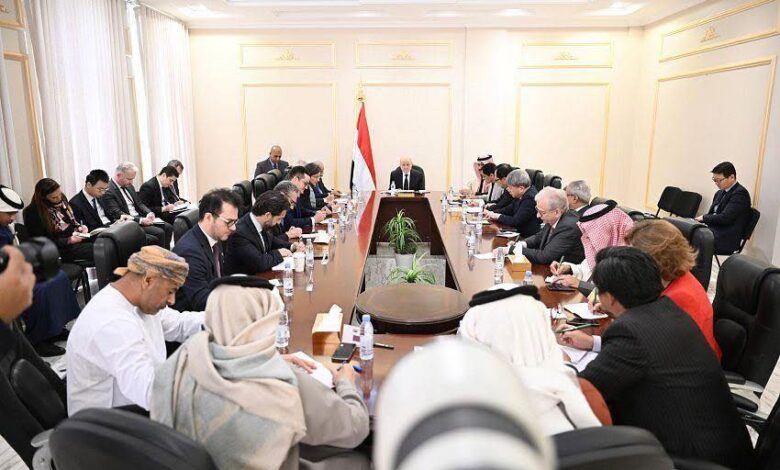
This came during the president’s meeting on Thursday with the ambassadors of the countries sponsoring the political process in Yemen, during which he reviewed a range of political, military, and service-related developments, as well as government efforts to consolidate state authority and extend its control over all liberated territories.
The president explained that the state has embarked on serious measures to unify security and military decision-making, including the withdrawal of armed forces and formations from the interim capital Aden and other provincial capitals—a long-awaited step that had been stalled for years, even after the signing of the Riyadh Agreement in November 2019. He emphasized that these measures represent a fundamental gateway to building a state based on law and order.
On the human rights front, the Chairman of the Presidential Leadership Council stressed that the government is proceeding with the closure of all illegal detention facilities and has tasked the National Commission to Investigate Alleged Human Rights Violations—an independent national mechanism supported by the international community—with carrying out field missions and fully performing its duties, ensuring that there is no impunity.
President Al-Alimi pointed to a noticeable improvement in service levels in the liberated governorates, particularly in the electricity and water sectors in the interim capital Aden, where electricity generation increased from just two hours per day to approximately 14 hours. He also noted the commitment of all government institutions to deposit revenues into the government’s account at the Central Bank, describing this as clear evidence of the recovery of state institutions and improved financial discipline.
In this context, the president praised the pivotal role of Saudi Arabia, confirming the completion of salary payments for all military formations that had previously been funded by Abu Dhabi. He also highlighted the reinforcement of the general budget with public sector salaries and the launch of service and development projects in several governorates, at a cost approaching two billion Saudi riyals.
On the political level, the Yemeni president announced that preparations are underway to convene the Southern–Southern Dialogue under the generous sponsorship of Saudi Arabia, with the participation of all southern components without exclusion or marginalization, contributing to the unification of the southern front within the framework of the state.
He also affirmed that filling vacancies within the Presidential Leadership Council, appointing a new prime minister, and naming a new governor for the interim capital Aden reflect the smoothness of decision-making and the reconstitution of state institutions in accordance with the constitution, the Declaration of Transfer of Power, and the governing rules of the council and its supporting bodies, after years of paralysis and division.
In a notable stance, the Chairman of the Presidential Leadership Council expressed surprise at the Emirati reaction to the course of state restoration, particularly the promotion of claims that ending the Emirati presence would open the door to a surge in terrorism. He stressed that experience has proven the opposite.
The president said:
“The duality of security decision-making, the multiplicity of loyalties, and the existence of illegal prisons do not eliminate terrorism; rather, they reproduce it.”
He explained that the state is currently working to shift the confrontation from merely managing risk to addressing its root causes through a single sovereign decision and unified security institutions.
President Al-Alimi also pointed to grave human rights violations revealed after the end of the Emirati presence, including torture and enforced disappearances inside illegal detention facilities, emphasizing that such practices do not combat extremism but instead fuel it and provide a fertile environment for its growth.
In conclusion, President Al-Alimi stressed that the roots of the suffering and destruction affecting various parts of the country stem from the Iranian-backed Houthi coup, calling on the international community to move beyond crisis management toward actively contributing to a solution by supporting the legitimate government in extending its authority over all its territory and ensuring accountability and an end to impunity.