Yemen Monitor / Newsroom:
A Joint Monitoring Report on Yemen, issued by prominent international organizations including the FAO, UNICEF, and ACAPS, has revealed a severe deterioration in the country’s humanitarian situation.
The report stated that Yemen ranks fourth globally among the countries most exposed to food insecurity.
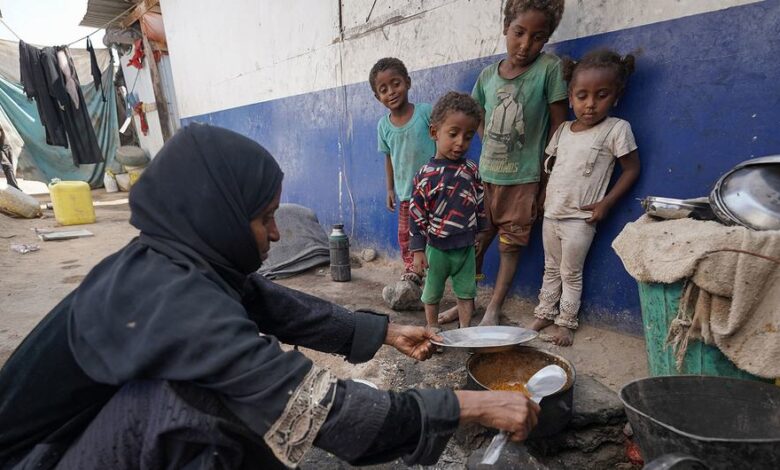
It explained that more than 18.3 million Yemenis—nearly half of the population—are facing acute levels of food insecurity by early 2026.
The report warned that 41,000 people in areas under Houthi control have reached Phase 5 of the Integrated Food Security Phase Classification (IPC), which is classified as catastrophic (famine-like conditions).
It confirmed that 61% of Yemeni households are unable to meet their minimum food needs. Governorates such as Al-Bayda (52%), Raymah (47%), and Al-Jawf (46%)—all in Houthi-controlled areas—recorded the highest levels of food deprivation.
In areas under the Yemeni government, the governorate of Al-Dhalea recorded 51% of households suffering from severe food shortages, followed by Abyan (42%), then Lahj and Shabwa (40%).
The report noted that the recent military escalation in the south—particularly the December 2025 attack by the Southern Transitional Council on Hadramawt and Al-Mahra, and the subsequent Saudi response through the “Nation’s Shield” (Dir‘ Al-Watan) forces, which reclaimed strategic areas such as Mukalla in January 2026—has eroded households’ ability to cope.
The report also documented the displacement of 462 new families in November 2025, the highest displacement rate since 2023, as a result of escalating armed confrontations. It identified critical indicators in food markets, noting that dollar-denominated food prices in the north far exceeded global prices, severely restricting civilians’ access to food despite relative exchange-rate stability in government-controlled areas.
International organizations warned that the continuation of the conflict and the division of power in the south threatens the collapse of state institutions, exacerbating the energy crisis and electricity outages, leading to a decline in health services and water networks, and further restricting humanitarian access to contested areas.
Yemen is facing a harsh winter of hunger, as drought, declining international aid, and military escalation converge, making the risk of famine imminent unless urgent and sustained humanitarian intervention takes place, according to international news agencies.