Yemen Monitor/ Marib/ Exclusive:
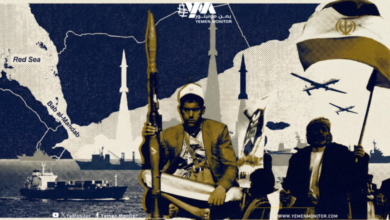
The armed Houthi group has pushed massive military reinforcements—including missile launchpads, drones, and kamikaze submarines—to the heights and coasts of the Hudaidah and Taiz governorates overlooking the Red Sea. These rapid field maneuvers aim to impose a blockade on maritime traffic and disrupt transit through international waterways.
On Monday, the Houthis had announced a blockade on Saudi maritime navigation in the Red Sea and the Gulf of Aden extending to the Arabian Sea. Early Thursday morning, the movement announced attacks on two Saudi oil tankers.
Private sources told “Yemen Monitor” that the group transferred missile launchpads, drones, and remote-control devices to vital mountainous heights in the Maqbanah district of Taiz governorate (west), coinciding with the deployment of similar reinforcements to Jabal Ras and the Al-Garrahi district in Hudaidah governorate.
A military source close to the group confirmed to “Yemen Monitor” that the Houthis pushed booby-trapped boats and uncrewed kamikaze submarines to the edges of Kamaran Island and neighboring uninhabited islands near the international shipping lane.
In this context, the Associated Press quoted three Houthi officials stating that the group had been planning for months to disrupt navigation in the strait. The officials, who spoke on condition of anonymity because they were not authorized to speak to the media, clarified that these plans include using naval mines, booby-trapped boats, drones, and helicopters to enable fighters to board vessels.
They said ships will first be warned against crossing defined boundaries in the strait. If ships ignore these warnings, the Houthis will resort to military action.
The sources spoke to “Yemen Monitor” on condition of anonymity out of fear of Houthi retaliation.
In the Strait of Hormuz, Iran has shown that even sporadic attacks on ships can be enough to effectively close a vital waterway by raising risks and insurance premiums.
Ahmed Nagi, a senior Yemen analyst at the International Crisis Group, said the blockade also benefits the Houthis’ ally, Iran, at a time when the United States has resumed its daily airstrikes.
Nagi added: “From Iran’s perspective, opening additional pressure points across the region gives it more leverage. The Houthis provide Tehran with leverage over one of the world’s most important maritime corridors.”
The Houthis face the risk of reigniting the war with Saudi Arabia and its allies in Yemen, where major fighting ended with a truce in 2022. The Saudi military says it will keep Bab al-Mandab open.
Major General Turki al-Malki, the Saudi military spokesperson, stated: “All Houthi threats against passing ships will be dealt with swiftly and decisively, as these threats constitute a blatant violation of international law and fall under acts of maritime piracy.”