Grundberg for Security Council: The Future of South Yemen Cannot Be Determined by a Single Party or by Force

Yemen Monitor / Newsroom:
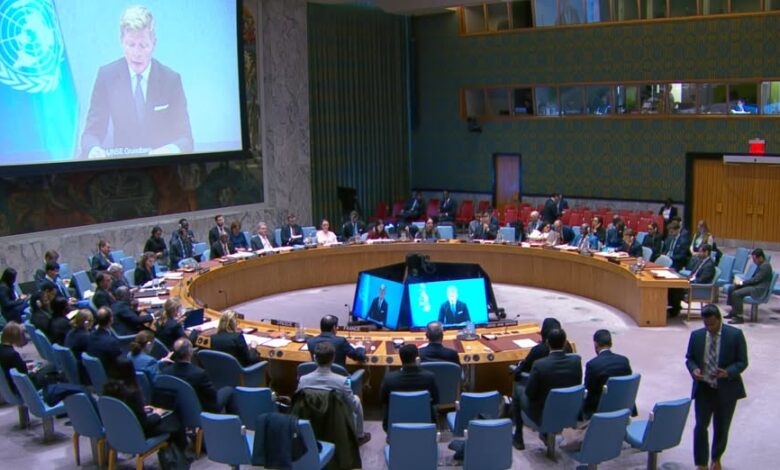
The United Nations Envoy to Yemen, Hans Grundberg, delivered a briefing to the Security Council, emphasizing that the future of South Yemen cannot be determined or imposed by any single party through force. He stated that the initiative launched by Yemeni President Rashad Al-Alimi to convene a dialogue conference hosted by the Kingdom of Saudi Arabia represents an opportunity to begin addressing the “Southern Issue” through political participation.
The UN envoy noted that the security situation in parts of the south remains fragile, pointing out that the Southern Issue is closely linked to fundamental questions regarding the future of the state, security arrangements, and economic governance.
He highlighted that instability is clearly manifested in the economy through rising prices, delayed salary payments, and the deterioration of basic services. Grundberg stressed that any political or security disturbance, even if brief, could double the pressure on the currency, deepen the fiscal deficit, and obstruct reform efforts.
Grundberg emphasized the importance of neutralizing economic institutions, including the Central Bank, from political and security disputes and maintaining momentum in the economic reform agenda. He noted that political, economic, and security challenges are interconnected and cannot be addressed in isolation from one another.
The UN envoy asserted that Yemen needs a comprehensive political process that allows all Yemenis space to discuss and negotiate core issues rather than dealing with them separately. He praised the efforts of the Sultanate of Oman in hosting recent discussions regarding the release of prisoners, stressing the need for the parties to move from agreement to implementation.
Grundberg concluded his remarks by stating that the current moment requires Yemeni leaders to invest in politics instead of force, in institutions instead of fragmentation, and in the national interest instead of narrow calculations. He also emphasized that the continued detention of UN staff by the Houthis in Sana’a is a matter of grave concern and must be addressed urgently.
This briefing comes one week after the turbulent events witnessed in Hadramawt and Al-Mahrah. These events began with an escalation by the Southern Transitional Council (STC) in both governorates, reaching border areas with Oman and Saudi Arabia, before government forces—supported by Saudi Arabia—intervened and regained control of the situation. This led to the departure of STC President Aidarous Al-Zubaidi to the UAE.
Last Friday, the Southern Transitional Council announced its dissolution, along with all its main and subsidiary bodies and apparatuses, and the closure of all its domestic and foreign offices. This followed a meeting of its presidency and senior leadership in preparation for the Riyadh Conference, which aims to resolve the crisis in southern Yemen and bring together all southern political components.