Yemen Monitor / Newsroom:
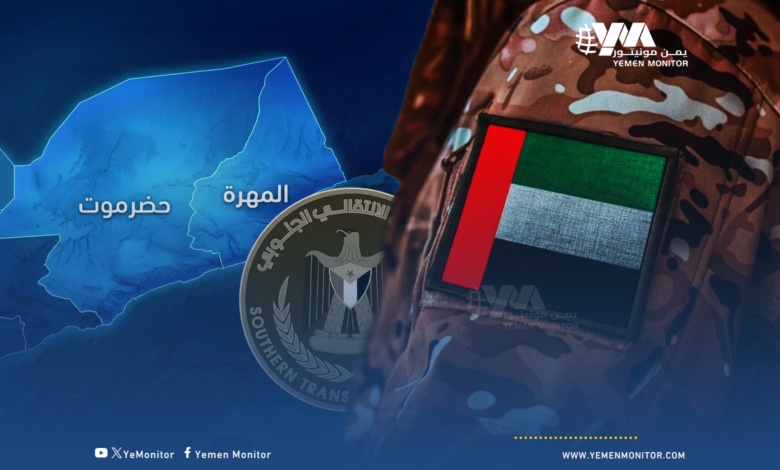
Amid the rapid transformations unfolding in the governorates of Hadramawt and Al-Mahra, a recent research study issued by the Mocha Center for Strategic Studies, prepared by Yemeni researcher Ismail Al-Suhaili, reveals that the scene in eastern Yemen has shifted from a phase of “managed competition” among allies to one of “decisive action on the ground.” This pivotal moment has reshaped the balance of power and opened the door to complex scenarios for the future of the Yemeni state.
The study, titled “From Competition to Withdrawal,” goes beyond merely describing recent events. It offers a forward-looking reading of the post-withdrawal phase, outlining three main scenarios that could shape Yemen’s trajectory and regional security in the coming period.
The paper tracks the dramatic transformations in eastern Yemen as the result of long-accumulated undeclared understandings and low-intensity regional competition, which eventually reached a breaking point, shattering previous balances and imposing new realities on the ground.
According to the study, what occurred in Hadramawt and Al-Mahra was not an isolated event, but rather a turning point in how conflict has been managed within the anti-Houthi camp, and a direct reflection of shifting priorities among influential regional powers.
Scenario One: Restoration of the State and Consolidation of Sovereignty
The first, and most optimistic, scenario is based on Saudi Arabia’s success in capitalizing on the current moment of transformation to entrench full Yemeni state sovereignty in liberated areas, in its capacity as the effective leader of the coalition supporting legitimacy.
This path assumes an accelerated process of integrating all military and security formations under the Ministries of Defense and Interior, and the return of the Presidential Leadership Council and the government to perform their duties from inside the country—restoring the authority and credibility of the state and its institutions.
According to the study, achieving this scenario would place Saudi Arabia in the role of a regional guarantor capable of sponsoring an inclusive Southern dialogue that ends divisions and paves the way for a comprehensive political settlement leading to the end of the Houthi coup and the establishment of long-term stability.
Scenario Two: Freezing the Conflict and Erosion of the State
In contrast, the study presents a more realistic but less decisive scenario, in which the current situation continues, with Riyadh succeeding in preventing a slide into open military confrontation and containing regional realignments, without moving toward genuine state-building.
In this context, the paper warns that state institutions may remain only nominally present, while influence is redistributed among multiple local actors governed by undeclared regional understandings—resulting in a condition of “neither war nor state.”
The center believes this scenario carries latent risks, most notably opening the door to low-intensity regional competition that undermines prospects for real stability and merely postpones an eventual explosion rather than resolving it.
Scenario Three: Comprehensive Setback and Recycling of the Conflict
The most dangerous scenario, described by the study as a “fatal setback,” would result from the failure of dialogue tracks and the return of some regional actors to military options, amid international laxity or a weakened Saudi stance.
This trajectory would threaten the collapse of what remains of state institutions and transform Yemen once again into an open arena of conflict—posing a direct threat to Saudi national security, undermining the very idea of the Yemeni state, and plunging the country into a prolonged cycle of security chaos.
The Mocha Center’s study concludes that Yemen’s future now stands at a critical crossroads. The success of Yemen’s legitimate authorities depends not only on managing the crisis, but on their ability to turn the current “moment of decisiveness” into a unifying national path that addresses the roots of the conflict and ends years of competition that have drained the state and society.
The paper stresses that the options on the table are no longer theoretical, but urgent political and security decisions that will determine whether Yemen moves toward restoring the state or falls once again into the trap of chaos and recycled conflict.