Yemen Monitor / Newsroom:
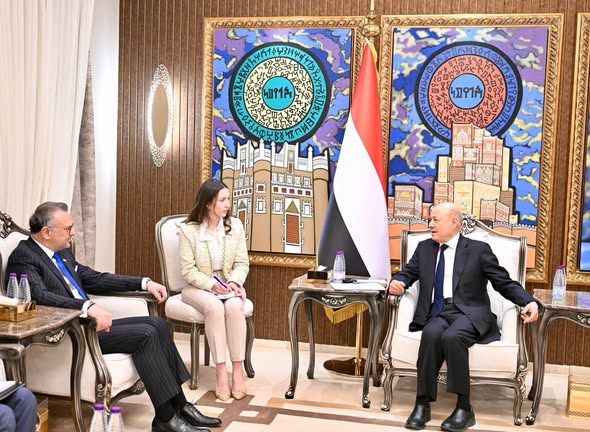
The Chairman of Yemeni Presidential Leadership Council, Rashad Mohammed Al-Alimi, met on Tuesday with the US President’s Senior Adviser for Arab and African Affairs, Massad Boulos, and the United States Ambassador to Yemen, Steven Fagin.
The meeting discussed the course of bilateral relations between Yemen and the US, developments on the national scene, ways to enhance US support for government reform efforts, and ongoing cooperation between the two countries in counterterrorism, confronting the Iran-backed Houthi militias, and addressing extremist organizations linked to them.
Al-Alimi expressed his appreciation for the level of partnership with the US and its continued support for Yemen’s constitutional legitimacy in international forums, stressing that the cohesion of the international position in support of Yemen has been a key factor in preserving state institutions and backing the Yemeni people’s aspirations for security, stability, and peace.
He also praised the humanitarian role played by the US over recent years, expressing hope for the resumption of humanitarian support programs and stronger assistance to the government in service and development sectors.
The meeting addressed US efforts to curb the capabilities of the Houthi militias and reduce Iranian influence in Yemen and the region, including intercepting weapons and drug shipments and designating the Houthis as a terrorist organization. Al-Alimi emphasized the importance of these steps in protecting regional security and international maritime routes.
On domestic issues, the Chairman of the Presidential Leadership Council reviewed recent developments related to the unilateral moves of the Southern Transitional Council (STC) in the governorates of Hadramawt and Al-Mahra, warning of their repercussions on Yemen’s security and stability, as well as that of the region, particularly given the areas’ geographic sensitivity linked to energy routes and international shipping lanes.
He explained that the decision to end the Emirati military presence was taken within the framework of protecting de-escalation efforts and preserving the unity of the state and the integrity of its territory, not for escalation purposes.
Al-Alimi also commended Saudi Arabia’s role in reducing tensions, securing the handover of military camps, and protecting civilians, affirming that the sovereign decisions taken—including the declaration of a state of emergency—were based on constitutional authorities and aimed primarily at protecting citizens and preventing the militarization of political activity.
He noted that these measures also helped protect the Southern Cause from descending into chaos, stressing that arrangements are underway to convene an inclusive Southern dialogue conference to address the Southern issue within the framework of the state and its legitimate institutions.
For his part, the US President’s adviser reaffirmed Washington’s commitment to supporting Yemen’s unity and stability, working to resume US aid programs, and continuing cooperation with the Yemeni government in counterterrorism, confronting the Houthi coup, protecting waterways, supporting reforms, and unifying security and military decision-making under the umbrella of state institutions.