Yemen Monitor / Marib / Exclusive:
A Gulf official said that Saudi Arabia bombed an Emirati weapons shipment at the Yemeni port of Mukalla because it felt it had been deceived by Abu Dhabi.
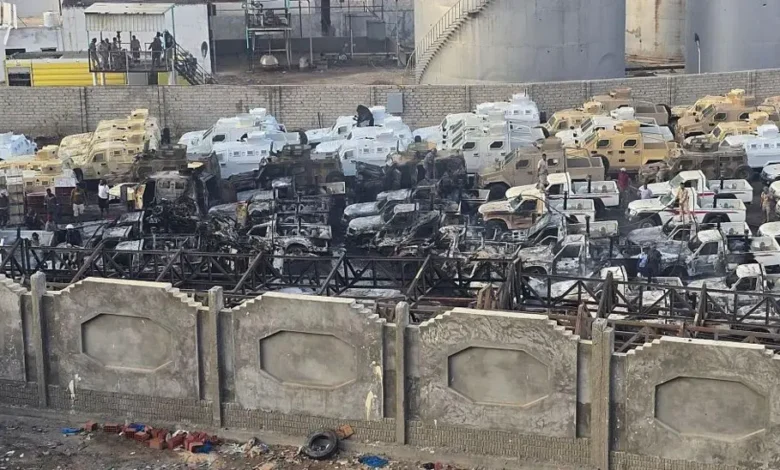
On Tuesday, tensions between the two regional powers escalated dramatically when Saudi-led forces struck the port of Mukalla in southern Yemen, targeting what Riyadh said was an Emirati-linked weapons shipment bound for the separatist Southern Transitional Council (STC).
The website Middle East Eye quoted an unnamed Gulf official as saying that the Kingdom’s precise strikes surprised both the Emirati leadership and U.S. officials alike.
The official added, “This was not expected in senior circles,” noting that the Saudi show of force came because Riyadh felt it had been “deceived” after learning that the UAE was moving to reinforce the STC with weapons and armored vehicles even as it was negotiating de-escalation with Saudi Arabia.
Saudi Arabia justified the strike by saying that the STC’s advances and the weapons shipments posed a threat to its national security. It also expressed disappointment over what it described as “pressure exerted by the UAE” on the separatists to carry out military operations in the governorates of Hadramout and Al-Mahra, which lie along the borders with the Kingdom and neighboring Oman.
The unprecedented nature of the strikes prompted U.S. Secretary of State Marco Rubio to hold calls with his Emirati and Saudi counterparts, although official readouts of those conversations were brief. A U.S. diplomat and a Gulf official said Washington is working intensively to prevent further escalation.
Experts believe that the Saudi strikes and the Emirati withdrawal raise questions about how Abu Dhabi can continue supporting its main proxies.
Mohammed Al-Basha, a Yemen affairs expert and founder of the Basha Report, said that while the UAE can mobilize hundreds of thousands of well-armed fighters on the ground, Saudi Arabia has greater control over maritime chokepoints and border crossings, which would hinder Abu Dhabi’s efforts to rearm its militia allies in a prolonged conflict.
Meanwhile, Hisham Al-Ghannam, a Saudi defense analyst and researcher at the Carnegie Middle East Center, said: “While the UAE can mobilize large proxy forces, Saudi Arabia’s advantage today lies elsewhere: international legitimacy, strategic depth, economic influence, and lessons learned.”