Yemen Monitor / Newsroom:
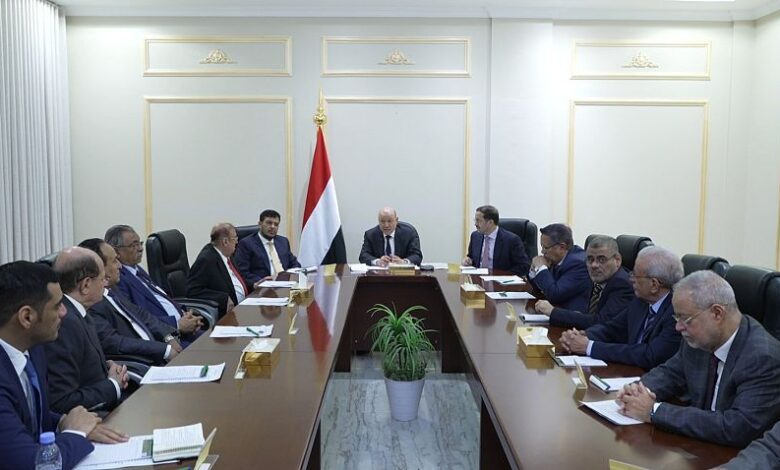
The Chairman of Yemen’s Presidential Leadership Council, Rashad Mohammed Al-Alimi, discussed with the Advisory Council the latest developments in the tense situation in the governorates of Hadramawt and Al-Mahra, amid escalating military movements by the STC. He reiterated his support for Saudi-Emirati mediation efforts to contain the escalation and protect civilians.
During the meeting, Al-Alimi praised the role played by the Advisory Council and called for intensified efforts to formulate a comprehensive national vision that preserves the existing political consensus, safeguards state institutions, and adheres to the constitution and the references of the transitional phase—foremost among them the Declaration of the Transfer of Power and the Riyadh Agreement.
The Chairman of the Presidential Leadership Council briefed the advisers on a comprehensive picture of developments in the eastern governorates, considering that the state had acted with a high sense of responsibility in dealing with what he described as a “dangerous escalation” resulting from military movements aimed at imposing a fait accompli by force and undermining the foundations upon which the transitional phase was built.
Al-Alimi noted that what is taking place in Hadramawt has gone beyond the bounds of political disagreement and has turned into a gradual course of unilateral measures, beginning with administrative decisions and expanding into military deployments in several districts, in a clear challenge to national, regional, and international reference frameworks.
The Chairman of the Presidential Leadership Council criticized the use of the slogan of “counterterrorism” as a cover for redrawing control balances on the ground, stressing that this file is the exclusive responsibility of the state and its formal institutions. He emphasized that any actions outside this framework do not serve security, but rather open the door to security vacuums that threaten stability.
Al-Alimi also addressed the humanitarian repercussions accompanying the escalation, referring to field and human rights reports that spoke of civilian casualties and attacks on public and private property. He warned that this poses a direct threat to social peace and the social fabric in Hadramawt and Al-Mahrah, in addition to weakening the legal standing of the state.
In this context, the Chairman of the Presidential Leadership Council reviewed the outcomes of the National Defense Council meeting, which described the current escalation as a blatant violation of the references of the transitional phase and a rebellion against state institutions. He affirmed the state’s commitment to protecting civilians and preventing the situation from sliding into further violence.
Al-Alimi explained that the political leadership, based on the recommendations of the National Defense Council, submitted an official request to the Coalition to Support Legitimacy to take urgent measures to protect civilians in Hadramawt. This request was met with an immediate response from the Joint Forces Command, within the framework of efforts to contain tensions and restore stability.
He affirmed that any military movements that contradict de-escalation efforts or endanger civilians will be dealt with firmly, in support of the de-escalation efforts led by Saudi Arabia and the United Arab Emirates. This includes ensuring the withdrawal of STC forces from military camps, handing them over to the Nation’s Shield Forces, and enabling local authorities to exercise their constitutional powers.
The Chairman of the Presidential Leadership Council renewed his high appreciation for the Saudi-Emirati role, considering their mediation a fundamental pillar for protecting civilians, alleviating humanitarian suffering, and supporting Yemenis’ aspirations for security, stability, and peace.