Yemen Monitor / Newsroom:
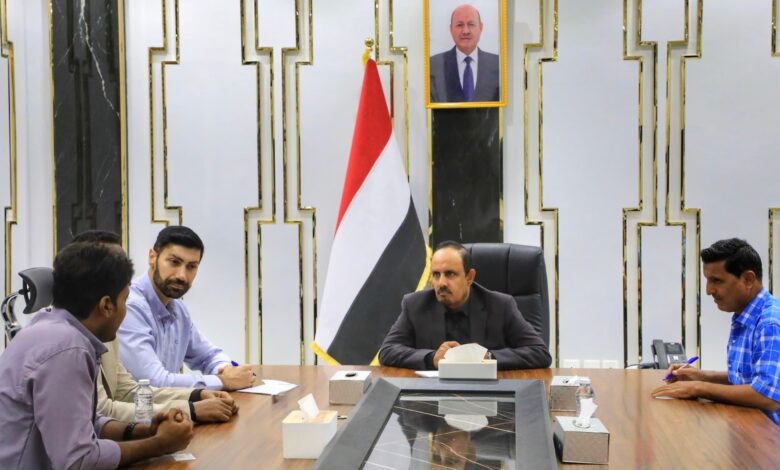
Hadhramaut Governor Mabkhoot Mubarak bin Madi praised the efforts of CARE International in the governorate’s development sectors, describing its projects as a model for sustainable interventions that strengthen capacities, diversify livelihoods, address the needs of local communities, stimulate economic activity, and improve living standards.
The commendation came during a meeting today between the governor and the organization’s Deputy Country Director, Salah Hammoudi, who presented a report on ongoing projects in Hadhramaut.
Hammoudi reviewed the project to enhance the capacities of fishermen and diversify their livelihoods in the fisheries sector, which has reached 75% completion, funded by GIZ and implemented in the districts of Mukalla, Shihr, Raydah and Qusai’ir, Brom Mayfa‘, and Eastern Dis.
The project aims to develop the skills of fishermen and fisherwomen, provide equipment and technical support, improve the production environment, and empower women within the fish value chains.
Its components include training and equipping 2,000 fishermen in sustainable fishing, safety, and the use of GPS; motivational training for 1,750 fishermen; distribution of fishing gear such as iceboxes and fish detectors to improve production and reduce effort; and the rehabilitation of four ports with furniture, fishing scales, electronic equipment, and solar power. It also includes support for women through training, grants, business and leadership skills development, and fish processing and preparation.
Hammoudi also discussed the project to build resilience in Yemen through community-based integrated humanitarian systems of transformation and leadership, part of the Food Security Safety Net Program in Hadhramaut. The project has reached 35% completion, funded by the UK Foreign, Commonwealth & Development Office (FCDO), and implemented in Mukalla, its outskirts, and Ghail Bawazir.
The project aims to reduce food insecurity and famine risks among households and communities, and to enhance effective food security response.
Its activities include conditional cash transfers for 180 families for six cycles, unconditional cash transfers for 90 families for six cycles, rehabilitation of two community assets, cash support for 100 small farmers, distribution of seeds and agricultural tools to 100 farmers once, training agricultural extension workers on modern practices, training trainers on business development, providing small grants as capital for 100 families, and training facilitators of savings and loan groups in basic financial management.
The governor valued the organization’s humanitarian and developmental role in the neediest districts, noting that directing its projects supports partnership with the local authority and backs its efforts within the 2025–2029 economic and social development plan. The plan, recently launched at an official ceremony in Mukalla with broad regional and international attendance, focuses on improving developmental governance, optimizing resources, enhancing basic and social services, and leveraging promising opportunities and comparative advantages to increase economic growth and create jobs.
For his part, the Deputy Country Director expressed his thanks to the local authority for its continued facilitation of the organization’s teams, confirming that the cooperation has accelerated project implementation, expanded its scope, and delivered services more effectively to ensure the sustainability of development interventions.