Yemen Monitor / Newsroom:
As war continues to strip away the historical identity engraved in Yemen’s stones, the Yemeni government has issued a new appeal to the international community, urging cooperation to stop the ongoing smuggling and looting of cultural artifacts and heritage, which have been systematically plundered for years. The government emphasized that the battle to preserve national identity is no less important than the fight to restore the state.
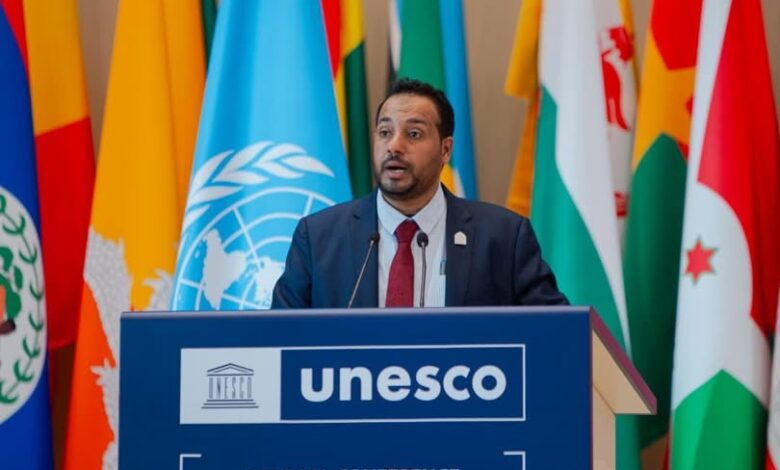
This came in a speech delivered by Minister of Education Tareq Al-Akbari during the 43rd General Conference of the United Nations Educational, Scientific and Cultural Organization (UNESCO), held in Samarkand, Uzbekistan. Al-Akbari stressed that Yemen is fighting a “two-front battle”—one against war and another against the erasure of its civilizational memory spanning thousands of years.
Al-Akbari stated that the government is working on new national legislation and strengthening international partnerships to recover looted artifacts and combat smuggling networks that have exploited wartime chaos to plunder Yemen’s history and sell it in foreign auctions.
Despite the country’s hardships, he said, Yemen still possesses an extraordinary cultural legacy that forms part of humanity’s collective memory. He noted that the country has 26 sites listed on UNESCO’s Tentative List of World Heritage Sites, but urgently needs financial and technical support to protect them from deterioration.
The minister praised the UNESCO Executive Board’s decision to adopt Item No. (47) in support of Yemen in the fields of education, heritage, and media, describing the move as “a symbolic yet significant step in difficult times—proof that the world has not forgotten Yemen.”
Al-Akbari called on UNESCO member states to develop long-term partnership programs that go beyond emergency aid and contribute to strengthening education, culture, and creative industries as effective tools for economic recovery and rebuilding national identity.
He concluded by affirming that Yemen’s heritage is not merely stones and monuments, but rather a national memory and part of humanity’s shared consciousness, stressing that saving it is a shared responsibility that extends beyond Yemen’s borders to the conscience of the entire world.