Aid Paralysis and Political Strangulation: Yemen Slips Towards Silent Famine

Yemen Monitor/Sana’a/Exclusive:
The humanitarian landscape in Yemen is undergoing a catastrophic shift, with relief operations in areas controlled by the Houthi group reaching a “state of complete operational paralysis,” according to reports from the World Food Programme (WFP).
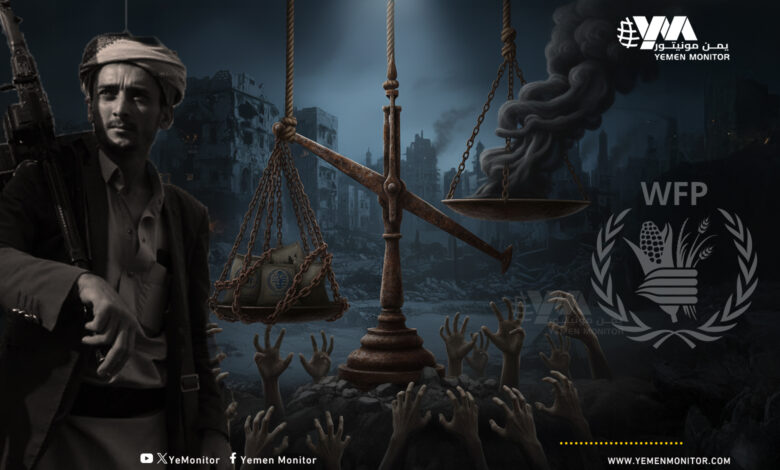
This comprehensive freezing of food and humanitarian aid, which effectively began with the suspension of the Programme’s activities at the end of August 2025, now threatens to push millions of inhabitants in northern Yemen—who already suffer from the highest rates of food insecurity—to the brink of a silent famine.
WFP data confirms that all its assistance is currently suspended in Houthi-controlled areas, a direct result of the escalation of the security crisis and the targeting of humanitarian workers. This escalation culminated with the revelation that 29 of the Programme’s staff members have been detained by the Houthis in northern Yemen this year, a practice the United Nations described as “ongoing arbitrary detentions.”
This hostile security climate has not only led to the suspension of aid but has also resulted in the effective disruption of the Programme’s country office in Sana’a, the center of operations management. An official at the Programme told “Yemen Monitor” that the office’s work is “unavailable” at the moment.
In September and October 2025, the Programme provided no food aid in Houthi-controlled areas, while it continued to provide emergency assistance to approximately 3 million people in areas controlled by the internationally recognized government, where it completed the fifth cycle of General Food Assistance in mid-October.
These Houthi actions are viewed as the use of humanitarian aid as a tool for political pressure to extract concessions or impose complete control over the distribution process, posing a serious challenge that undermines the principles of neutrality and independence of humanitarian work.
Ramifications of the Paralysis: Threat to Vital Services and Worsening Food Poverty
The freeze imposed on the WFP operations has extended beyond food aid to logistics and accountability services, threatening the ability of other humanitarian partners to function. A WFP status report issued at the end of last October indicated that the Logistics Cluster, led by the Programme, was unable to provide any support to partners in September due to ongoing operational challenges.
Humanitarian fuel has also been suspended, with the Programme announcing the suspension of the on-demand fuel service in areas under Sana’a authorities (Houthi-controlled). This fuel is vital for supporting health, water, and sanitation (WASH) facilities, placing these essential services under severe pressure and threatening their cessation.
The report also revealed the halt of monitoring and accountability mechanisms, as the Programme’s Community Feedback Mechanism became ineffective due to operational restrictions. Furthermore, the beneficiary re-targeting and registration exercise, a crucial procedure to ensure aid reaches those who deserve it, remains suspended in areas under Houthi authorities.
This obstruction confirms that the humanitarian crisis in Yemen is no longer just a funding crisis but a crisis of access and protection, where humanitarian personnel have become targets and aid is used as a political pressure tool, exposing millions of inhabitants in northern Yemen to the risk of renewed nutritional deterioration.
The UN Programme had previously announced earlier this year the cessation of treatment for moderate acute malnutrition (MAM) in Houthi-controlled areas due to running out of supplies, threatening the lives of about half a million children who were previously receiving treatment. However, it stated that UNICEF would only cover critical cases, meaning thousands of children would be left without timely therapeutic intervention. In October, UNICEF and the World Health Organization (WHO) also halted their interventions in Houthi areas, leaving these children in a dire situation.
The WFP official, who preferred to remain anonymous because he was not authorized to speak to the media, told “Yemen Monitor” that the crisis in northern Yemen has shifted from a funding crisis to a crisis of “access and protection,” where humanitarian personnel have become direct targets of the de facto authority (the Houthis).
The Houthis refuse to discuss measures to cover the vacuum created by the withdrawal of UN agencies from their areas of control. Conversely, the Houthis stormed the headquarters of 5 new international organizations in Sana’a on Wednesday.
The Houthis are directing espionage charges at arrested Yemeni employees working for UN agencies, including a female employee detained by the Houthis days after giving birth to her baby, who subsequently died.
A security source and a lawyer in Sana’a told “Yemen Monitor” that the Houthis have referred the files of 42 UNICEF and WFP employees to the Public Prosecution in preparation for their trial on charges of “espionage,” which can lead to the death penalty.
The WFP official stated: “The campaigns of arbitrary detention and enforced disappearance targeting humanitarian workers have created a climate of fear that threatens organizations’ ability to operate freely and independently; the start of the trial of Yemeni employees exacerbates the dire situation.”
Silent Famine Crisis in Hotspots
The report indicates that 61% of Yemeni households were struggling to meet their minimum food needs in September, and severe food deprivation affects one-third of households (34%). The disaster lies in the fact that the aid suspension affects the hunger hotspots that record the highest rates of poor consumption, such as Al-Bayda, Raymah, and Al-Jawf, all located under the control of Sana’a (Houthis).
The most vulnerable groups, primarily internally displaced persons (IDPs) residing in displacement camps in Houthi areas, are the most affected. With the halting of emergency aid and school feeding, a sharp deterioration in food consumption patterns is expected, pushing more families towards “harsh” coping strategies such as begging.
It is likely that, due to aid reduction, the population will be forced to resort to more dangerous negative coping mechanisms, which often include begging, selling assets, early marriage, and other practices to secure a living.
Estimates suggest that over 75% of the aid that entered Yemen since 2015 went to the areas they control, and information confirms that a significant portion of it is being looted and sold on the black market to finance their war efforts and enrich their leaders.
The Spectre of Funding Shortfall Exacerbates the Catastrophe in the South
In areas controlled by the internationally recognized government, despite the continuation of aid, the humanitarian operation faces a parallel and equally dangerous challenge: a severe funding shortfall. Figures show that the Programme’s operations for Yemen are suffering from a huge funding gap of 91% for the next six months (November 2025 – April 2026), with net funding requirements amounting to $434 million USD.
The Programme warns that this dramatic shortage in contributions will lead to a significant reduction in aid starting in early 2026. This reduction will affect 3.4 million people and will end the General Food Assistance (GFA) program to transition to a more targeted program, meaning millions of former beneficiaries will be removed from the circle of support at a critical time.
In light of these facts, Yemen appears to be heading towards a silent famine fueled by politicization, negligence, and international failure. Unless urgent steps are taken to reopen aid channels and ensure the protection of humanitarian workers, the catastrophe will be not only humanitarian but also moral.