The Shock of the “Trump Plan”… Have the Houthis Lost the “Palestine Card”? Ideological Confusion Strikes the Group After Hamas’s Approval
By Heba Al-Tuba’ai

Yemen Monitor / Reports Unit:
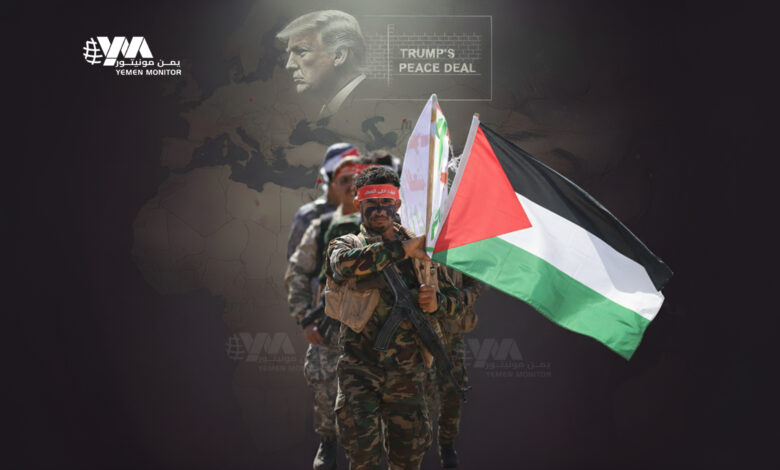
The partial approval by Hamas movement of the peace and prisoner exchange agreement put forward by the Trump administration has caused clear confusion within Houthi circles. The political and religious leadership in Sana’a considered the development a stab in the back of the “Axis of Resistance.” Meanwhile, reactions varied between a relatively balanced official stance and sharp rhetoric coming from media arms and second-tier leaders, in an effort interpreted as an attempt to reshape the internal narrative and address the symbolic void created by the Palestinian developments.
The Houthi response took a dual approach. On the one hand, Mohammed Ali al-Houthi, a member of the Political Council, seemed keen on a relatively calm tone when he said that “peace is not built by threat, and the US is not a mediator but a party to the aggression,” describing what is known as the Trump deal as the “Deal of Shame.” On the other hand, tweets and articles from lower-level leaders surfaced, describing the agreement as “historical surrender” and the “cursed deal” that grants the occupation new legal cover. This pushed the Houthi social media sphere into a state of media confusion and conflicting messages.
The positions escalated among the Houthi ranks. Accounts and electronic crowds circulated phrases of condemnation and mobilization. This included a post by Akram Hajar, a Houthi journalist on the X platform, which stated: “Do you realize the extent of the crimes that Saudi Arabia has committed and continues to commit against the Yemeni people?! It has torn the fabric of the single homeland, scattered the social structure, and planted venomous snakes that strike the people with their malicious poisons. This is not a passing war; it is a systematic annihilation targeting the entire Yemeni existence!”
This type of rhetoric reflects tangible Houthi anger that shifts attention away from the crisis of symbolic identity (the loss of Palestine’s position as a unifying, justifying cause) towards inciting hostility against regional opponents and feeding vengeful narratives specifically against Gulf states.
Posts like Akram’s are used as mobilization fuel to lend historical legitimacy to the group’s policies and mobilization mechanisms. They serve as evidence that the domestic arena is not silent or accepting; rather, it is in the process of re-producing a discourse that replaces the lost external symbol with directed local grievances.

Unannounced Division
Political analyst Nabil Al-Bakari says: “So far, there has been no clear Houthi position regarding Hamas’s stance on Trump’s peace and Gaza ceasefire initiative, which means they are also in a state of total confusion about what has happened.”
Speaking to Yemen Monitor, Al-Bakari explained that the Houthis are displeased with Hamas’s position because, if peace is achieved in Gaza, the Houthis would lose one of their most important political cards—one they have long used to stir emotions and maneuver domestically, silencing any internal voices demanding rights or services, on the grounds that they are the “de facto authority” in their areas of control.
Within the group itself, there is an unannounced internal split. One faction calls for restraint and warns against publicly attacking Palestinian factions for fear of fracturing the “Axis of Resistance.” The other views any silence as a duplicitous stance that could be interpreted as complicity. Local sources indicate that the group’s leadership has resorted to replaying old speeches by Abdul-Malik al-Houthi, repeatedly invoking phrases such as “Al Quds is a symbol that cannot be bargained over” and “truth is not measured by individuals”—an effort to preserve loyalty and convince their base that the current situation is a test of faith, not a political failure.
Pressure is also mounting from the group’s grassroots base. Younger members and former fighters have expressed disappointment and doubt in the symbolic legitimacy they were taught during ideological and cultural training sessions. Several Telegram channels and Facebook groups have called for punishing those who normalize relations and for blaming Iran for its “silence,” while an increased volume of incitement messages urged preparations for a new phase of confrontation.
Other Houthi leaders have reframed the agenda, introducing new scapegoats: their rhetoric has shifted toward warnings about the “American and Israeli threat in the Red Sea and Bab al-Mandab”, along with renewed accusations that Gulf states have “betrayed the nation” and “conspired against the cause.”
This shift is far from accidental—it serves two parallel purposes: to divert attention from internal economic failures and security breaches, and to reinvigorate the movement’s base by manufacturing a tangible, external enemy to rally against.

Coverage of Israeli Strikes
The Houthi media tactic included another practical dimension: amplifying and promoting news of Israeli strikes on Gaza, with a focus on images of victims and tragic human stories. This amplification serves a dual function: first, internal distraction from points of weakness; and second, an attempt to re-mobilize feelings of anger that might push Palestinian factions to reconsider their balances or even withdraw from the agreement’s terms. This prolongs the conflict and ensures the Houthis retain a share in “the continuation of the cause” that they have long used to justify their authority. It is also employed as a strategic tool to keep the Palestinian file vital in their internal and external calculations.
In the tactical landscape, other statements were issued to weave this narrative. Among them were remarks attributed to leaders within the movement suggesting that “the ball is now in the court of Arab and Islamic nations to support Hamas.” At the same time, Houthi-aligned popular voices on social media platforms called for hostile positions toward Gulf states, viewing their governments as responsible for the tragedies in Yemen. This rhetoric serves to create internal hostility that, in turn, becomes a rallying label for mobilizing the masses. It also justifies tightening the security grip and intensifying calls for mobilization and collection of funds under the banner of “preparing for confrontation.”
The Crisis of Peace
“Perhaps if the Trump initiative proceeds to its end and the war in Gaza stops, Trump and his allies will turn to settling scores with Iran and its proxies in the region, foremost among them the Houthis, who have already entered the circle of American and Israeli targeting,” Al-Bakkari adds.
Abdul Sattar Al-Shamiri, also a political analyst, believes that Iran’s current needs require the Houthi outlet to be active, as there is no other outlet that can be activated. Since the Houthi movement acts as a radar for Iranian foreign policy directions, “I think they will continue their activity, at least in the Red Sea, under new pretexts.”
“Iran will invent a new scapegoat for the Houthis,” Al-Shamiri says, “but the reality is that the international community, specifically the European Union, will improve its stance toward anger against the Houthis, moving from merely defending ships to actively engaging with the US and UK in direct attack on the Houthis.”
In other words, there is now an objective condition available—external anger—and if this condition converges with the subjective condition—the readiness of the legitimate government to advance and strike the Houthis from within if support is provided—then the Houthis will fall. However, he believes it won’t be in one blow; instead, funding sources will be dried up, and they will receive significant strikes.
He adds in his interview with “Yemen Monitor”: “Over time, they can be besieged or gradually weakened. After a period, which may be long or short, we might say that the Houthi group is in crisis and will return to specific places within the broad map they currently control, like Amran. But this is not soon. This prediction is contingent on the readiness and movement of the legitimate government. If it remains in its current position without action and relies only on external forces, I believe we are facing another scenario which suggests the Houthi movement will remain able to survive and continue, but will lack the ability to achieve stability.”