Yemen Monitor / Tehran / Exclusive:
Over 40 Israeli assassinations targeting commanders from Iran’s Revolutionary Guard and Quds Force have resulted in the Houthi armed group losing key military figures who had contributed significantly to its missile program. This marks a major setback for the group, which has relied heavily on Iranian military support since the assassination of Qassem Soleimani.
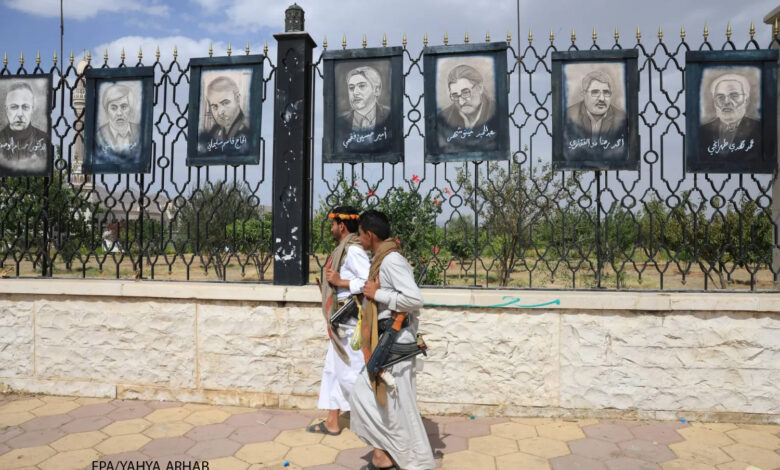
According to intelligence sources, Brigadier General Jawad Pourrajabi—one of the leading commanders in the missile unit—was killed. He played a pivotal role in missile operations across several regional arenas, including Syria, Lebanon, Iraq, and Yemen. Iranian media once reported that he used to tell his wife he served tea at a government office to hide his real role, until his assassination exposed his identity.
The information revealed that Jawad significantly bolstered the Houthis’ missile capabilities, training their weapons specialists in assembly techniques and coordinating both domestic and foreign operations.
The second commander, announced by the Revolutionary Guard on Sunday, was Abu al-Fadl (Hassan) Nikouei, a prominent Quds Force intelligence official known by his alias “Hajj Younes.” He was killed in the latest Israeli strikes on Iran. Media close to the IRGC described him as a shadow companion to Qassem Soleimani, the Quds Force commander killed in 2020.
“Hajj Younes” was well-known for his role in Syria but also oversaw the presence of Houthis there, facilitating their covert travel to Iran for training without passport stamps. He referred to Iranian support for the Houthis as “sacred and humanitarian” in defense of Iran. He was known for his calm demeanor, even when addressing internal opposition within Iran.
Brigadier General Behnam Shahriari, another major Quds Force figure who used several aliases, was linked to arms smuggling operations to the Houthis for over a decade. He led Unit 190 of the Quds Force, the division responsible for transporting arms and facilitating military logistics to Iran’s proxy groups.
Shahriari managed vast smuggling networks spanning Yemen, the Horn of Africa, the Gulf states, and even Turkey. He oversaw large-scale trafficking operations that used front companies and disguised civilian shipments via land, sea, and air routes.
Meanwhile, Mohsen Rezaei, a key Revolutionary Guard figure, has been one of the most vocal supporters of the Houthis within Iran’s military establishment. Over the past two years, he frequently appeared on the Houthis’ Al-Masirah TV channel.
The assassinations of Iranian military commanders are significantly affecting the country’s armed networks, with replacements difficult to find. However, the long-term impact on the Houthis will depend on Iran’s broader foreign policy toward the “Axis of Resistance.”