Yemen Monitor/Newsroom:
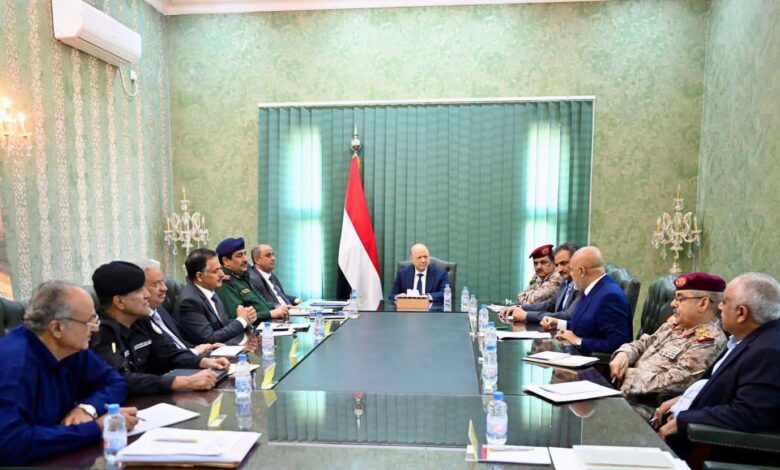
In a high-level meeting held today, Saturday, in the interim Yemeni capital, Aden, President of the Presidential Leadership Council Rashad Al-Alimi chaired a meeting of the Supreme Security Committee. The meeting was attended by Prime Minister Salem bin Braik and a number of senior military and security leaders to discuss the latest security developments in the liberated governorates.
The meeting was a continuation of the President’s directives from the previous session, focusing specifically on monitoring security and military performance and achievements in combating terrorism. The most prominent of these achievements was the dismantling of one of the most dangerous terrorist cells linked to the Houthi militia and Al-Qaeda and ISIS organizations. This cell was active in Taiz governorate, carrying out assassinations and bombings in various areas.
The Security Committee confirmed that the security campaign targeting this cell revealed its direct links to Houthi leaders Mohammed Abdulkarim Al-Ghamari and Abdulqader Al-Shami. It also confirmed the involvement of Amjad Khaled, former commander of the Transport Brigade, in managing a dangerous terrorist network operating for the Houthis.
According to what was presented during the meeting, investigations with cell members revealed their involvement in the assassination of World Food Program Director Moayad Hamidi in the city of Turbah. This operation was an attempt by the Houthi militias to undermine international organizations’ trust in security measures in the liberated areas.
The network was also proven to be involved in the bombing of Aden Governor Ahmed Lamlas’s convoy in 2021, widespread targeting operations against investigators, military leaders, and public figures, in addition to assassination attempts in Aden, Lahj, Taiz, and Al-Bayda.
During the campaign, security forces seized explosives manufacturing labs, improvised explosive devices, and booby-trapped cars, along with documented materials for physical liquidations and coordinates that were being sent to the Houthis as part of a plan to internally destabilize cities.
The committee praised the role of the people of Taiz in supporting the security campaign, emphasizing that citizen awareness was crucial in exposing terrorist plots. It stressed that Taiz will remain a safety valve for the state and the republic.
Furthermore, the committee directed the adoption of stricter measures to pursue sleeper cells and activate cooperation with Interpol and sister countries to extradite wanted individuals. It also approved support for the Anti-Narcotics Directorate and the expansion of the role of media and cultural institutions in countering terrorist ideologies and Houthi infiltration.
In conclusion, the committee emphasized the importance of raising security readiness and unifying the national ranks in confronting the Houthi-Iranian scheme that seeks to dismantle the state and spread chaos. It affirmed that the state is ready to deter any threat targeting Yemenis, their security, and their future.