The Houthis as Iran’s Nuclear Proxy: A Shared Destiny Amid Escalation Shaking the Middle East – Special Report
By/ Mohammed Abdullah

Yemen Monitor/Reports Unit:
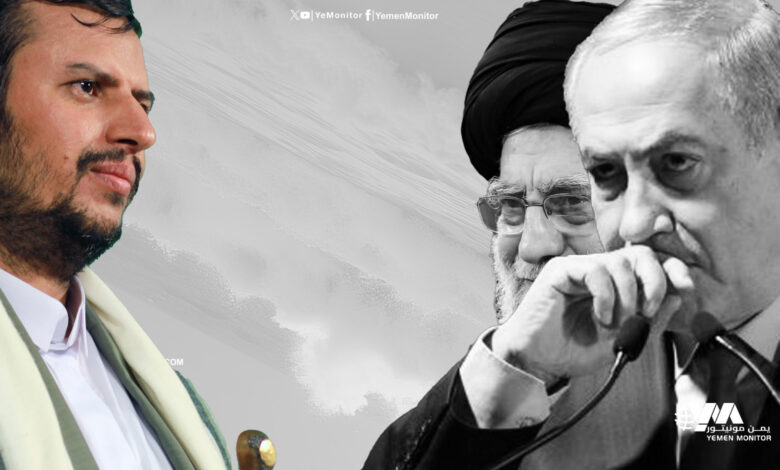
The recent escalation in the Middle East indicates a dangerous shift in the balance of power. The Iranian-backed Houthi group has emerged as a major player in the escalating confrontation with Israel. This escalation coincides with Netanyahu’s announcement that Iran is seeking to provide the Houthis with nuclear technology, threatening to expand the conflict to include nuclear dimensions.
In an unprecedented regional escalation, the Houthi group carried out a missile attack targeting sites inside Israel early Sunday, coinciding with a large-scale Iranian attack on Tel Aviv. This direct military coordination signals the Houthis’ role as a key Iranian arm.
The Israeli Broadcasting Authority announced that the attack was “complex” and included the launch of missiles from Iran and Yemen, in addition to swarms of drones targeting the greater Tel Aviv area, describing the strikes as “coordinated and multi-front.” For his part, Houthi military spokesman Yahya Saree announced that his forces had targeted “sensitive targets” in the occupied city of Jaffa (Tel Aviv), which is the first explicit declaration of direct operational coordination with Tehran.
This came after a speech by the group’s leader, Abdul-Malik al-Houthi, in which he affirmed his group’s full support for Iran, indicating that the war against Israel has become “open and continuous.”
This Houthi stance reveals a striking strategic shift, reflecting increasing involvement in the Iran-led “Axis of Resistance.” This could redraw the map of regional alliances and open the door to an open escalation that reshapes geopolitical and military equations in the region.

Netanyahu: Iran Seeks to Provide the Houthis with Nuclear Technology
Israeli Prime Minister Benjamin Netanyahu stated that Iran was preparing to send nuclear weapons to the Houthis. This statement came just hours after an Israeli airstrike on the Yemeni capital, Sanaa, which targeted a meeting of senior Houthi leaders, including Chief of Staff Mohammed Abdul Karim al-Ghamari. The strike, which preceded a coordinated Houthi attack aligned with Iran, signals Israel’s intent to strike at the core of the “Axis of Resistance.”
In an interview with the American channel Fox News, Netanyahu revealed that Israeli intelligence had detected Iranian attempts to transfer nuclear weapons or related technologies to the Houthi group in Yemen. He emphasized that this move was one of the key motives behind Israel’s recent strike on Iran, stating, “Israel will not allow an advanced nuclear threat to be established on its southern flank,” in a clear reference to Yemen.
This statement, made at a critical moment, warns of an expanding confrontation that now includes the nuclear dimension of Iran’s project. According to Israel, this threat is no longer confined within Iranian borders but is being distributed through Tehran’s regional proxies—chief among them the Houthis. The announcement places Israel in direct confrontation with the Tehran–Sanaa axis and underscores what observers see as a qualitative shift in the Houthis’ role. Their involvement now extends beyond launching drones and missiles to becoming part of Iran’s multi-dimensional nuclear deterrence strategy.
Analysts believe Netanyahu’s remarks also carry political motives aimed at reigniting international concern over Iran’s nuclear program—this time through the lens of the Houthis in Yemen. The talk of transferring nuclear technology to a group internationally classified as a terrorist organization could serve as justification for expanding Israeli military operations across the region, while also acting as a diplomatic tool to renew pressure on Iran in international forums.

A Pivotal Moment in the Regional Conflict
Researcher and academic Omar Abdul Jalil views the simultaneous Houthi attacks with the recent Iranian strike on Israel as more than just momentary solidarity or a military display. Instead, he sees it as part of a broader strategic plan driven by Tehran to counter Israeli escalation and offset its political and military losses through its proxies in the region. Abdul Jalil explains that the relationship between Iran and the Houthis is organic, with the group quickly engaging in confrontation whenever Tehran faces setbacks, not only to protect Iran as a strategic ally but also to protect itself.
Abdul Jalil further tells “Yemen Monitor” that the Houthi group represents Iran’s most capable and maneuverable card, unlike other proxies in the region. Therefore, he expects to see a widespread escalation from the Houthis on multiple fronts: targeting Israeli depth and striking shipping in Bab al-Mandab Strait, while Iran exerts pressure from the Strait of Hormuz. However, Abdul Jalil warned that these steps are “fraught with risks,” as attacks on international shipping could provoke a collective international response, especially with increasing internal pressure against the Houthis from local Yemeni forces.
Fundamental Shifts in the Balance of Power in the Middle East
With the Houthis officially entering the confrontation, the crisis has evolved from a limited conflict between Tehran and Tel Aviv into a regional struggle with multiple arms and fronts. The recent Israeli strike on Iran—and the subsequent military responses from Yemen—marks a critical turning point, signaling an open escalation that could reshape the Middle East for the coming decades.
Political analyst Fahd Rajeh told Yemen Monitor that the Israeli attack on Iran is not merely a military reaction, but a strategic test of Tehran’s ability to protect its security and intelligence infrastructure. The strike exposed the extent of Israel’s penetration into the Iranian regime’s inner workings, prompting Iran to activate its regional proxies—especially the Houthis—as part of its indirect retaliation strategy.
Rajeh warns that Tehran stands at a dangerous crossroads. Failing to regain the initiative or demonstrate deterrent capabilities could lead to internal fractures. Notably, he says, the Houthis appear to be the only faction within Tehran’s axis that has so far withstood Israeli strikes—strengthening their status within the Iranian alliance as a reliable military force.
Rajeh adds that “the regional landscape is shifting toward a broader and more complex confrontation, with evolving rules of engagement. The battle has moved beyond a bilateral conflict between Israel and Iran into a multi-front open war that may prove difficult to contain—and one that could redraw political boundaries through sheer force.”